<?xml version="1.0" encoding="utf-8"?>
<feed xmlns="http://www.w3.org/2005/Atom">
    <id>https://recover.qytrees.com/blog</id>
    <title>Qytrees Blog</title>
    <updated>2025-04-04T00:00:00.000Z</updated>
    <generator>https://github.com/jpmonette/feed</generator>
    <link rel="alternate" href="https://recover.qytrees.com/blog"/>
    <subtitle>Qytrees Blog</subtitle>
    <icon>https://recover.qytrees.com/img/favicon.png</icon>
    <entry>
        <title type="html"><![CDATA[Pricing Crypto Options with a Flexible, API-Driven Approach]]></title>
        <id>https://recover.qytrees.com/blog/pricing-crypto-options-with-a-flexible-api-driven-approach</id>
        <link href="https://recover.qytrees.com/blog/pricing-crypto-options-with-a-flexible-api-driven-approach"/>
        <updated>2025-04-04T00:00:00.000Z</updated>
        <summary type="html"><![CDATA[In our previous blog, we emphasized the importance of implied volatility for option traders and demonstrated how to retrieve it—across any strike scale and expiry—using a flexible API that:]]></summary>
        <content type="html"><![CDATA[<p>In our previous <a href="https://qytrees.com/blog/Option-Volatility-Surface-with-a-Flexible-API-Driven-Approach" target="_blank" rel="noopener noreferrer">blog</a>, we emphasized the importance of implied volatility for option traders and demonstrated how to retrieve it—across any strike scale and expiry—using a flexible API that:</p>
<ul>
<li>Supports a range of expiry definitions (tenor-based, listed, or custom date/time).</li>
<li>Offers multiple strike scales (strike, moneyness, log-moneyness, delta call/put, or FX-style).</li>
</ul>
<p>Transitioning from implied volatility to actual pricing requires the same versatile API—offering possibility to calculate these with different premium conventions (especially in FX or digital assets). In this post, we explore how to streamline pricing by:</p>
<ul>
<li>Allowing configurable premium conventions (for example, paying the premium in a chosen currency), and</li>
<li>Defining preset payoffs that let users retrieve implied volatility, pricing, and risk metrics for multiple structures (European vanilla, digitals, risk reversals, strangles, ...) in one request.</li>
</ul>
<p>Today, our focus is on European vanilla options as a straightforward example. The same method applies to more complex payoffs, which we’ll cover in future blogs.</p>
<h1>Options on Futures, Inverse Payouts in Digital Assets, and Premium Conventions</h1>
<p>In the digital asset options market, it is common for options to be written on futures rather than the underlying spot price, although the difference is generally not material as we discuss below. Settlement currencies may be "foreign" in FX terms (e.g. BTC) or domestic (e.g. USDC). For example, settling a BTCUSD option in BTC avoids direct USD exposure, while options on altcoins like XRP/USDC are typically settled in USDC—a digital asset pegged to USD. Below, we explain how these structures work and why they matter to traders. In general, exchange-traded options follow specific settlement and premium conventions; however, with a flexible API, users can also price and calculate risk for OTC (over-the-counter) options that are not exchange traded.</p>
<h2 class="anchor anchorWithStickyNavbar_LWe7" id="reminder-call-put-and-inverse-options">Reminder: Call, Put, and Inverse Options<a href="https://recover.qytrees.com/blog/pricing-crypto-options-with-a-flexible-api-driven-approach#reminder-call-put-and-inverse-options" class="hash-link" aria-label="Direct link to Reminder: Call, Put, and Inverse Options" title="Direct link to Reminder: Call, Put, and Inverse Options">​</a></h2>
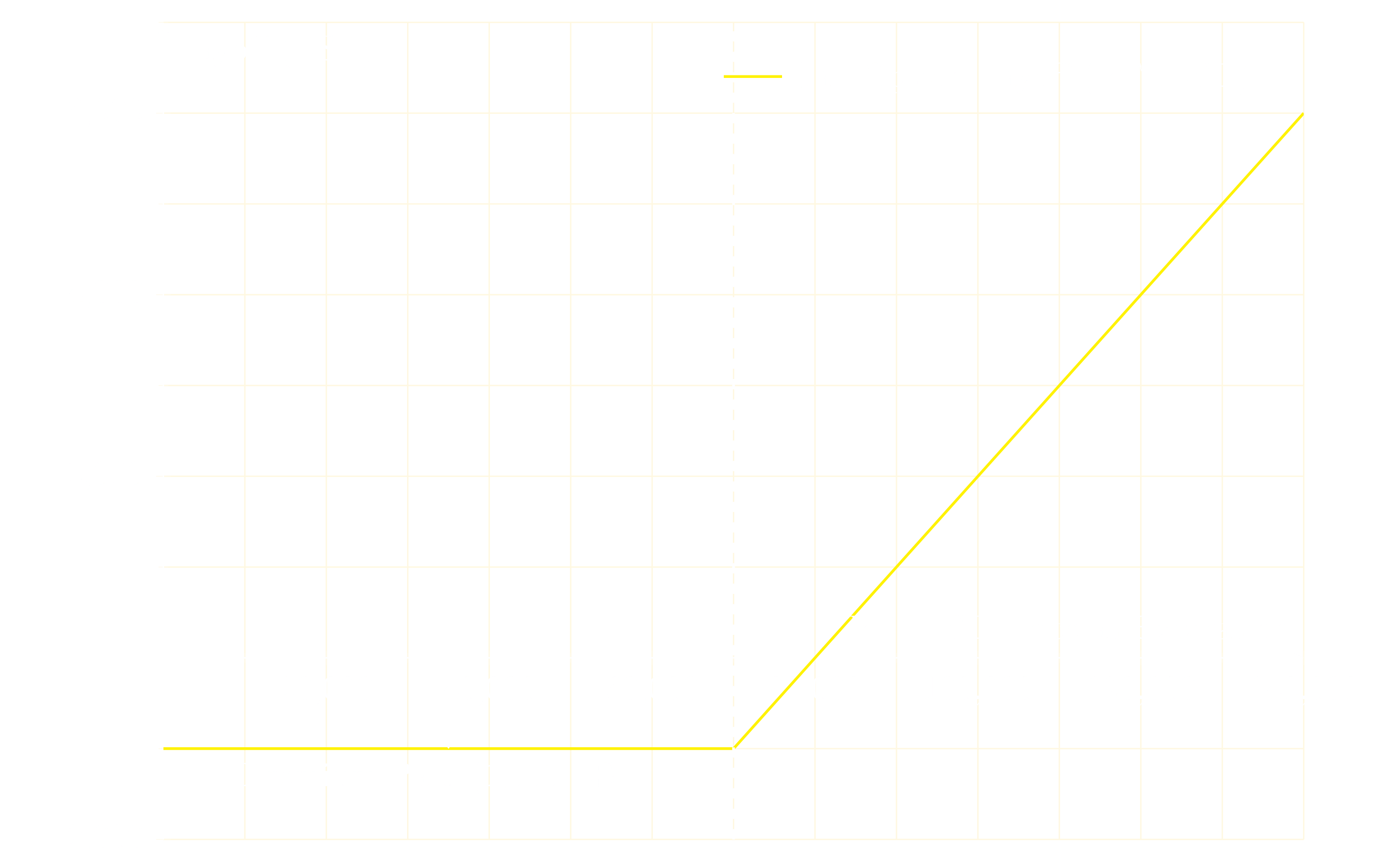
<p>A call option grants the holder the right—but not the obligation—to buy the underlying asset at a predetermined strike price at (or before) expiry, while a put option grants the holder the right to sell. For standard "vanilla" options, the payoffs at expiry are defined as:</p>
<ul>
<li>Call payoff: max(S − K, 0)</li>
<li>Put payoff: max(K − S, 0)</li>
</ul>
<p>Here, S represents the underlying asset's price (spot or futures) at expiry, and K is the strike price.</p>
<p>In the cryptocurrency market—such as BTC/USD—options may also be structured as "inverse," a term specific to crypto. In traditional FX markets, these are simply described as options settled in the foreign currency. For instance, in a BTC/USD pair, BTC is considered the "foreign" currency and USD the "domestic." Thus, an inverse option on BTC/USD settles in BTC rather than USD. This structure avoids USD cash exchange at maturity and can simplify regulatory considerations.</p>
<p>The payoffs for inverse options at expiry are:</p>
<ul>
<li>Inverse Call payoff: max(S − K, 0) / S</li>
<li>Inverse Put payoff: max(K − S, 0) / S</li>
</ul>
<p>In this context, S is the USD price of BTC at expiry, and the payoff is denominated directly in BTC. Although the underlying asset is often quoted as the spot price, these options typically reference future prices expiring at the same time as the option itself.</p>
<p>After properly adjusting for discount factors and changing numeraires (the reference currency for valuation), inverse options become economically similar to their standard (linear) counterparts. In other words, when accounting for the time value and currency conversions, inverse and linear options exhibit identical economic characteristics and risk-return profiles.</p>
<h2 class="anchor anchorWithStickyNavbar_LWe7" id="options-on-futures">Options on Futures<a href="https://recover.qytrees.com/blog/pricing-crypto-options-with-a-flexible-api-driven-approach#options-on-futures" class="hash-link" aria-label="Direct link to Options on Futures" title="Direct link to Options on Futures">​</a></h2>
<p>In the digital asset options market, particularly for Bitcoin, options are usually written on futures contracts rather than directly on the BTCUSD spot price. These futures are linked to an index aggregating prices from multiple exchanges and aren't generally tradable themselves. Options typically inherit expiry dates and attributes from these underlying futures, adding complexity due to indirect linkage to the spot price via futures and indices.</p>
<p>However, because digital asset options and futures typically share expiry dates, this indirect relationship has minimal practical impact. At expiry, futures prices converge with the underlying index price, aligning option values with their intrinsic index-based values.</p>
<p>Unlike commodities, where options and underlying futures often have mismatched expiry dates, crypto markets commonly align these expirations. Additionally, platforms like Deribit calculate settlement prices by averaging the underlying index price over a 30-minute window before expiry, reducing manipulation risk and ensuring fairness.</p>
<h2 class="anchor anchorWithStickyNavbar_LWe7" id="cash-settlement">Cash Settlement<a href="https://recover.qytrees.com/blog/pricing-crypto-options-with-a-flexible-api-driven-approach#cash-settlement" class="hash-link" aria-label="Direct link to Cash Settlement" title="Direct link to Cash Settlement">​</a></h2>
<p>Most digital asset options are cash-settled, meaning that at expiry you receive (or pay) the net "cash value" in either currency X or Y (for X/Y options). For example, BTC/USD options typically settle in BTC, while SOL/USDC options settle in USDC. Cash settlement avoids the logistical complexities associated with "physically" delivering multiple currency flows.</p>
<ul>
<li><strong>Physically Settled</strong>: This method involves exchanging the underlying asset (e.g., BTC for USD or vice versa) at the strike price upon expiry. Physical settlement is less common in crypto markets but is standard practice in many FX markets.</li>
<li><strong>Cash Settled</strong>: With cash settlement, the difference between the option’s payoff and the strike price is paid out directly in BTC or USD. This approach is generally preferred due to its simplicity, provided the settlement procedure remains consistent and transparent.</li>
</ul>
<h2 class="anchor anchorWithStickyNavbar_LWe7" id="premium-conventions">Premium Conventions<a href="https://recover.qytrees.com/blog/pricing-crypto-options-with-a-flexible-api-driven-approach#premium-conventions" class="hash-link" aria-label="Direct link to Premium Conventions" title="Direct link to Premium Conventions">​</a></h2>
<p>Exchanges often use specific premium conventions, but multiple possibilities exist for expressing premiums, particularly within FX markets. Typically, FX traders use different premium conventions depending on the currency pairs traded.</p>
<p>With Qytrees API, beyond selecting the asset for final settlement (e.g., BTC vs. USD), users can also choose how the option premium is quoted. Similar to FX markets—where a call option’s premium can be expressed in either the domestic or foreign currency—our API supports several premium conventions, represented through the PremiumConvention enum. These conventions are inspired by FX market practices, offering flexibility in how premiums are interpreted and reported.</p>
<p>We will cover the detailed mapping of these conventions, along with practical examples, in an upcoming blog post.</p>
<ul>
<li><strong>QUOTE_ASSET</strong>: Premium denominated in the “quote” (domestic) currency.</li>
<li><strong>BASE_ASSET_PERCENTAGE</strong>: Premium denominated in the “base” (foreign) currency (e.g., paying in BTC for BTC/USD options). Usually referred to as percentage foreign in FX.</li>
<li><strong>QUOTE_ASSET_PERCENTAGE and BASE_ASSET</strong> are more generally used in FX markets rather than digital assets markets, and commonly known as percentage domestic and foreign pips respectively.</li>
<li><strong>UNDISCOUNTED_...</strong>: These represent the same conventions but exclude discount factors, enabling pricing in terms of undiscounted amounts or percentages.</li>
</ul>
<p>By treating either asset as the numeraire, these conventions allow users to incorporate multiple quoting styles within a consistent framework,</p>
<h2 class="anchor anchorWithStickyNavbar_LWe7" id="the-payoff-node">The payoff node<a href="https://recover.qytrees.com/blog/pricing-crypto-options-with-a-flexible-api-driven-approach#the-payoff-node" class="hash-link" aria-label="Direct link to The payoff node" title="Direct link to The payoff node">​</a></h2>
<p>Qytrees API leverages GraphQL, offering several advantages as discussed in our previous <a href="https://qytrees.com/blog/Option-Volatility-Surface-with-a-Flexible-API-Driven-Approach" target="_blank" rel="noopener noreferrer">blog</a>. GraphQL allows you to precisely define your requirements by specifying each node and subnode. We've already explored how to define the strike and expiry nodes. Below, we will discuss the payoff node that applies to each strike and expiry.</p>
<p>For instance, a user can specify a range of strikes in Moneyness between 0.9 and 1.1 with increments of 0.1, along with a list of expiries in tenor format such as 1M, 6W:</p>
<div class="language-graphql codeBlockContainer_Ckt0 theme-code-block" style="--prism-color:#F8F8F2;--prism-background-color:#282A36"><div class="codeBlockContent_biex"><pre tabindex="0" class="prism-code language-graphql codeBlock_bY9V thin-scrollbar" style="color:#F8F8F2;background-color:#282A36"><code class="codeBlockLines_e6Vv"><span class="token-line" style="color:#F8F8F2"><span class="token attr-name" style="color:rgb(241, 250, 140)">strike</span><span class="token punctuation" style="color:rgb(248, 248, 242)">:</span><span class="token punctuation" style="color:rgb(248, 248, 242)">{</span><span class="token plain"></span><br></span><span class="token-line" style="color:#F8F8F2"><span class="token plain">  </span><span class="token attr-name" style="color:rgb(241, 250, 140)">selection</span><span class="token punctuation" style="color:rgb(248, 248, 242)">:</span><span class="token plain"> </span><span class="token property">null</span><span class="token plain"></span><br></span><span class="token-line" style="color:#F8F8F2"><span class="token plain">  </span><span class="token attr-name" style="color:rgb(241, 250, 140)">strikeType</span><span class="token punctuation" style="color:rgb(248, 248, 242)">:</span><span class="token punctuation" style="color:rgb(248, 248, 242)">{</span><span class="token attr-name" style="color:rgb(241, 250, 140)">scale</span><span class="token punctuation" style="color:rgb(248, 248, 242)">:</span><span class="token plain"> </span><span class="token constant" style="color:rgb(189, 147, 249)">MONEYNESS</span><span class="token punctuation" style="color:rgb(248, 248, 242)">}</span><span class="token plain"></span><br></span><span class="token-line" style="color:#F8F8F2"><span class="token plain">  </span><span class="token attr-name" style="color:rgb(241, 250, 140)">range</span><span class="token punctuation" style="color:rgb(248, 248, 242)">:</span><span class="token plain"> </span><span class="token punctuation" style="color:rgb(248, 248, 242)">[</span><span class="token number">0.9</span><span class="token punctuation" style="color:rgb(248, 248, 242)">,</span><span class="token plain"> </span><span class="token number">1.1</span><span class="token punctuation" style="color:rgb(248, 248, 242)">,</span><span class="token plain"> </span><span class="token number">0.1</span><span class="token punctuation" style="color:rgb(248, 248, 242)">]</span><span class="token plain"></span><br></span><span class="token-line" style="color:#F8F8F2"><span class="token plain"></span><span class="token punctuation" style="color:rgb(248, 248, 242)">}</span><span class="token plain"></span><br></span><span class="token-line" style="color:#F8F8F2"><span class="token plain"></span><span class="token attr-name" style="color:rgb(241, 250, 140)">expiry</span><span class="token punctuation" style="color:rgb(248, 248, 242)">:</span><span class="token punctuation" style="color:rgb(248, 248, 242)">{</span><span class="token plain"></span><br></span><span class="token-line" style="color:#F8F8F2"><span class="token plain">  </span><span class="token attr-name" style="color:rgb(241, 250, 140)">selection</span><span class="token punctuation" style="color:rgb(248, 248, 242)">:</span><span class="token plain"> </span><span class="token property">null</span><span class="token plain"></span><br></span><span class="token-line" style="color:#F8F8F2"><span class="token plain">  </span><span class="token attr-name" style="color:rgb(241, 250, 140)">list</span><span class="token punctuation" style="color:rgb(248, 248, 242)">:</span><span class="token plain"> </span><span class="token punctuation" style="color:rgb(248, 248, 242)">[</span><span class="token string" style="color:rgb(255, 121, 198)">"1M"</span><span class="token punctuation" style="color:rgb(248, 248, 242)">,</span><span class="token plain"> </span><span class="token string" style="color:rgb(255, 121, 198)">"6W"</span><span class="token punctuation" style="color:rgb(248, 248, 242)">]</span><span class="token plain"></span><br></span><span class="token-line" style="color:#F8F8F2"><span class="token plain"></span><span class="token punctuation" style="color:rgb(248, 248, 242)">}</span><br></span></code></pre><div class="buttonGroup__atx"><button type="button" aria-label="Copy code to clipboard" title="Copy" class="clean-btn"><span class="copyButtonIcons_eSgA" aria-hidden="true"><svg viewBox="0 0 24 24" class="copyButtonIcon_y97N"><path fill="currentColor" d="M19,21H8V7H19M19,5H8A2,2 0 0,0 6,7V21A2,2 0 0,0 8,23H19A2,2 0 0,0 21,21V7A2,2 0 0,0 19,5M16,1H4A2,2 0 0,0 2,3V17H4V3H16V1Z"></path></svg><svg viewBox="0 0 24 24" class="copyButtonSuccessIcon_LjdS"><path fill="currentColor" d="M21,7L9,19L3.5,13.5L4.91,12.09L9,16.17L19.59,5.59L21,7Z"></path></svg></span></button></div></div></div>
<p>For each strike and expiry combination, the payoff node assigns a payoff type.</p>
<p>The payoff node consists of two subnodes: Selection and List described below.</p>
<ul>
<li><strong>Selection</strong>: Using the selection subnode, a user can choose for example "LISTED," which includes all payoffs available from the selected source.</li>
<li><strong>List</strong>: With the List subnode, a user can explicitly define the desired payoff types. For example, the user below specifies two payoff types: a vanilla call and a vanilla put. This means that for each of the defined strikes and expiries, both of these payoffs will be generated.</li>
</ul>
<p>While many other payoff structures are supported, this section focuses specifically on vanilla options:</p>
<div class="language-graphql codeBlockContainer_Ckt0 theme-code-block" style="--prism-color:#F8F8F2;--prism-background-color:#282A36"><div class="codeBlockContent_biex"><pre tabindex="0" class="prism-code language-graphql codeBlock_bY9V thin-scrollbar" style="color:#F8F8F2;background-color:#282A36"><code class="codeBlockLines_e6Vv"><span class="token-line" style="color:#F8F8F2"><span class="token plain"> </span><span class="token attr-name" style="color:rgb(241, 250, 140)">payoff</span><span class="token punctuation" style="color:rgb(248, 248, 242)">:</span><span class="token plain"></span><br></span><span class="token-line" style="color:#F8F8F2"><span class="token plain">    </span><span class="token punctuation" style="color:rgb(248, 248, 242)">{</span><span class="token plain"></span><br></span><span class="token-line" style="color:#F8F8F2"><span class="token plain">      </span><span class="token attr-name" style="color:rgb(241, 250, 140)">selection</span><span class="token punctuation" style="color:rgb(248, 248, 242)">:</span><span class="token plain"> </span><span class="token property">null</span><span class="token plain"></span><br></span><span class="token-line" style="color:#F8F8F2"><span class="token plain">      </span><span class="token attr-name" style="color:rgb(241, 250, 140)">list</span><span class="token plain"> </span><span class="token punctuation" style="color:rgb(248, 248, 242)">:</span><span class="token plain"> </span><span class="token punctuation" style="color:rgb(248, 248, 242)">[</span><span class="token plain"></span><br></span><span class="token-line" style="color:#F8F8F2"><span class="token plain">        </span><span class="token punctuation" style="color:rgb(248, 248, 242)">{</span><span class="token attr-name" style="color:rgb(241, 250, 140)">vanilla</span><span class="token punctuation" style="color:rgb(248, 248, 242)">:</span><span class="token punctuation" style="color:rgb(248, 248, 242)">{</span><span class="token attr-name" style="color:rgb(241, 250, 140)">callPut</span><span class="token punctuation" style="color:rgb(248, 248, 242)">:</span><span class="token plain"> </span><span class="token constant" style="color:rgb(189, 147, 249)">CALL</span><span class="token punctuation" style="color:rgb(248, 248, 242)">}</span><span class="token punctuation" style="color:rgb(248, 248, 242)">}</span><span class="token plain"></span><br></span><span class="token-line" style="color:#F8F8F2"><span class="token plain">      	</span><span class="token punctuation" style="color:rgb(248, 248, 242)">{</span><span class="token attr-name" style="color:rgb(241, 250, 140)">vanilla</span><span class="token punctuation" style="color:rgb(248, 248, 242)">:</span><span class="token punctuation" style="color:rgb(248, 248, 242)">{</span><span class="token attr-name" style="color:rgb(241, 250, 140)">callPut</span><span class="token punctuation" style="color:rgb(248, 248, 242)">:</span><span class="token plain"> </span><span class="token constant" style="color:rgb(189, 147, 249)">PUT</span><span class="token punctuation" style="color:rgb(248, 248, 242)">}</span><span class="token punctuation" style="color:rgb(248, 248, 242)">}</span><span class="token plain"></span><br></span><span class="token-line" style="color:#F8F8F2"><span class="token plain">      </span><span class="token punctuation" style="color:rgb(248, 248, 242)">]</span><span class="token plain"></span><br></span><span class="token-line" style="color:#F8F8F2"><span class="token plain">    </span><span class="token punctuation" style="color:rgb(248, 248, 242)">}</span><br></span></code></pre><div class="buttonGroup__atx"><button type="button" aria-label="Copy code to clipboard" title="Copy" class="clean-btn"><span class="copyButtonIcons_eSgA" aria-hidden="true"><svg viewBox="0 0 24 24" class="copyButtonIcon_y97N"><path fill="currentColor" d="M19,21H8V7H19M19,5H8A2,2 0 0,0 6,7V21A2,2 0 0,0 8,23H19A2,2 0 0,0 21,21V7A2,2 0 0,0 19,5M16,1H4A2,2 0 0,0 2,3V17H4V3H16V1Z"></path></svg><svg viewBox="0 0 24 24" class="copyButtonSuccessIcon_LjdS"><path fill="currentColor" d="M21,7L9,19L3.5,13.5L4.91,12.09L9,16.17L19.59,5.59L21,7Z"></path></svg></span></button></div></div></div>
<h2 class="anchor anchorWithStickyNavbar_LWe7" id="output-nodes">Output Nodes<a href="https://recover.qytrees.com/blog/pricing-crypto-options-with-a-flexible-api-driven-approach#output-nodes" class="hash-link" aria-label="Direct link to Output Nodes" title="Direct link to Output Nodes">​</a></h2>
<p>The previously discussed nodes—strike, expiry, and payoff—form part of the <strong>input</strong> portion of the GraphQL query, enabling precise control over what the user wants to analyze. Once the inputs are defined, the output section determines what information is retrieved in response to the query.</p>
<p>In this blog, we focus on the <strong>Price Node</strong>, one of several available output nodes.</p>
<h2 class="anchor anchorWithStickyNavbar_LWe7" id="price-node">Price Node<a href="https://recover.qytrees.com/blog/pricing-crypto-options-with-a-flexible-api-driven-approach#price-node" class="hash-link" aria-label="Direct link to Price Node" title="Direct link to Price Node">​</a></h2>
<p>The price node, together with your selected premium convention and payoff structure, allows the API to compute option prices.</p>
<p>Below is an example using GraphQL aliases to retrieve prices using two different premium conventions simultaneously:</p>
<div class="language-graphql codeBlockContainer_Ckt0 theme-code-block" style="--prism-color:#F8F8F2;--prism-background-color:#282A36"><div class="codeBlockContent_biex"><pre tabindex="0" class="prism-code language-graphql codeBlock_bY9V thin-scrollbar" style="color:#F8F8F2;background-color:#282A36"><code class="codeBlockLines_e6Vv"><span class="token-line" style="color:#F8F8F2"><span class="token plain"> </span><span class="token attr-name" style="color:rgb(241, 250, 140)">quote_price</span><span class="token punctuation" style="color:rgb(248, 248, 242)">:</span><span class="token plain"> </span><span class="token property-query">price</span><span class="token punctuation" style="color:rgb(248, 248, 242)">(</span><span class="token attr-name" style="color:rgb(241, 250, 140)">premiumConvention</span><span class="token punctuation" style="color:rgb(248, 248, 242)">:</span><span class="token plain"> </span><span class="token constant" style="color:rgb(189, 147, 249)">QUOTE_ASSET</span><span class="token punctuation" style="color:rgb(248, 248, 242)">)</span><span class="token plain"> </span><span class="token punctuation" style="color:rgb(248, 248, 242)">{</span><span class="token plain"></span><br></span><span class="token-line" style="color:#F8F8F2"><span class="token plain">  </span><span class="token property">mid</span><span class="token plain"></span><br></span><span class="token-line" style="color:#F8F8F2"><span class="token plain"></span><span class="token punctuation" style="color:rgb(248, 248, 242)">}</span><span class="token plain"></span><br></span><span class="token-line" style="color:#F8F8F2"><span class="token plain" style="display:inline-block"></span><br></span><span class="token-line" style="color:#F8F8F2"><span class="token plain"></span><span class="token attr-name" style="color:rgb(241, 250, 140)">quote_price_percentage</span><span class="token punctuation" style="color:rgb(248, 248, 242)">:</span><span class="token plain"> </span><span class="token property-query">price</span><span class="token punctuation" style="color:rgb(248, 248, 242)">(</span><span class="token attr-name" style="color:rgb(241, 250, 140)">premiumConvention</span><span class="token punctuation" style="color:rgb(248, 248, 242)">:</span><span class="token plain"> </span><span class="token constant" style="color:rgb(189, 147, 249)">QUOTE_ASSET_PERCENTAGE</span><span class="token punctuation" style="color:rgb(248, 248, 242)">)</span><span class="token plain"> </span><span class="token punctuation" style="color:rgb(248, 248, 242)">{</span><span class="token plain"></span><br></span><span class="token-line" style="color:#F8F8F2"><span class="token plain">  </span><span class="token property">mid</span><span class="token plain"></span><br></span><span class="token-line" style="color:#F8F8F2"><span class="token plain"></span><span class="token punctuation" style="color:rgb(248, 248, 242)">}</span><br></span></code></pre><div class="buttonGroup__atx"><button type="button" aria-label="Copy code to clipboard" title="Copy" class="clean-btn"><span class="copyButtonIcons_eSgA" aria-hidden="true"><svg viewBox="0 0 24 24" class="copyButtonIcon_y97N"><path fill="currentColor" d="M19,21H8V7H19M19,5H8A2,2 0 0,0 6,7V21A2,2 0 0,0 8,23H19A2,2 0 0,0 21,21V7A2,2 0 0,0 19,5M16,1H4A2,2 0 0,0 2,3V17H4V3H16V1Z"></path></svg><svg viewBox="0 0 24 24" class="copyButtonSuccessIcon_LjdS"><path fill="currentColor" d="M21,7L9,19L3.5,13.5L4.91,12.09L9,16.17L19.59,5.59L21,7Z"></path></svg></span></button></div></div></div>
<p>In this example, quote_price and quote_price_percentage are aliases. They enable users to query the same field (price) multiple times with different arguments, without conflicts in the GraphQL response. Here, the user is requesting prices using two different premium conventions for all strikes, expiries, and payoffs defined in the input.</p>
<h2 class="anchor anchorWithStickyNavbar_LWe7" id="a-practical-example">A Practical Example<a href="https://recover.qytrees.com/blog/pricing-crypto-options-with-a-flexible-api-driven-approach#a-practical-example" class="hash-link" aria-label="Direct link to A Practical Example" title="Direct link to A Practical Example">​</a></h2>
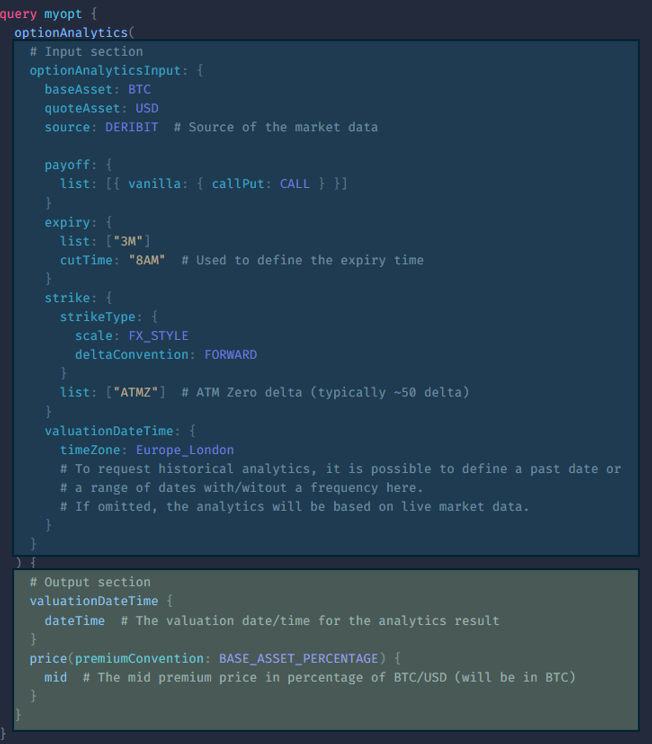
<p>Say you want to price a <strong>3-month BTC/USD At-The-Money Zero-Delta Straddle</strong>, where the premium is expressed in BTC. This can be configured in a single request using the API.</p>
<figure><p><img decoding="async" loading="lazy" alt="query" src="https://recover.qytrees.com/assets/images/query-16d18fb89fff3b41fd01dae5555d0225.png" width="652" height="744" class="img_ev3q"></p><figcaption style="text-align:center"><p>Query to price a 3-month BTC/USD At-The-Money Zero-Delta Straddle, where the premium is expressed in BTC</p></figcaption></figure>
<p>In future blog entries, we’ll explore additional output nodes, including:</p>
<ul>
<li>Implied Volatility Node – returns the full IV surface or selected slices.</li>
<li>Risk Node – provides option Greeks and sensitivity metrics.</li>
</ul>
<p>These modular output fields give users fine-grained control over the structure and granularity of the returned data.</p>
<h1>Conclusion</h1>
<p>This blog highlights the flexibility of the API, allowing users to build custom queries and request data of completely different nature—all within a single request.</p>
<p>We’ll explore additional data types and features in future posts.</p>
<p>If you have a specific use case or topic you'd like us to cover, feel free to reach out.</p>]]></content>
        <author>
            <name>Qytrees Research</name>
        </author>
        <category label="volatility" term="volatility"/>
        <category label="crypto-options" term="crypto-options"/>
        <category label="premium conventions" term="premium conventions"/>
        <category label="btc" term="btc"/>
        <category label="eth" term="eth"/>
    </entry>
    <entry>
        <title type="html"><![CDATA[Option Volatility Surface with a Flexible, API-Driven Approach]]></title>
        <id>https://recover.qytrees.com/blog/Option-Volatility-Surface-with-a-Flexible-API-Driven-Approach</id>
        <link href="https://recover.qytrees.com/blog/Option-Volatility-Surface-with-a-Flexible-API-Driven-Approach"/>
        <updated>2025-03-16T00:00:00.000Z</updated>
        <summary type="html"><![CDATA[In this post, we discuss how implied volatility (IV) is compared across different strikes, maturities. We’ll show how moneyness, log-moneyness, and delta quoting conventions help you visualize and interpret the “volatility smile.” Finally, we’ll highlight how an adaptable API—like Qytrees—streamlines retrieving and analyzing these data points.]]></summary>
        <content type="html"><![CDATA[<p>In this post, we discuss how <strong>implied volatility (IV)</strong> is compared across different strikes, maturities. We’ll show how moneyness, log-moneyness, and delta quoting conventions help you visualize and interpret the “volatility smile.” Finally, we’ll highlight how an adaptable API—like Qytrees—streamlines retrieving and analyzing these data points.</p>
<h1>Reminder: Why Implied Volatility?</h1>
<p>Options grant holders the right (but not the obligation) to buy or sell an underlying asset at a specific strike on or before a certain date. Factors like the forward price, strike, maturity, and interest rates make raw option prices vary widely across assets, tenors or strikes. For example the price of a 1 month call option At the Money Forward strike for BTC/USD is as of writing of this blog around 5000 USD whereas for ETH/USD the price is around 150 USD.</p>
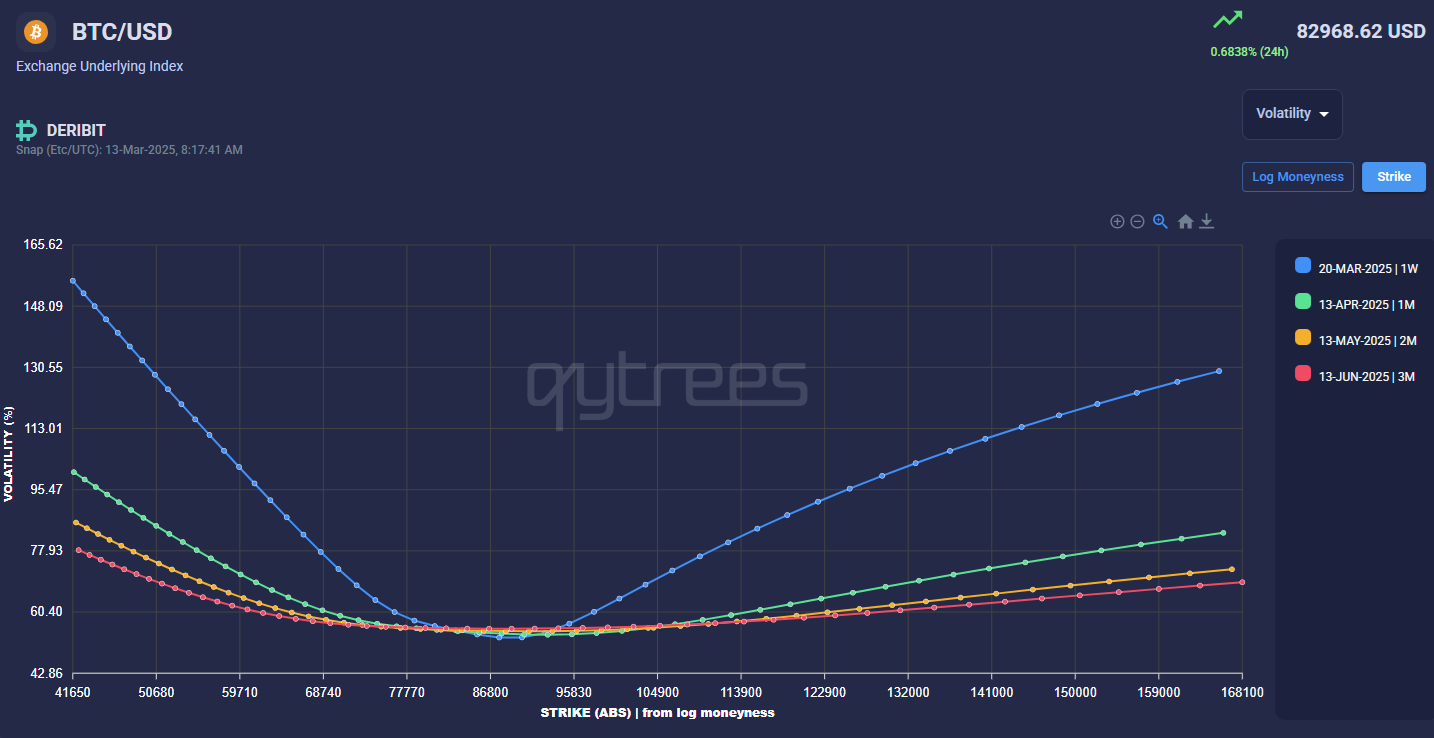
<p><strong>Implied volatility (IV)</strong> simplifies this comparison by “reverse-engineering” volatility from the price using the Black–Scholes model. When plotted against strike, IV often forms a <strong>U-shaped (convex) volatility smile</strong>, shaped by market perceptions of risk (e.g., more demands for OTM puts in bear markets or OTM calls in bullish ones) and hedging strategies. Because IV is standardized, traders can compare options more directly—then convert IV back to a price when needed by using the BS pricing machinery.</p>
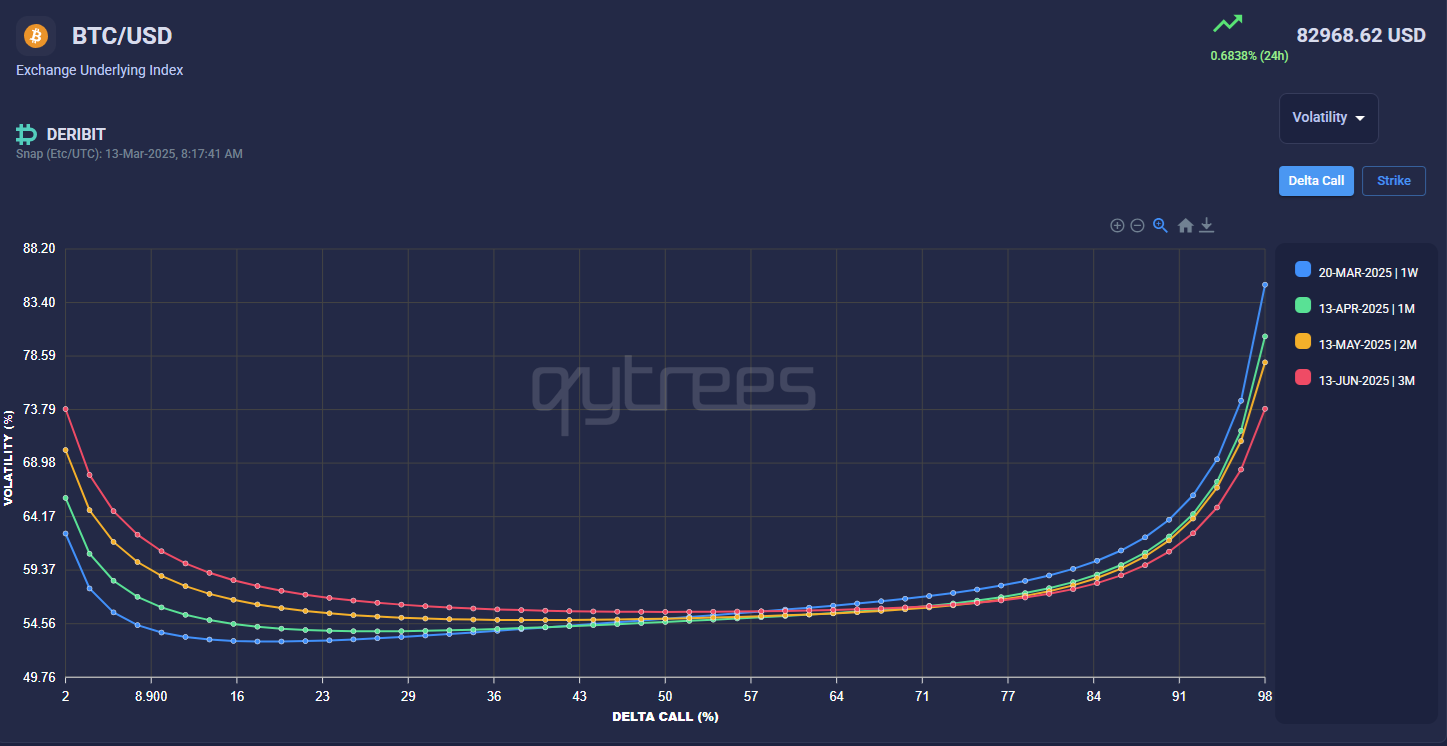
<figure><p><img decoding="async" loading="lazy" alt="smile_strikes" src="https://recover.qytrees.com/assets/images/smile_strikes-ef23a8d51be802729245708d3066fc6f.png" width="1434" height="738" class="img_ev3q"></p><figcaption style="text-align:center"><p>Vol smile function of Strikes.</p></figcaption></figure>
<p>A <strong>consistent volatility smile</strong> is central to pricing more complex products and managing risk. (Check out our other posts <a href="https://qytrees.com/blog/smile-models-for-digital-assets" target="_blank" rel="noopener noreferrer">here</a> for in-depth discussions.)</p>
<h1>Several Key Scales for the Vol Smile</h1>
<h2 class="anchor anchorWithStickyNavbar_LWe7" id="moneyness-definition">Moneyness Definition<a href="https://recover.qytrees.com/blog/Option-Volatility-Surface-with-a-Flexible-API-Driven-Approach#moneyness-definition" class="hash-link" aria-label="Direct link to Moneyness Definition" title="Direct link to Moneyness Definition">​</a></h2>
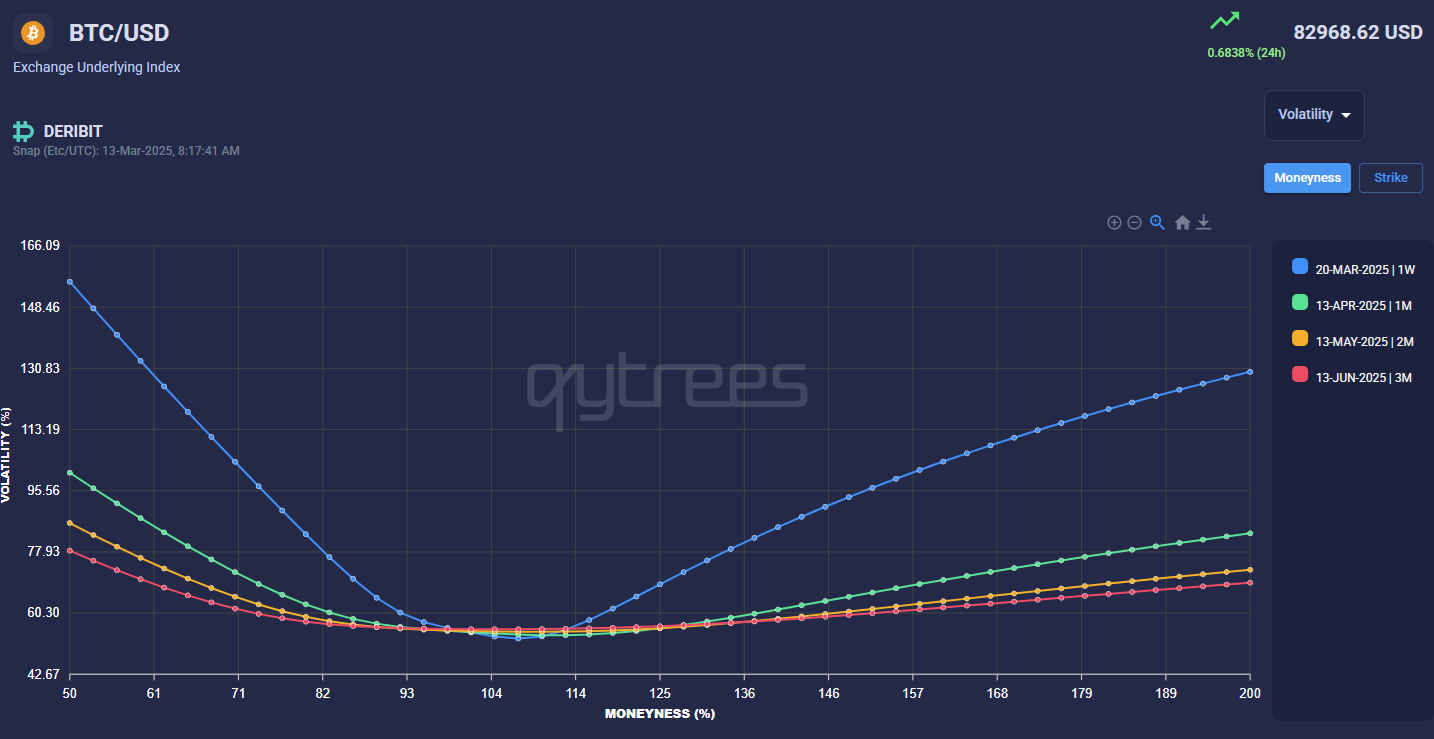
<p>Moneyness = Strike / Forward</p>
<p><strong>Rationale</strong>: Normalizes the strike relative to the forward price, simplifying comparisons across underlyings and maturities.</p>
<figure><p><img decoding="async" loading="lazy" alt="smile_moneyness" src="https://recover.qytrees.com/assets/images/smile_moneyness-794ed318055c9862177801df7fc0e4df.png" width="1434" height="739" class="img_ev3q"></p><figcaption style="text-align:center"><p>Vol smile function of Moneyness.</p></figcaption></figure>
<h2 class="anchor anchorWithStickyNavbar_LWe7" id="log-moneyness-definition">Log-Moneyness Definition<a href="https://recover.qytrees.com/blog/Option-Volatility-Surface-with-a-Flexible-API-Driven-Approach#log-moneyness-definition" class="hash-link" aria-label="Direct link to Log-Moneyness Definition" title="Direct link to Log-Moneyness Definition">​</a></h2>
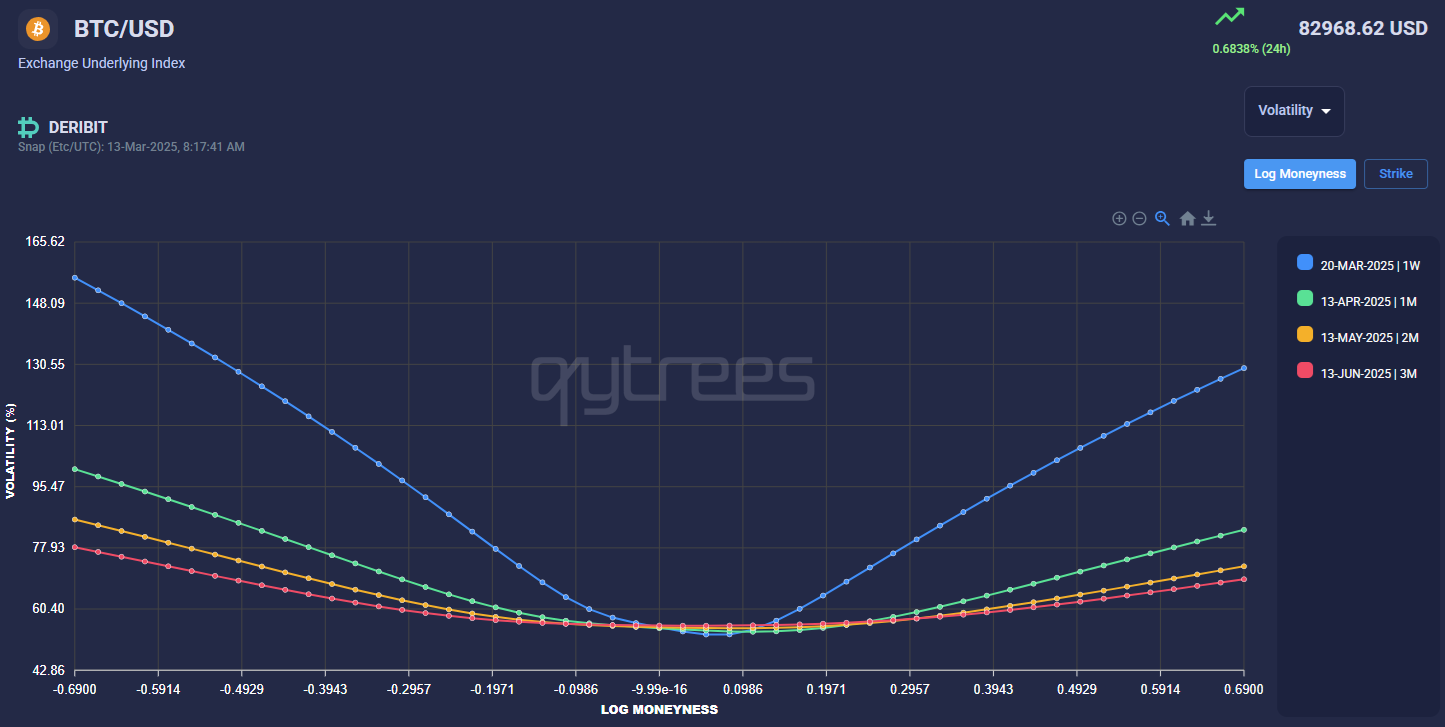
<p>Log-Moneyness = Log(Strike / Forward)</p>
<p><strong>Benefit</strong>: Creates a more symmetric shape around at-the-money, aligning better with certain pricing models.</p>
<figure><p><img decoding="async" loading="lazy" alt="smile_log_moneyness" src="https://recover.qytrees.com/assets/images/smile_log_moneyness-5d4170b876d553b3a86116c64c4451b4.png" width="1445" height="727" class="img_ev3q"></p><figcaption style="text-align:center"><p>Vol smile function of Log-Moneyness.</p></figcaption></figure>
<h2 class="anchor anchorWithStickyNavbar_LWe7" id="delta-based-delta-range">Delta-Based Delta Range<a href="https://recover.qytrees.com/blog/Option-Volatility-Surface-with-a-Flexible-API-Driven-Approach#delta-based-delta-range" class="hash-link" aria-label="Direct link to Delta-Based Delta Range" title="Direct link to Delta-Based Delta Range">​</a></h2>
<p>Calls typically span 0%–100%, while puts run –100%–0%.</p>
<p><strong>Why It’s Useful</strong>: Plotting IV vs. delta (e.g., a “25-delta call”) is a common practice in FX and crypto, yielding a uniform yardstick across underlyings.</p>
<p><strong>Different Delta Definitions</strong>: Market convention in FX vary by currency pair and sometimes by maturity (We’ll explore these in another post). In the crypto market, such conventions are not yet considered but FX Traders view can be applied on crypto as well.</p>
<h3 class="anchor anchorWithStickyNavbar_LWe7" id="delta-call">Delta Call<a href="https://recover.qytrees.com/blog/Option-Volatility-Surface-with-a-Flexible-API-Driven-Approach#delta-call" class="hash-link" aria-label="Direct link to Delta Call" title="Direct link to Delta Call">​</a></h3>
<figure><p><img decoding="async" loading="lazy" alt="smile_delta_call" src="https://recover.qytrees.com/assets/images/smile_delta_call-2de6894873419b69261aae859685180e.png" width="1447" height="746" class="img_ev3q"></p><figcaption style="text-align:center"><p>Vol smile function of Delta Call.</p></figcaption></figure>
<h3 class="anchor anchorWithStickyNavbar_LWe7" id="delta-put">Delta Put<a href="https://recover.qytrees.com/blog/Option-Volatility-Surface-with-a-Flexible-API-Driven-Approach#delta-put" class="hash-link" aria-label="Direct link to Delta Put" title="Direct link to Delta Put">​</a></h3>
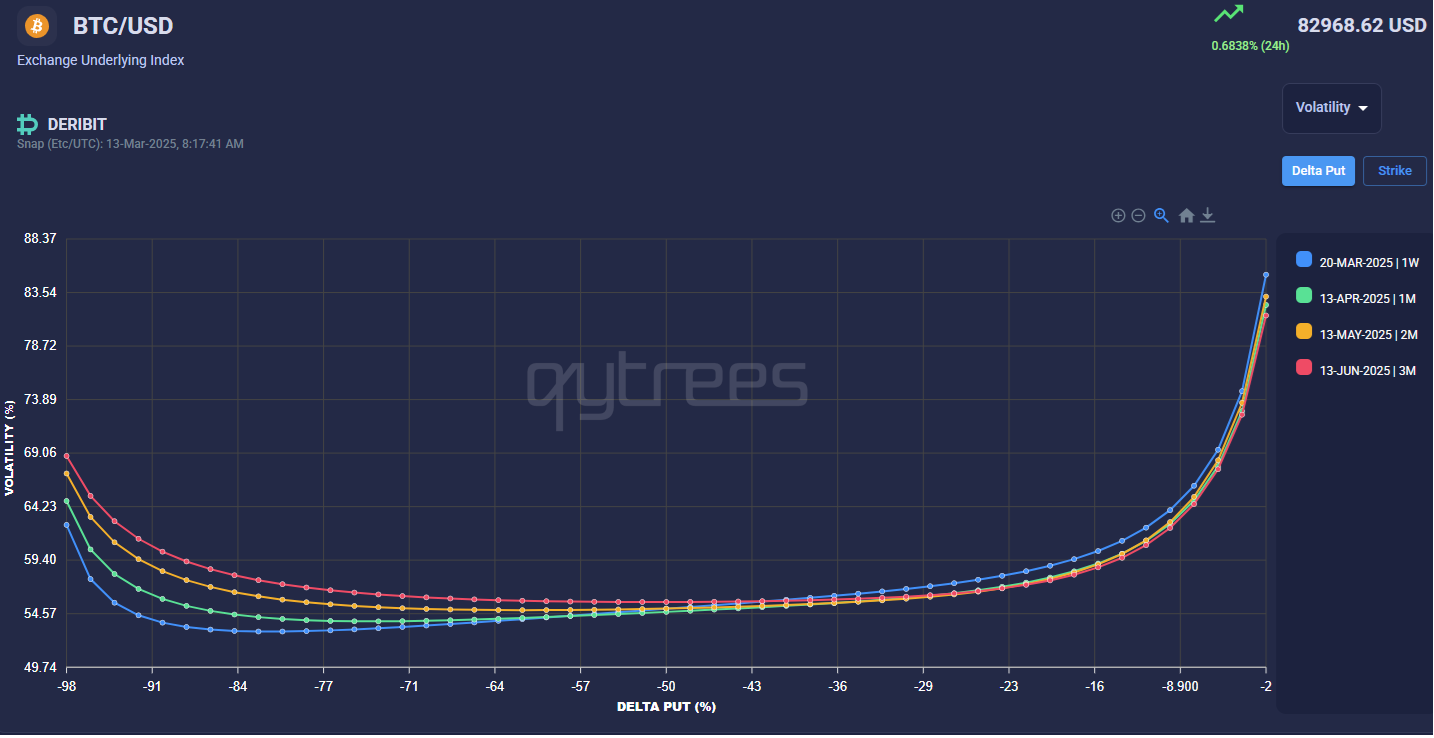
<figure><p><img decoding="async" loading="lazy" alt="smile_delta_put" src="https://recover.qytrees.com/assets/images/smile_delta_put-63acb3c9ab49b0ccc92b43af75d1614d.png" width="1434" height="738" class="img_ev3q"></p><figcaption style="text-align:center"><p>Vol smile function of Delta Put.</p></figcaption></figure>
<h2 class="anchor anchorWithStickyNavbar_LWe7" id="fx-style-representation-of-the-volatility-smile">FX Style representation of the Volatility smile<a href="https://recover.qytrees.com/blog/Option-Volatility-Surface-with-a-Flexible-API-Driven-Approach#fx-style-representation-of-the-volatility-smile" class="hash-link" aria-label="Direct link to FX Style representation of the Volatility smile" title="Direct link to FX Style representation of the Volatility smile">​</a></h2>
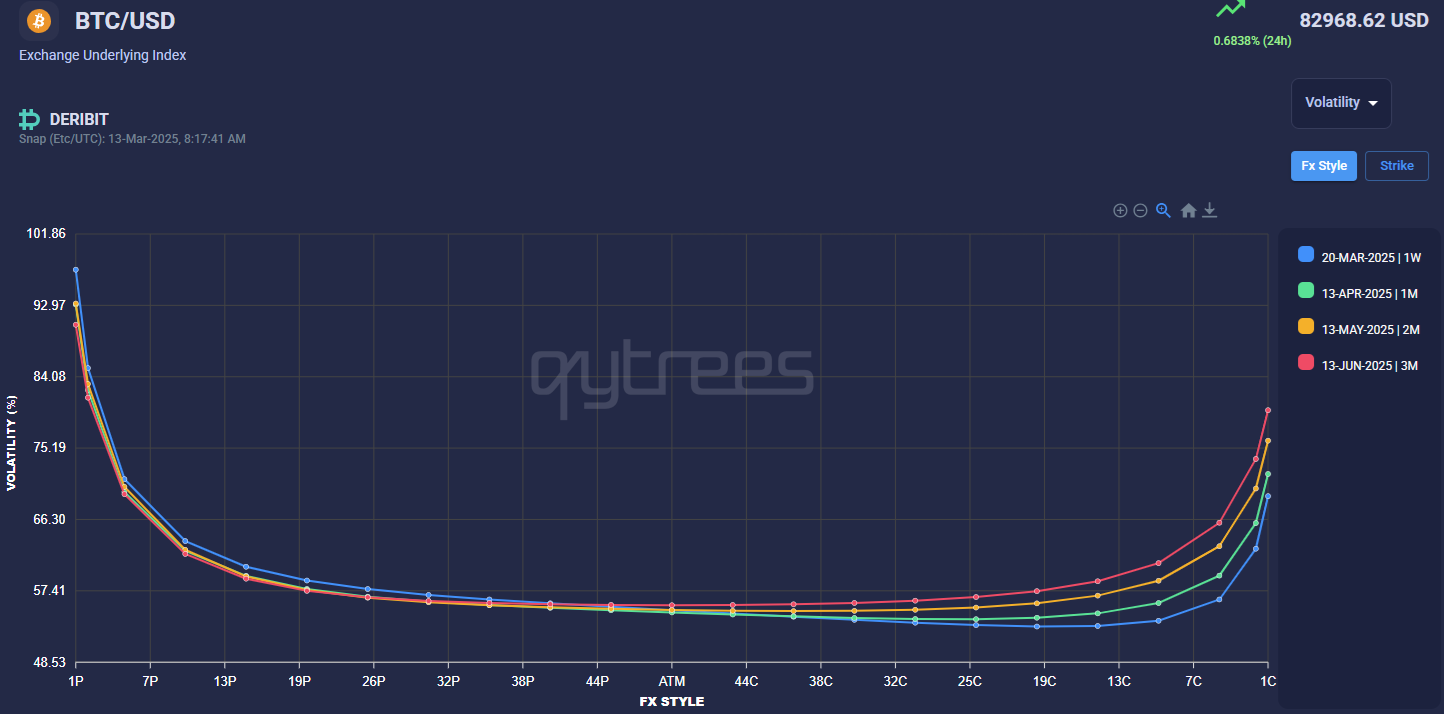
<p><strong>FX-Inspired Conventions</strong>: Traders often track 2, 5, 10, or 25 delta calls/puts at various maturities. Platforms like Bloomberg provide direct comparisons for these standard deltas.</p>
<p><strong>ATM Variations</strong>: “At-the-money” may be forward-based or delta-neutral (DN). FX markets often prefer DN.</p>
<figure><p><img decoding="async" loading="lazy" alt="smile_fx_style" src="https://recover.qytrees.com/assets/images/smile_fx_style-67cf694c9a8e14e3e38ea7a5499d8021.png" width="1444" height="714" class="img_ev3q"></p><figcaption style="text-align:center"><p>FX Style representation of Vol smile.</p></figcaption></figure>
<h1>Streamlining Data Retrieval with an Adaptable API</h1>
<p>Traditionally, retrieving volatilities or strikes for a specific convention can mean juggling forward prices, discount curves, or iterative solvers—especially under multiple delta definitions (premium-adjusted vs. spot, etc.). With Qytrees’ GraphQL-powered API, you can:</p>
<ul>
<li>When using delta call or delta put or fx style specify Your delta Convention**: Premium-adjusted, forward, spot, etc.</li>
<li><strong>Any Delta</strong> (e.g., a 23-delta put)</li>
<li>Or choose any values for your chosen scales (exemple log-moneyness or strikes).</li>
<li><strong>Input the strikes in the scale that is suitable for you</strong> — or reverse it: give a strike, retrieve its delta or vice versa.</li>
</ul>
<h2 class="anchor anchorWithStickyNavbar_LWe7" id="key-benefits">Key Benefits<a href="https://recover.qytrees.com/blog/Option-Volatility-Surface-with-a-Flexible-API-Driven-Approach#key-benefits" class="hash-link" aria-label="Direct link to Key Benefits" title="Direct link to Key Benefits">​</a></h2>
<ul>
<li><strong>Request Exactly What You Need</strong>: Pull vol data for particular tenors, strikes, or deltas in a single request.</li>
<li><strong>Compare Scales</strong>: Pivot between strike-based, moneyness-based, log-moneyness-based, and delta-based quoting without extra queries.</li>
<li><strong>Focus on Analysis</strong>: Minimize tedious computations and emphasize market insights.</li>
<li><strong>Build a Vol Matrix</strong>: Easily create custom volatility grids for any maturity, strike, or delta convention.</li>
<li><strong>Vectorized &amp; Parallel Computations</strong>: Fetch multiple maturities or valuation dates—in different time zones or cutoffs—just as quickly as for a single date.</li>
<li><strong>Parallel computation for valuation dates</strong> – allows you to do historical analysis in a smooth way by defining the range of historical data and the observation frequency</li>
</ul>
<h2 class="anchor anchorWithStickyNavbar_LWe7" id="qytrees-graphql-basics-for-option-analytics">Qytrees' GraphQL Basics for Option Analytics<a href="https://recover.qytrees.com/blog/Option-Volatility-Surface-with-a-Flexible-API-Driven-Approach#qytrees-graphql-basics-for-option-analytics" class="hash-link" aria-label="Direct link to Qytrees' GraphQL Basics for Option Analytics" title="Direct link to Qytrees' GraphQL Basics for Option Analytics">​</a></h2>
<p>Qytrees' GraphQL endpoint allows you to build custom queries around a predefined schema. For option data, you typically define:</p>
<ul>
<li>baseAsset and quoteAsset</li>
<li>An expiry node (to choose tenors, explicit dates, or listed exchange expiries)</li>
<li>A strike node (to choose scale, moneyness, or delta conventions)</li>
<li>Optional additional nodes (e.g., a payoff node for pricing) will be discussed in upcoming blogs.</li>
</ul>
<h3 class="anchor anchorWithStickyNavbar_LWe7" id="defining-expiries-in-one-node">Defining Expiries in One Node<a href="https://recover.qytrees.com/blog/Option-Volatility-Surface-with-a-Flexible-API-Driven-Approach#defining-expiries-in-one-node" class="hash-link" aria-label="Direct link to Defining Expiries in One Node" title="Direct link to Defining Expiries in One Node">​</a></h3>
<p>The <em>expiry</em> node is especially powerful in Qytrees. Common use cases include:</p>
<ul>
<li><em>Tenor-Based</em>
An example below:</li>
</ul>
<div class="language-graphql codeBlockContainer_Ckt0 theme-code-block" style="--prism-color:#F8F8F2;--prism-background-color:#282A36"><div class="codeBlockContent_biex"><pre tabindex="0" class="prism-code language-graphql codeBlock_bY9V thin-scrollbar" style="color:#F8F8F2;background-color:#282A36"><code class="codeBlockLines_e6Vv"><span class="token-line" style="color:#F8F8F2"><span class="token attr-name" style="color:rgb(241, 250, 140)">expiry</span><span class="token punctuation" style="color:rgb(248, 248, 242)">:</span><span class="token plain"> </span><span class="token punctuation" style="color:rgb(248, 248, 242)">{</span><span class="token plain"></span><br></span><span class="token-line" style="color:#F8F8F2"><span class="token plain">  </span><span class="token attr-name" style="color:rgb(241, 250, 140)">list</span><span class="token punctuation" style="color:rgb(248, 248, 242)">:</span><span class="token plain"> </span><span class="token punctuation" style="color:rgb(248, 248, 242)">[</span><span class="token string" style="color:rgb(255, 121, 198)">"1M"</span><span class="token punctuation" style="color:rgb(248, 248, 242)">,</span><span class="token plain"> </span><span class="token string" style="color:rgb(255, 121, 198)">"2M"</span><span class="token punctuation" style="color:rgb(248, 248, 242)">,</span><span class="token plain"> </span><span class="token string" style="color:rgb(255, 121, 198)">"7W2D"</span><span class="token punctuation" style="color:rgb(248, 248, 242)">]</span><span class="token punctuation" style="color:rgb(248, 248, 242)">,</span><span class="token plain"></span><br></span><span class="token-line" style="color:#F8F8F2"><span class="token plain">  </span><span class="token attr-name" style="color:rgb(241, 250, 140)">cutTime</span><span class="token punctuation" style="color:rgb(248, 248, 242)">:</span><span class="token plain"> </span><span class="token string" style="color:rgb(255, 121, 198)">"8AM"</span><span class="token plain"></span><br></span><span class="token-line" style="color:#F8F8F2"><span class="token plain"></span><span class="token punctuation" style="color:rgb(248, 248, 242)">}</span><br></span></code></pre><div class="buttonGroup__atx"><button type="button" aria-label="Copy code to clipboard" title="Copy" class="clean-btn"><span class="copyButtonIcons_eSgA" aria-hidden="true"><svg viewBox="0 0 24 24" class="copyButtonIcon_y97N"><path fill="currentColor" d="M19,21H8V7H19M19,5H8A2,2 0 0,0 6,7V21A2,2 0 0,0 8,23H19A2,2 0 0,0 21,21V7A2,2 0 0,0 19,5M16,1H4A2,2 0 0,0 2,3V17H4V3H16V1Z"></path></svg><svg viewBox="0 0 24 24" class="copyButtonSuccessIcon_LjdS"><path fill="currentColor" d="M21,7L9,19L3.5,13.5L4.91,12.09L9,16.17L19.59,5.59L21,7Z"></path></svg></span></button></div></div></div>
<p>Specify rolling tenors (like 1M, 2M), and optionally set a cutTime (e.g., 8 AM). If cutTime is omitted, the system uses rolling tenors relative to the valuation date/time.</p>
<ul>
<li><em>Explicit Dates</em></li>
</ul>
<div class="language-graphql codeBlockContainer_Ckt0 theme-code-block" style="--prism-color:#F8F8F2;--prism-background-color:#282A36"><div class="codeBlockContent_biex"><pre tabindex="0" class="prism-code language-graphql codeBlock_bY9V thin-scrollbar" style="color:#F8F8F2;background-color:#282A36"><code class="codeBlockLines_e6Vv"><span class="token-line" style="color:#F8F8F2"><span class="token attr-name" style="color:rgb(241, 250, 140)">expiry</span><span class="token punctuation" style="color:rgb(248, 248, 242)">:</span><span class="token plain"> </span><span class="token punctuation" style="color:rgb(248, 248, 242)">{</span><span class="token plain"></span><br></span><span class="token-line" style="color:#F8F8F2"><span class="token plain">  </span><span class="token attr-name" style="color:rgb(241, 250, 140)">list</span><span class="token punctuation" style="color:rgb(248, 248, 242)">:</span><span class="token plain"> </span><span class="token punctuation" style="color:rgb(248, 248, 242)">[</span><span class="token string" style="color:rgb(255, 121, 198)">"21/04/2025 08:30"</span><span class="token punctuation" style="color:rgb(248, 248, 242)">,</span><span class="token plain"> </span><span class="token string" style="color:rgb(255, 121, 198)">"21/06/2025 12:30"</span><span class="token punctuation" style="color:rgb(248, 248, 242)">]</span><span class="token plain"></span><br></span><span class="token-line" style="color:#F8F8F2"><span class="token plain"></span><span class="token punctuation" style="color:rgb(248, 248, 242)">}</span><br></span></code></pre><div class="buttonGroup__atx"><button type="button" aria-label="Copy code to clipboard" title="Copy" class="clean-btn"><span class="copyButtonIcons_eSgA" aria-hidden="true"><svg viewBox="0 0 24 24" class="copyButtonIcon_y97N"><path fill="currentColor" d="M19,21H8V7H19M19,5H8A2,2 0 0,0 6,7V21A2,2 0 0,0 8,23H19A2,2 0 0,0 21,21V7A2,2 0 0,0 19,5M16,1H4A2,2 0 0,0 2,3V17H4V3H16V1Z"></path></svg><svg viewBox="0 0 24 24" class="copyButtonSuccessIcon_LjdS"><path fill="currentColor" d="M21,7L9,19L3.5,13.5L4.91,12.09L9,16.17L19.59,5.59L21,7Z"></path></svg></span></button></div></div></div>
<p>Provide exact date/times. If you omit times or cutTime, a default cutoff is used similar to listed option from the same data soure.</p>
<ul>
<li><em>Listed Exchange Expiries</em></li>
</ul>
<div class="language-graphql codeBlockContainer_Ckt0 theme-code-block" style="--prism-color:#F8F8F2;--prism-background-color:#282A36"><div class="codeBlockContent_biex"><pre tabindex="0" class="prism-code language-graphql codeBlock_bY9V thin-scrollbar" style="color:#F8F8F2;background-color:#282A36"><code class="codeBlockLines_e6Vv"><span class="token-line" style="color:#F8F8F2"><span class="token attr-name" style="color:rgb(241, 250, 140)">expiry</span><span class="token punctuation" style="color:rgb(248, 248, 242)">:</span><span class="token plain"> </span><span class="token punctuation" style="color:rgb(248, 248, 242)">{</span><span class="token plain"></span><br></span><span class="token-line" style="color:#F8F8F2"><span class="token plain">  </span><span class="token attr-name" style="color:rgb(241, 250, 140)">selection</span><span class="token punctuation" style="color:rgb(248, 248, 242)">:</span><span class="token plain"> </span><span class="token constant" style="color:rgb(189, 147, 249)">LISTED</span><span class="token plain"></span><br></span><span class="token-line" style="color:#F8F8F2"><span class="token plain"></span><span class="token punctuation" style="color:rgb(248, 248, 242)">}</span><br></span></code></pre><div class="buttonGroup__atx"><button type="button" aria-label="Copy code to clipboard" title="Copy" class="clean-btn"><span class="copyButtonIcons_eSgA" aria-hidden="true"><svg viewBox="0 0 24 24" class="copyButtonIcon_y97N"><path fill="currentColor" d="M19,21H8V7H19M19,5H8A2,2 0 0,0 6,7V21A2,2 0 0,0 8,23H19A2,2 0 0,0 21,21V7A2,2 0 0,0 19,5M16,1H4A2,2 0 0,0 2,3V17H4V3H16V1Z"></path></svg><svg viewBox="0 0 24 24" class="copyButtonSuccessIcon_LjdS"><path fill="currentColor" d="M21,7L9,19L3.5,13.5L4.91,12.09L9,16.17L19.59,5.59L21,7Z"></path></svg></span></button></div></div></div>
<p>Pulls only exchange-listed expiry dates (e.g., from Deribit).</p>
<p>By customizing expiry, you can retrieve precisely the volatility data you need—whether you’re after standard tenors, fixed calendar dates, or exchange-specific listings.</p>
<h3 class="anchor anchorWithStickyNavbar_LWe7" id="controlling-the-strike-node">Controlling the Strike Node<a href="https://recover.qytrees.com/blog/Option-Volatility-Surface-with-a-Flexible-API-Driven-Approach#controlling-the-strike-node" class="hash-link" aria-label="Direct link to Controlling the Strike Node" title="Direct link to Controlling the Strike Node">​</a></h3>
<p>Similarly, the <em>strike</em> node defines how you set or retrieve strikes:</p>
<ul>
<li><em>Delta Convention Example</em></li>
</ul>
<div class="language-graphql codeBlockContainer_Ckt0 theme-code-block" style="--prism-color:#F8F8F2;--prism-background-color:#282A36"><div class="codeBlockContent_biex"><pre tabindex="0" class="prism-code language-graphql codeBlock_bY9V thin-scrollbar" style="color:#F8F8F2;background-color:#282A36"><code class="codeBlockLines_e6Vv"><span class="token-line" style="color:#F8F8F2"><span class="token attr-name" style="color:rgb(241, 250, 140)">strike</span><span class="token punctuation" style="color:rgb(248, 248, 242)">:</span><span class="token plain"> </span><span class="token punctuation" style="color:rgb(248, 248, 242)">{</span><span class="token plain"></span><br></span><span class="token-line" style="color:#F8F8F2"><span class="token plain">    </span><span class="token attr-name" style="color:rgb(241, 250, 140)">strikeType</span><span class="token punctuation" style="color:rgb(248, 248, 242)">:</span><span class="token plain"> </span><span class="token punctuation" style="color:rgb(248, 248, 242)">{</span><span class="token plain"></span><br></span><span class="token-line" style="color:#F8F8F2"><span class="token plain">        </span><span class="token attr-name" style="color:rgb(241, 250, 140)">scale</span><span class="token punctuation" style="color:rgb(248, 248, 242)">:</span><span class="token plain"> </span><span class="token constant" style="color:rgb(189, 147, 249)">DELTA_CALL</span><span class="token plain"></span><br></span><span class="token-line" style="color:#F8F8F2"><span class="token plain">        </span><span class="token attr-name" style="color:rgb(241, 250, 140)">deltaConvention</span><span class="token punctuation" style="color:rgb(248, 248, 242)">:</span><span class="token plain"> </span><span class="token constant" style="color:rgb(189, 147, 249)">FORWARD</span><span class="token plain"></span><br></span><span class="token-line" style="color:#F8F8F2"><span class="token plain">    </span><span class="token punctuation" style="color:rgb(248, 248, 242)">}</span><span class="token punctuation" style="color:rgb(248, 248, 242)">,</span><span class="token plain"></span><br></span><span class="token-line" style="color:#F8F8F2"><span class="token plain">    </span><span class="token attr-name" style="color:rgb(241, 250, 140)">list</span><span class="token punctuation" style="color:rgb(248, 248, 242)">:</span><span class="token plain"> </span><span class="token punctuation" style="color:rgb(248, 248, 242)">[</span><span class="token number">0.12</span><span class="token punctuation" style="color:rgb(248, 248, 242)">,</span><span class="token plain"> </span><span class="token number">0.133</span><span class="token punctuation" style="color:rgb(248, 248, 242)">,</span><span class="token plain"> </span><span class="token number">0.543</span><span class="token punctuation" style="color:rgb(248, 248, 242)">,</span><span class="token plain"> </span><span class="token number">0.65</span><span class="token punctuation" style="color:rgb(248, 248, 242)">]</span><span class="token plain"></span><br></span><span class="token-line" style="color:#F8F8F2"><span class="token plain"></span><span class="token punctuation" style="color:rgb(248, 248, 242)">}</span><br></span></code></pre><div class="buttonGroup__atx"><button type="button" aria-label="Copy code to clipboard" title="Copy" class="clean-btn"><span class="copyButtonIcons_eSgA" aria-hidden="true"><svg viewBox="0 0 24 24" class="copyButtonIcon_y97N"><path fill="currentColor" d="M19,21H8V7H19M19,5H8A2,2 0 0,0 6,7V21A2,2 0 0,0 8,23H19A2,2 0 0,0 21,21V7A2,2 0 0,0 19,5M16,1H4A2,2 0 0,0 2,3V17H4V3H16V1Z"></path></svg><svg viewBox="0 0 24 24" class="copyButtonSuccessIcon_LjdS"><path fill="currentColor" d="M21,7L9,19L3.5,13.5L4.91,12.09L9,16.17L19.59,5.59L21,7Z"></path></svg></span></button></div></div></div>
<p>This example node allows you to request strikes at specific call delta levels using a forward-based delta convention.</p>
<ul>
<li><em>Log-Moneyness Range</em></li>
</ul>
<div class="language-graphql codeBlockContainer_Ckt0 theme-code-block" style="--prism-color:#F8F8F2;--prism-background-color:#282A36"><div class="codeBlockContent_biex"><pre tabindex="0" class="prism-code language-graphql codeBlock_bY9V thin-scrollbar" style="color:#F8F8F2;background-color:#282A36"><code class="codeBlockLines_e6Vv"><span class="token-line" style="color:#F8F8F2"><span class="token attr-name" style="color:rgb(241, 250, 140)">strike</span><span class="token punctuation" style="color:rgb(248, 248, 242)">:</span><span class="token plain"> </span><span class="token punctuation" style="color:rgb(248, 248, 242)">{</span><span class="token plain"></span><br></span><span class="token-line" style="color:#F8F8F2"><span class="token plain">  </span><span class="token attr-name" style="color:rgb(241, 250, 140)">strikeType</span><span class="token punctuation" style="color:rgb(248, 248, 242)">:</span><span class="token plain"> </span><span class="token punctuation" style="color:rgb(248, 248, 242)">{</span><span class="token plain"></span><br></span><span class="token-line" style="color:#F8F8F2"><span class="token plain">    </span><span class="token attr-name" style="color:rgb(241, 250, 140)">scale</span><span class="token punctuation" style="color:rgb(248, 248, 242)">:</span><span class="token plain"> </span><span class="token constant" style="color:rgb(189, 147, 249)">LOG_MONEYNESS</span><span class="token plain"></span><br></span><span class="token-line" style="color:#F8F8F2"><span class="token plain">  </span><span class="token punctuation" style="color:rgb(248, 248, 242)">}</span><span class="token punctuation" style="color:rgb(248, 248, 242)">,</span><span class="token plain"></span><br></span><span class="token-line" style="color:#F8F8F2"><span class="token plain">  </span><span class="token attr-name" style="color:rgb(241, 250, 140)">range</span><span class="token punctuation" style="color:rgb(248, 248, 242)">:</span><span class="token plain"> </span><span class="token punctuation" style="color:rgb(248, 248, 242)">[</span><span class="token number">-1</span><span class="token punctuation" style="color:rgb(248, 248, 242)">,</span><span class="token plain"> </span><span class="token number">1.5</span><span class="token punctuation" style="color:rgb(248, 248, 242)">,</span><span class="token plain"> </span><span class="token number">0.1</span><span class="token punctuation" style="color:rgb(248, 248, 242)">]</span><span class="token plain"></span><br></span><span class="token-line" style="color:#F8F8F2"><span class="token plain"></span><span class="token punctuation" style="color:rgb(248, 248, 242)">}</span><br></span></code></pre><div class="buttonGroup__atx"><button type="button" aria-label="Copy code to clipboard" title="Copy" class="clean-btn"><span class="copyButtonIcons_eSgA" aria-hidden="true"><svg viewBox="0 0 24 24" class="copyButtonIcon_y97N"><path fill="currentColor" d="M19,21H8V7H19M19,5H8A2,2 0 0,0 6,7V21A2,2 0 0,0 8,23H19A2,2 0 0,0 21,21V7A2,2 0 0,0 19,5M16,1H4A2,2 0 0,0 2,3V17H4V3H16V1Z"></path></svg><svg viewBox="0 0 24 24" class="copyButtonSuccessIcon_LjdS"><path fill="currentColor" d="M21,7L9,19L3.5,13.5L4.91,12.09L9,16.17L19.59,5.59L21,7Z"></path></svg></span></button></div></div></div>
<p>Here, you define a range for log-moneyness from –1 to 1.5 in increments of 0.1.</p>
<ul>
<li><em>FX-Style Delta</em></li>
</ul>
<div class="language-graphql codeBlockContainer_Ckt0 theme-code-block" style="--prism-color:#F8F8F2;--prism-background-color:#282A36"><div class="codeBlockContent_biex"><pre tabindex="0" class="prism-code language-graphql codeBlock_bY9V thin-scrollbar" style="color:#F8F8F2;background-color:#282A36"><code class="codeBlockLines_e6Vv"><span class="token-line" style="color:#F8F8F2"><span class="token attr-name" style="color:rgb(241, 250, 140)">strike</span><span class="token punctuation" style="color:rgb(248, 248, 242)">:</span><span class="token plain"> </span><span class="token punctuation" style="color:rgb(248, 248, 242)">{</span><span class="token plain"></span><br></span><span class="token-line" style="color:#F8F8F2"><span class="token plain">  </span><span class="token attr-name" style="color:rgb(241, 250, 140)">strikeType</span><span class="token punctuation" style="color:rgb(248, 248, 242)">:</span><span class="token plain"> </span><span class="token punctuation" style="color:rgb(248, 248, 242)">{</span><span class="token plain"></span><br></span><span class="token-line" style="color:#F8F8F2"><span class="token plain">    </span><span class="token attr-name" style="color:rgb(241, 250, 140)">scale</span><span class="token punctuation" style="color:rgb(248, 248, 242)">:</span><span class="token plain"> </span><span class="token constant" style="color:rgb(189, 147, 249)">FX_STYLE</span><span class="token punctuation" style="color:rgb(248, 248, 242)">,</span><span class="token plain"></span><br></span><span class="token-line" style="color:#F8F8F2"><span class="token plain">    </span><span class="token attr-name" style="color:rgb(241, 250, 140)">deltaConvention</span><span class="token punctuation" style="color:rgb(248, 248, 242)">:</span><span class="token plain"> </span><span class="token constant" style="color:rgb(189, 147, 249)">SPOT</span><span class="token plain"></span><br></span><span class="token-line" style="color:#F8F8F2"><span class="token plain">  </span><span class="token punctuation" style="color:rgb(248, 248, 242)">}</span><span class="token punctuation" style="color:rgb(248, 248, 242)">,</span><span class="token plain"></span><br></span><span class="token-line" style="color:#F8F8F2"><span class="token plain">  </span><span class="token attr-name" style="color:rgb(241, 250, 140)">list</span><span class="token punctuation" style="color:rgb(248, 248, 242)">:</span><span class="token plain"> </span><span class="token punctuation" style="color:rgb(248, 248, 242)">[</span><span class="token string" style="color:rgb(255, 121, 198)">"2P"</span><span class="token punctuation" style="color:rgb(248, 248, 242)">,</span><span class="token plain"> </span><span class="token string" style="color:rgb(255, 121, 198)">"4P"</span><span class="token punctuation" style="color:rgb(248, 248, 242)">,</span><span class="token plain"> </span><span class="token string" style="color:rgb(255, 121, 198)">"12P"</span><span class="token punctuation" style="color:rgb(248, 248, 242)">,</span><span class="token plain"> </span><span class="token string" style="color:rgb(255, 121, 198)">"27P"</span><span class="token punctuation" style="color:rgb(248, 248, 242)">,</span><span class="token plain"> </span><span class="token string" style="color:rgb(255, 121, 198)">"35P"</span><span class="token punctuation" style="color:rgb(248, 248, 242)">,</span><span class="token plain"> </span><span class="token string" style="color:rgb(255, 121, 198)">"DNS"</span><span class="token punctuation" style="color:rgb(248, 248, 242)">,</span><span class="token plain"> </span><span class="token string" style="color:rgb(255, 121, 198)">"25C"</span><span class="token punctuation" style="color:rgb(248, 248, 242)">,</span><span class="token plain"> </span><span class="token string" style="color:rgb(255, 121, 198)">"10C"</span><span class="token punctuation" style="color:rgb(248, 248, 242)">,</span><span class="token plain"> </span><span class="token string" style="color:rgb(255, 121, 198)">"5C"</span><span class="token punctuation" style="color:rgb(248, 248, 242)">]</span><span class="token plain"></span><br></span><span class="token-line" style="color:#F8F8F2"><span class="token plain"></span><span class="token punctuation" style="color:rgb(248, 248, 242)">}</span><br></span></code></pre><div class="buttonGroup__atx"><button type="button" aria-label="Copy code to clipboard" title="Copy" class="clean-btn"><span class="copyButtonIcons_eSgA" aria-hidden="true"><svg viewBox="0 0 24 24" class="copyButtonIcon_y97N"><path fill="currentColor" d="M19,21H8V7H19M19,5H8A2,2 0 0,0 6,7V21A2,2 0 0,0 8,23H19A2,2 0 0,0 21,21V7A2,2 0 0,0 19,5M16,1H4A2,2 0 0,0 2,3V17H4V3H16V1Z"></path></svg><svg viewBox="0 0 24 24" class="copyButtonSuccessIcon_LjdS"><path fill="currentColor" d="M21,7L9,19L3.5,13.5L4.91,12.09L9,16.17L19.59,5.59L21,7Z"></path></svg></span></button></div></div></div>
<p>This approach follows an FX-style definition, specifying deltas such as “2P” (2-delta put) or “25C” (25-delta call). <em>DNS</em> refers to a <em>Delta Neutral Straddle</em>.</p>
<ul>
<li><em>Listed Strikes</em></li>
</ul>
<div class="language-graphql codeBlockContainer_Ckt0 theme-code-block" style="--prism-color:#F8F8F2;--prism-background-color:#282A36"><div class="codeBlockContent_biex"><pre tabindex="0" class="prism-code language-graphql codeBlock_bY9V thin-scrollbar" style="color:#F8F8F2;background-color:#282A36"><code class="codeBlockLines_e6Vv"><span class="token-line" style="color:#F8F8F2"><span class="token attr-name" style="color:rgb(241, 250, 140)">strike</span><span class="token punctuation" style="color:rgb(248, 248, 242)">:</span><span class="token plain"> </span><span class="token punctuation" style="color:rgb(248, 248, 242)">{</span><span class="token plain"></span><br></span><span class="token-line" style="color:#F8F8F2"><span class="token plain">  </span><span class="token attr-name" style="color:rgb(241, 250, 140)">selection</span><span class="token punctuation" style="color:rgb(248, 248, 242)">:</span><span class="token plain"> </span><span class="token constant" style="color:rgb(189, 147, 249)">LISTED</span><span class="token plain"></span><br></span><span class="token-line" style="color:#F8F8F2"><span class="token plain"></span><span class="token punctuation" style="color:rgb(248, 248, 242)">}</span><br></span></code></pre><div class="buttonGroup__atx"><button type="button" aria-label="Copy code to clipboard" title="Copy" class="clean-btn"><span class="copyButtonIcons_eSgA" aria-hidden="true"><svg viewBox="0 0 24 24" class="copyButtonIcon_y97N"><path fill="currentColor" d="M19,21H8V7H19M19,5H8A2,2 0 0,0 6,7V21A2,2 0 0,0 8,23H19A2,2 0 0,0 21,21V7A2,2 0 0,0 19,5M16,1H4A2,2 0 0,0 2,3V17H4V3H16V1Z"></path></svg><svg viewBox="0 0 24 24" class="copyButtonSuccessIcon_LjdS"><path fill="currentColor" d="M21,7L9,19L3.5,13.5L4.91,12.09L9,16.17L19.59,5.59L21,7Z"></path></svg></span></button></div></div></div>
<p>Fetches only strikes actively listed on your chosen exchange.</p>
<p>As shown, Qytrees supports a broad range of strike and expiry definitions, enabling direct access to both standard and more specialized quoting styles.</p>
<h1>Conclusion</h1>
<p>Implied volatility makes comparing options across diverse strikes, maturities, and underlyings more efficient. Whether you prefer moneyness, log-moneyness, or delta-based quoting, the critical decision is choosing a scale that fits your trading or research goals. With Qytrees’ flexible GraphQL API, you can:</p>
<ul>
<li>Define expiries in a single node (tenors, explicit dates, or listed calendars)</li>
<li>Seamlessly request vol data in any scale—strike, moneyness, log-moneyness, or delta</li>
<li>Stay focused on insights, risk, and strategy rather than data wrangling</li>
</ul>
<p>Stay tuned for upcoming posts covering term structure, skew, and other advanced methods of analyzing volatility surfaces!</p>
<p>If you have specific questions or scenarios you’d like us to cover, let us know.</p>]]></content>
        <author>
            <name>Qytrees Research</name>
        </author>
        <category label="volatility" term="volatility"/>
        <category label="crypto-options" term="crypto-options"/>
        <category label="strike scales" term="strike scales"/>
        <category label="flexible maturity" term="flexible maturity"/>
        <category label="btc" term="btc"/>
    </entry>
    <entry>
        <title type="html"><![CDATA[A Simple Option Trading Strategy with Realized Volatility]]></title>
        <id>https://recover.qytrees.com/blog/simple-option-trading-strategy-with-realized-volatility</id>
        <link href="https://recover.qytrees.com/blog/simple-option-trading-strategy-with-realized-volatility"/>
        <updated>2024-10-28T00:00:00.000Z</updated>
        <summary type="html"><![CDATA[In this blog, we discuss the relationship between realized volatility (RV) and implied volatility (IV), focusing on BTC as a case study. The goal is to introduce a simple option trading strategy that takes advantage of potential mispricing between RV and IV. We'll then compare the performance of this strategy against an alternative approach that doesn't incorporate RV information, highlighting the value of using RV in volatility-based trading strategies.]]></summary>
        <content type="html"><![CDATA[<p>In this blog, we discuss the relationship between <strong>realized volatility (RV)</strong> and <strong>implied volatility (IV)</strong>, focusing on <strong>BTC</strong> as a case study. The goal is to introduce a simple option trading strategy that takes advantage of potential mispricing between RV and IV. We'll then compare the performance of this strategy against an alternative approach that doesn't incorporate RV information, highlighting the value of using RV in volatility-based trading strategies.</p>
<h3 class="anchor anchorWithStickyNavbar_LWe7" id="disclaimer">Disclaimer:<a href="https://recover.qytrees.com/blog/simple-option-trading-strategy-with-realized-volatility#disclaimer" class="hash-link" aria-label="Direct link to Disclaimer:" title="Direct link to Disclaimer:">​</a></h3>
<p>This analysis is for <strong>educational purposes</strong> only and is <strong>not financial advice</strong>. The strategies discussed, particularly those involving shorting options, carry significant risks, especially in volatile markets like cryptocurrencies. This blog does not cover the impact of margin, which can increase risk for traders.</p>
<h2 class="anchor anchorWithStickyNavbar_LWe7" id="what-is-realized-volatility">What is Realized Volatility?<a href="https://recover.qytrees.com/blog/simple-option-trading-strategy-with-realized-volatility#what-is-realized-volatility" class="hash-link" aria-label="Direct link to What is Realized Volatility?" title="Direct link to What is Realized Volatility?">​</a></h2>
<p>Realized Volatility (RV) measures the historical volatility of an asset by calculating the standard deviation of its spot price over a defined period. This gives traders insight into how much an asset’s price has fluctuated in the past. For more details on how RV is calculated, refer to <a href="https://qytrees.com/blog/realized-volatility-in-digital-assets" target="_blank" rel="noopener noreferrer">here</a>.</p>
<p>The key parameters in RV calculation are the <strong>frequency of observations</strong> and the <strong>lookback period</strong>. For instance, <strong>daily RV</strong> uses daily spot price observations, while <strong>weekly RV</strong> uses weekly observations. The lookback period determines how far back the analysis goes, providing an average volatility over that time frame. A well-chosen lookback period smooths out short-term fluctuations but remains relevant to current market conditions. If the period is too long, older data may skew the results and fail to reflect the latest market dynamics. Therefore, the lookback period must be long enough to ensure accuracy but not too long to lose relevance.</p>
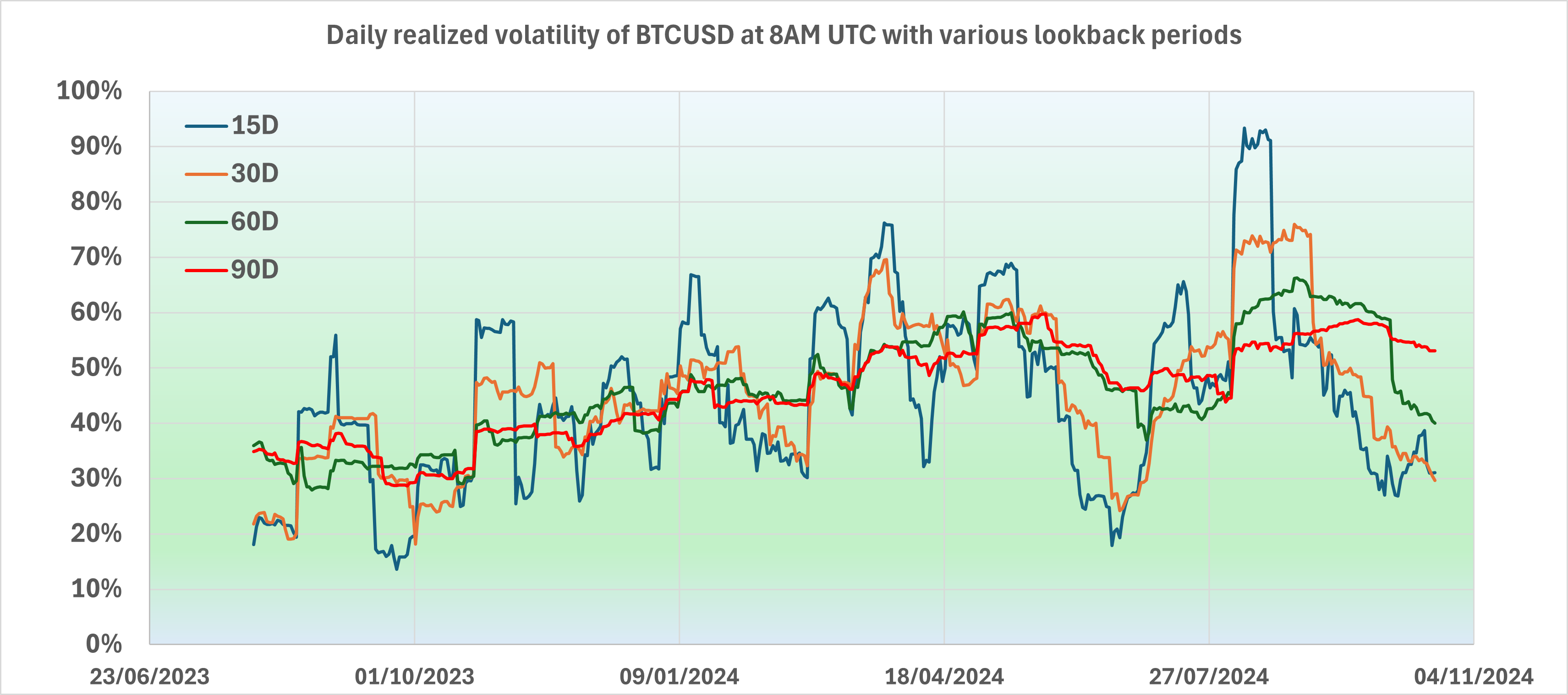
<figure><p><img decoding="async" loading="lazy" alt="btc_rv" src="https://recover.qytrees.com/assets/images/btc_rv-7301882a7d8c5356bc48ae5aae32df0b.png" width="3422" height="1517" class="img_ev3q"></p><figcaption style="text-align:center"><p>Daily Realized Volatility Observed at 8 AM UTC with Various Lookback Periods.</p></figcaption></figure>
<p>The graphic above shows the daily Realized Volatility (RV) using different lookback periods (15, 30, 60, and 90 days). As the lookback period increases, RV becomes smoother, reducing the influence of short-term fluctuations. This highlights the importance of selecting an appropriate lookback period when analyzing volatility—it's a crucial parameter for traders.</p>
<p>In this analysis, we focus on daily RV, as our strategy centers around daily expiring options. By aligning the RV calculation with the options' expiration timeframe, we ensure that the volatility we're analyzing is relevant to the short-term nature of the trades.</p>
<h2 class="anchor anchorWithStickyNavbar_LWe7" id="what-is-implied-volatility">What is Implied Volatility?<a href="https://recover.qytrees.com/blog/simple-option-trading-strategy-with-realized-volatility#what-is-implied-volatility" class="hash-link" aria-label="Direct link to What is Implied Volatility?" title="Direct link to What is Implied Volatility?">​</a></h2>
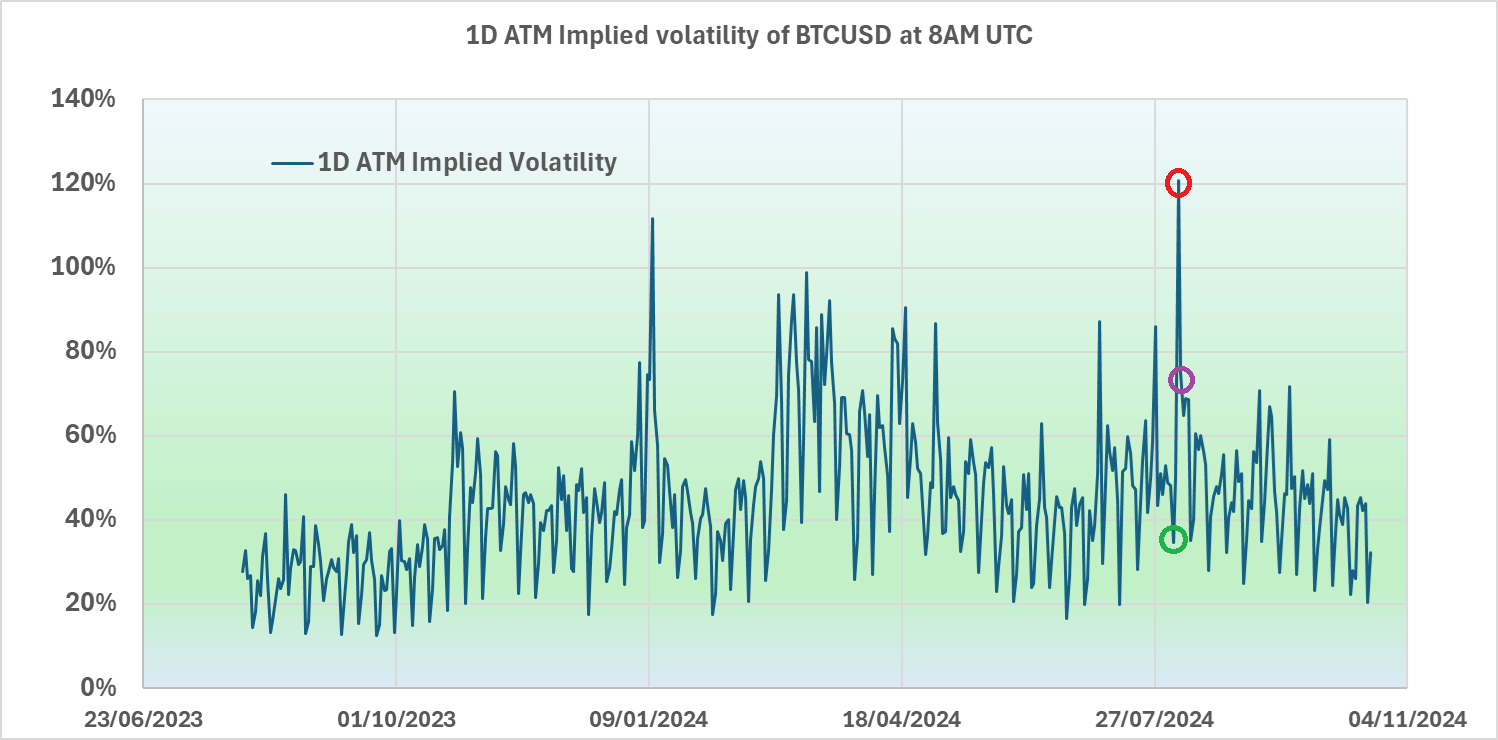
<p><strong>Implied Volatility (IV)</strong> reflects the market's expectations for future volatility. In the options market, IV represents the volatility implied by the market prices of options contracts. For this analysis, we will focus on the 1-day At-The-Money (ATM) IV, which estimates how volatile the market expects the asset to be over the next 24 hours.</p>
<figure><p><img decoding="async" loading="lazy" alt="btc_iv" src="https://recover.qytrees.com/assets/images/btc_iv-229ab69286a161425cc44a6acc85afff.png" width="1498" height="740" class="img_ev3q"></p><figcaption style="text-align:center"><p>1D ATM Implied Volatility of BTCUSD at 8AM UTC.</p></figcaption></figure>
<p>The graphic above shows <strong>1-day ATM implied volatility (IV)</strong> observed at 8 AM UTC daily, from July 2023 to October 2024. The IV is highly volatile, with significant fluctuations occurring from one day to the next. For example, on August 3rd, 5th, and 6th, 2024 (highlighted by coloured circles), IV surged from <strong>35% to over 110%</strong>, then fell back to <strong>75%</strong> the following day.</p>
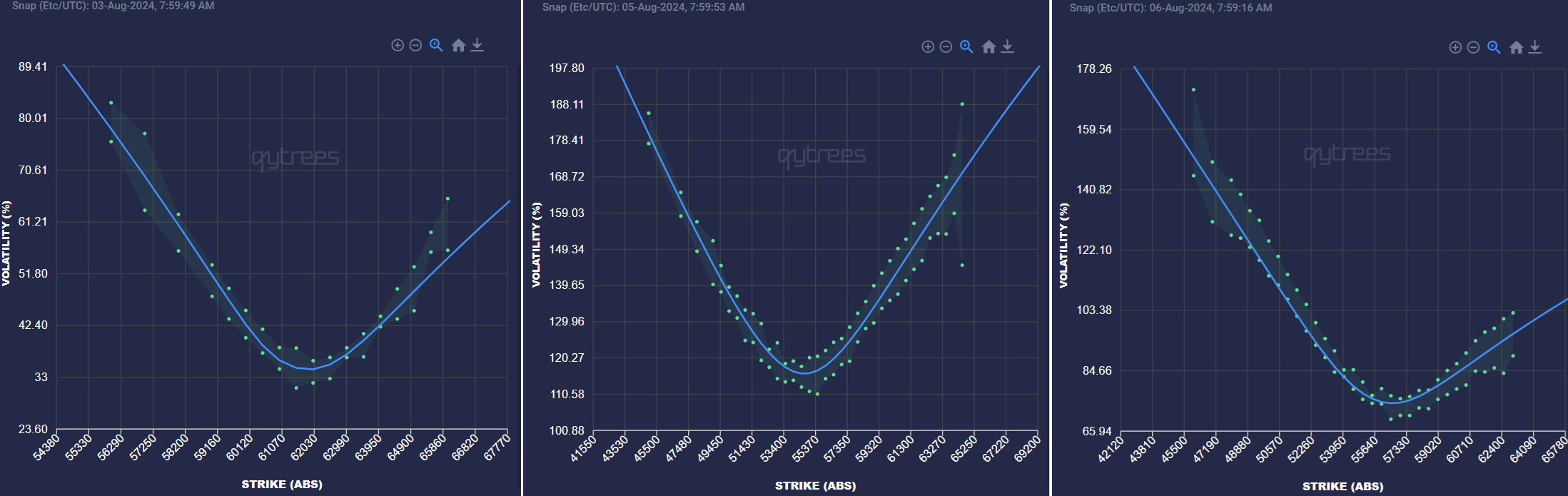
<p>These significant changes in implied volatility (IV) are the result of <strong>short-term market dynamics</strong>. To demonstrate this, we’ve plotted the corresponding volatility smiles for the highlighted dates. Since these smiles are well-calibrated, it confirms that the observed IV fluctuations are directly influenced by shifts in market conditions.</p>
<figure><p><img decoding="async" loading="lazy" alt="smiles" src="https://recover.qytrees.com/assets/images/smiles-2e03c43fb012262f7ecdc5f7fbc76e6e.png" width="2197" height="695" class="img_ev3q"></p><figcaption style="text-align:center"><p>1D BTCUSD Volatility Smile at 8AM UTC on 03-08-2024, 05-08-2024 and 06-08-2024.</p></figcaption></figure>
<h1>Comparing Realized Volatility to Implied Volatility</h1>
<p>When Realized Volatility (RV) is lower than Implied Volatility (IV), it suggests that the market may be <strong>overestimating future volatility based on historical data</strong>. This can create opportunities for traders to sell volatility through strategies like selling straddles or strangles.</p>
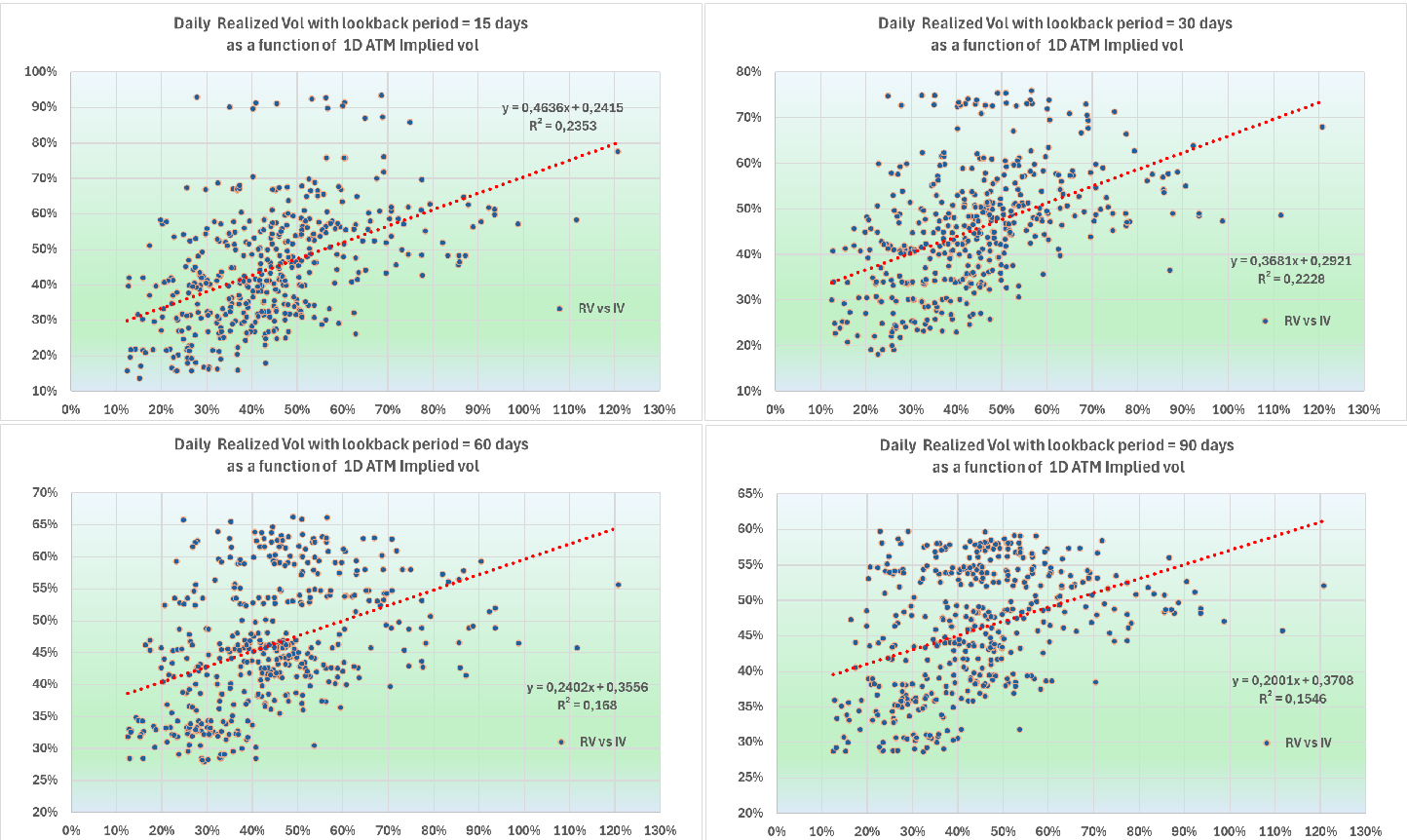
<p>However, since RV depends on the lookback period, it's important to determine which RV to compare against IV. In the graphics below, we plot daily ATM IV against RV for different lookback periods. The correlations between the two are weak, ranging from <strong>15% to 24%</strong>, indicating that no single lookback period consistently outperforms the others in capturing this relationship.</p>
<figure><p><img decoding="async" loading="lazy" alt="interp" src="https://recover.qytrees.com/assets/images/interp-1d134b2aa0dd9f408134d568790a672a.png" width="1444" height="862" class="img_ev3q"></p><figcaption style="text-align:center"><p>Daily Realized Volatility as a function of 1D ATM Implied volatility between July 2023 and October 2024.</p></figcaption></figure>
<p>The percentage of days when daily Implied Volatility (IV) is lower than daily Realized Volatility (RV) for various lookback periods, spanning from 1st August 2023 to 20th October 2024, varies between 50% and 60%.</p>
<h1>Trading Strategy Based on RV and IV</h1>
<p>Our strategy takes advantage of the difference between Realized Volatility (RV) and Implied Volatility (IV). We’ll compare RV, using different lookback periods, with the 1-day ATM IV at 8 a.m. UTC. If RV is lower than IV, we will sell a 1-day ATM straddle, aiming to profit from the possible market’s overestimation of future volatility.</p>
<h1>Why Sell a Straddle?</h1>
<p>A <strong>straddle</strong> is an options strategy where both a call and a put option are sold at the same strike price, with the expectation that the asset's price will remain close to that level. In this strategy, the straddle is <strong>held until maturity</strong>, without dynamic hedging. The options are sold when implied volatility (IV) is high, particularly when IV exceeds realized volatility (RV), allowing the seller to collect a higher premium.</p>
<p>The strategy profits if the asset's price remains stable, enabling the seller to retain part of the premium. However, it’s important to note that selling options carries significant risk if there are large price movements away from the strike price, as this can result in substantial losses for the seller.</p>
<h1>Backtesting the Strategy</h1>
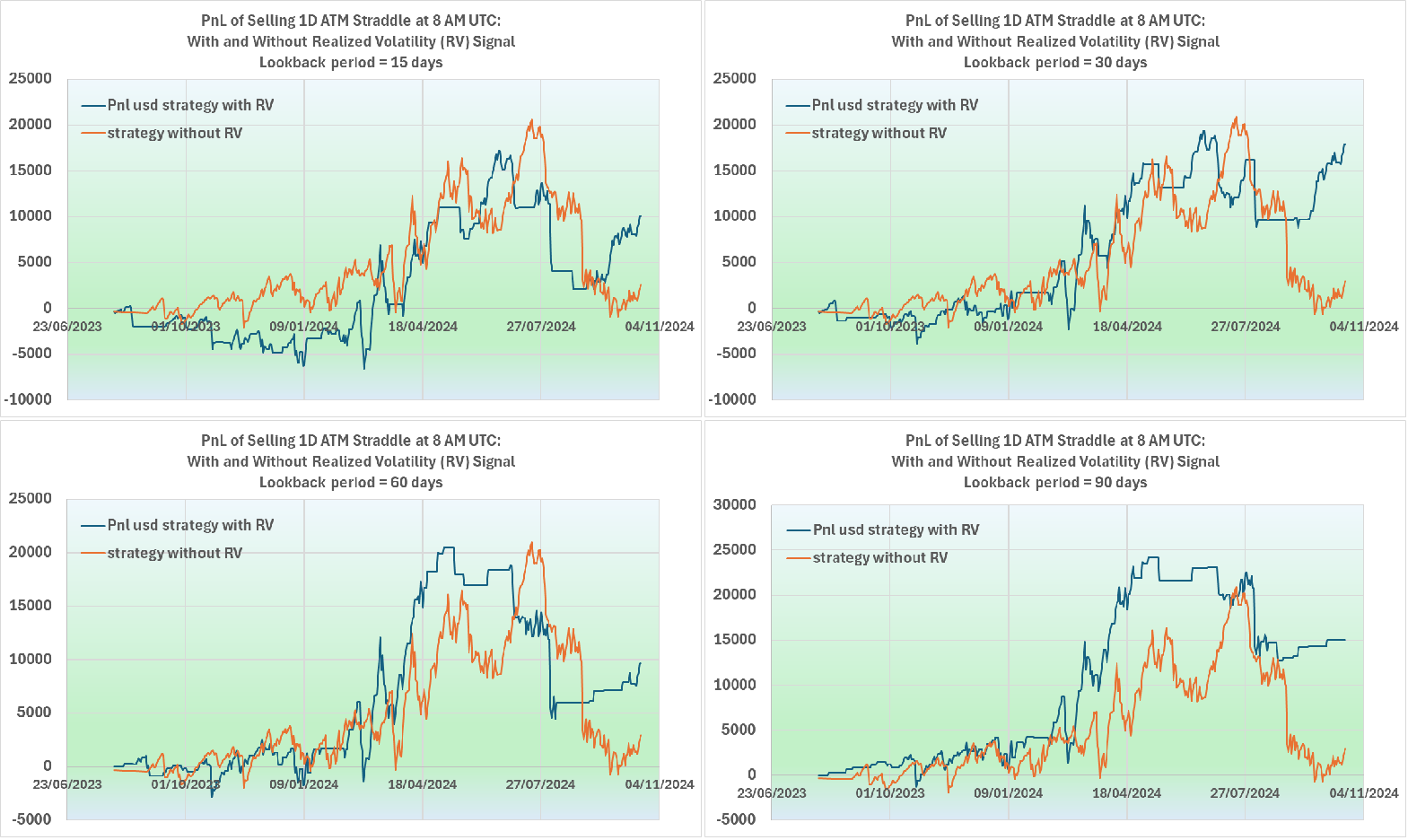
<p>We will backtest this strategy and compare it to a simpler approach where we sell the 1-day ATM straddle every day, without considering the relationship between RV and IV. This comparison will allow us to assess how using RV as a signal in our strategy impacts overall performance. Since none of the lookback periods showed a clear advantage in the earlier analysis, this parameter will need to be calibrated during the backtest. It is a crucial element of the strategy that requires optimization.</p>
<p>For this analysis, we will use the average mid 1d-ATM volatility observed in the market. The straddle will be sold at the bid price, reflecting the highest price buyers are willing to pay. We will apply a 5% volatility spread as a proxy, which is a conservative estimate within the typical bid-ask volatility spread range of 3-8%, accounting for the difference between buying and selling volatility. This adjustment ensures that the strategy factors in market liquidity and spread costs.</p>
<p>Additionally, <strong>trading commissions</strong> will be included, similar to the fees charged by major exchanges. A fee will be applied for opening positions, calculated as a percentage of the spot index price of the underlying asset (typically 0.03%) at the time of the transaction, multiplied by the number of contracts. These fees will be capped in line with industry-standard fee structures as a percentage of the option price.</p>
<figure><p><img decoding="async" loading="lazy" alt="backtest" src="https://recover.qytrees.com/assets/images/backtest-10b942ce154270351fba75d256c99eb4.png" width="1569" height="936" class="img_ev3q"></p><figcaption style="text-align:center"><p>Backtesting the 1D ATM Straddle Short-Selling Strategy with a Signal Based on Realized Volatility (RV) using various Lookback periods, and comparing it to the approach of Selling the Straddle Daily, regardless of RV.</p></figcaption></figure>
<h1>Conclusion</h1>
<p>The backtesting results demonstrate that the strategy is <strong>sensitive to the chosen lookback period</strong>, with the 90-day lookback providing the best PnL profile while reducing the number of trades.
These findings underscore the value of using Realized Volatility (RV) as a filter in options trading strategies. Incorporating RV as a volatility indicator can enhance the base strategy of selling daily 1D ATM straddles by mitigating risk during periods of high volatility and optimising overall performance.</p>
<p>By combining historical volatility measures, such as RV, with options trading strategies, traders can gain deeper insights and make more informed decisions. This approach highlights the potential to improve traditional options strategies by integrating reliable volatility metrics into the trading process.</p>]]></content>
        <author>
            <name>Qytrees Research</name>
        </author>
        <category label="volatility" term="volatility"/>
        <category label="introduction" term="introduction"/>
        <category label="btc" term="btc"/>
    </entry>
    <entry>
        <title type="html"><![CDATA[Options and Leverage Trading]]></title>
        <id>https://recover.qytrees.com/blog/options-and-leverage-trading</id>
        <link href="https://recover.qytrees.com/blog/options-and-leverage-trading"/>
        <updated>2024-10-01T00:00:00.000Z</updated>
        <summary type="html"><![CDATA[Leverage trading is a popular strategy among traders seeking amplified returns, especially in the volatile crypto markets.]]></summary>
        <content type="html"><![CDATA[<p>Leverage trading is a popular strategy among traders seeking amplified returns, especially in the volatile crypto markets.
However, with high rewards come significant risks. Liquidations are common in futures trading, often resulting in substantial
losses. For instance, on August 5, 2024, a significant market decline led to the liquidation of nearly 300,000 crypto traders
from their leveraged positions or collateral trades, according to data from Coinglass. <a href="https://cointelegraph.com/news/crypto-market-crash-1b-liquidations-2024" target="_blank" rel="noopener noreferrer">Reference</a></p>
<h3 class="anchor anchorWithStickyNavbar_LWe7" id="disclaimer">Disclaimer:<a href="https://recover.qytrees.com/blog/options-and-leverage-trading#disclaimer" class="hash-link" aria-label="Direct link to Disclaimer:" title="Direct link to Disclaimer:">​</a></h3>
<p>This article is purely instructional and is not financial advice. Long options trading comes with strategic advantages and risks,
including the potential loss of the entire premium paid. While long options avoid the liquidation risks associated with futures,
if the option expires out of the money, the premium is lost. Additionally, shorting options carries significant risks and is not discussed in this article.</p>
<h2 class="anchor anchorWithStickyNavbar_LWe7" id="the-dangers-of-leverage-trading-with-futures">The Dangers of Leverage Trading with Futures<a href="https://recover.qytrees.com/blog/options-and-leverage-trading#the-dangers-of-leverage-trading-with-futures" class="hash-link" aria-label="Direct link to The Dangers of Leverage Trading with Futures" title="Direct link to The Dangers of Leverage Trading with Futures">​</a></h2>
<p>Let’s use Deribit as an example. On this platform, the initial margin for futures leverage trading starts at <strong>4%</strong>, allowing traders to leverage up to 25x their capital. While margin requirements increase slightly with position size, we’ll ignore that for simplicity.</p>
<p>Imagine you open a BTC futures position at <strong>$56,000</strong> with 25x leverage. The initial margin required would be:</p>
<span class="katex-display"><span class="katex"><span class="katex-mathml"><math xmlns="http://www.w3.org/1998/Math/MathML" display="block"><semantics><mrow><mtext>Initial&nbsp;Margin</mtext><mo>=</mo><mn>4</mn><mi mathvariant="normal">%</mi><mo>×</mo><mn>56</mn><mo separator="true">,</mo><mn>000</mn><mo>=</mo><mn>2</mn><mo separator="true">,</mo><mn>240</mn><mtext> </mtext><mtext>USD</mtext></mrow><annotation encoding="application/x-tex">\text{Initial Margin} = 4\% \times 56,000 = 2,240 \, \text{USD}</annotation></semantics></math></span><span class="katex-html" aria-hidden="true"><span class="base"><span class="strut" style="height:0.8889em;vertical-align:-0.1944em"></span><span class="mord text"><span class="mord">Initial&nbsp;Margin</span></span><span class="mspace" style="margin-right:0.2778em"></span><span class="mrel">=</span><span class="mspace" style="margin-right:0.2778em"></span></span><span class="base"><span class="strut" style="height:0.8333em;vertical-align:-0.0833em"></span><span class="mord">4%</span><span class="mspace" style="margin-right:0.2222em"></span><span class="mbin">×</span><span class="mspace" style="margin-right:0.2222em"></span></span><span class="base"><span class="strut" style="height:0.8389em;vertical-align:-0.1944em"></span><span class="mord">56</span><span class="mpunct">,</span><span class="mspace" style="margin-right:0.1667em"></span><span class="mord">000</span><span class="mspace" style="margin-right:0.2778em"></span><span class="mrel">=</span><span class="mspace" style="margin-right:0.2778em"></span></span><span class="base"><span class="strut" style="height:0.8778em;vertical-align:-0.1944em"></span><span class="mord">2</span><span class="mpunct">,</span><span class="mspace" style="margin-right:0.1667em"></span><span class="mord">240</span><span class="mspace" style="margin-right:0.1667em"></span><span class="mord text"><span class="mord">USD</span></span></span></span></span></span>
<p>So, you need <strong>$2,240</strong> to control a <strong>$56,000</strong> position. Now, if the price rises to <strong>$64,000</strong> (a market increase of <strong>14.2%</strong>), your profit would be:</p>
<span class="katex-display"><span class="katex"><span class="katex-mathml"><math xmlns="http://www.w3.org/1998/Math/MathML" display="block"><semantics><mrow><mn>64</mn><mo separator="true">,</mo><mn>000</mn><mo>−</mo><mn>56</mn><mo separator="true">,</mo><mn>000</mn><mo>=</mo><mn>8</mn><mo separator="true">,</mo><mn>000</mn><mtext> </mtext><mtext>USD</mtext></mrow><annotation encoding="application/x-tex">64,000 - 56,000 = 8,000 \, \text{USD}</annotation></semantics></math></span><span class="katex-html" aria-hidden="true"><span class="base"><span class="strut" style="height:0.8389em;vertical-align:-0.1944em"></span><span class="mord">64</span><span class="mpunct">,</span><span class="mspace" style="margin-right:0.1667em"></span><span class="mord">000</span><span class="mspace" style="margin-right:0.2222em"></span><span class="mbin">−</span><span class="mspace" style="margin-right:0.2222em"></span></span><span class="base"><span class="strut" style="height:0.8389em;vertical-align:-0.1944em"></span><span class="mord">56</span><span class="mpunct">,</span><span class="mspace" style="margin-right:0.1667em"></span><span class="mord">000</span><span class="mspace" style="margin-right:0.2778em"></span><span class="mrel">=</span><span class="mspace" style="margin-right:0.2778em"></span></span><span class="base"><span class="strut" style="height:0.8778em;vertical-align:-0.1944em"></span><span class="mord">8</span><span class="mpunct">,</span><span class="mspace" style="margin-right:0.1667em"></span><span class="mord">000</span><span class="mspace" style="margin-right:0.1667em"></span><span class="mord text"><span class="mord">USD</span></span></span></span></span></span>
<p>This results in a net profit of:</p>
<span class="katex-display"><span class="katex"><span class="katex-mathml"><math xmlns="http://www.w3.org/1998/Math/MathML" display="block"><semantics><mrow><mfrac><mrow><mn>8</mn><mo separator="true">,</mo><mn>000</mn><mo>−</mo><mn>2</mn><mo separator="true">,</mo><mn>240</mn></mrow><mrow><mn>2</mn><mo separator="true">,</mo><mn>240</mn></mrow></mfrac><mo>=</mo><mn>257</mn><mi mathvariant="normal">%</mi></mrow><annotation encoding="application/x-tex">\frac{8,000 - 2,240}{2,240} = 257\%</annotation></semantics></math></span><span class="katex-html" aria-hidden="true"><span class="base"><span class="strut" style="height:2.2019em;vertical-align:-0.8804em"></span><span class="mord"><span class="mopen nulldelimiter"></span><span class="mfrac"><span class="vlist-t vlist-t2"><span class="vlist-r"><span class="vlist" style="height:1.3214em"><span style="top:-2.314em"><span class="pstrut" style="height:3em"></span><span class="mord"><span class="mord">2</span><span class="mpunct">,</span><span class="mspace" style="margin-right:0.1667em"></span><span class="mord">240</span></span></span><span style="top:-3.23em"><span class="pstrut" style="height:3em"></span><span class="frac-line" style="border-bottom-width:0.04em"></span></span><span style="top:-3.677em"><span class="pstrut" style="height:3em"></span><span class="mord"><span class="mord">8</span><span class="mpunct">,</span><span class="mspace" style="margin-right:0.1667em"></span><span class="mord">000</span><span class="mspace" style="margin-right:0.2222em"></span><span class="mbin">−</span><span class="mspace" style="margin-right:0.2222em"></span><span class="mord">2</span><span class="mpunct">,</span><span class="mspace" style="margin-right:0.1667em"></span><span class="mord">240</span></span></span></span><span class="vlist-s">​</span></span><span class="vlist-r"><span class="vlist" style="height:0.8804em"><span></span></span></span></span></span><span class="mclose nulldelimiter"></span></span><span class="mspace" style="margin-right:0.2778em"></span><span class="mrel">=</span><span class="mspace" style="margin-right:0.2778em"></span></span><span class="base"><span class="strut" style="height:0.8056em;vertical-align:-0.0556em"></span><span class="mord">257%</span></span></span></span></span>
<p>This example demonstrates the appeal of leverage trading—large returns with relatively small initial capital.</p>
<p>However, the maintenance margin for the same futures contract is typically <strong>2%</strong>. This means that if the BTC price drops
by just <strong>2%</strong>, your position could be liquidated, resulting in a <strong>50%</strong> loss on your initial investment.
In the highly volatile crypto markets, a <strong>2%</strong> price swing can occur within minutes, making leverage trading particularly
risky. To mitigate this risk, it's crucial to set stop-losses or implement other risk management strategies.</p>
<h2 class="anchor anchorWithStickyNavbar_LWe7" id="the-power-of-options-in-leverage-trading">The Power of Options in Leverage Trading<a href="https://recover.qytrees.com/blog/options-and-leverage-trading#the-power-of-options-in-leverage-trading" class="hash-link" aria-label="Direct link to The Power of Options in Leverage Trading" title="Direct link to The Power of Options in Leverage Trading">​</a></h2>
<p>Now, let’s explore options—a more flexible and controlled way to leverage trades. While traditionally used for risk management,
options also serve as powerful tools for speculation, offering both better control over downside risk and the potential for upside gains.</p>
<p>On platforms like <a href="https://www.deribit.com/" target="_blank" rel="noopener noreferrer">Deribit</a> , going long on an option means the only capital at risk is the
premium you pay upfront. Unlike futures, there are no margin requirements, so liquidation is not a concern, even if the
market moves against you. This provides traders with greater peace of mind while still offering the opportunity for significant returns.</p>
<p>For example, let’s say you purchase a 6-month call option with a <strong>$60,000</strong> strike price while the spot price is <strong>$56,000</strong>.
This option gives you the right (but not the obligation) to buy BTC at <strong>$60,000</strong> upon expiration. However, you don’t have
to wait until maturity to benefit—you can sell the option at any time. If the market moves in your favor, meaning the BTC price increases, you can lock in profits without needing to wait to exercise the option.</p>
<p>The option premium is influenced by factors such as implied volatility <span class="katex"><span class="katex-mathml"><math xmlns="http://www.w3.org/1998/Math/MathML"><semantics><mrow><mo stretchy="false">(</mo><mi>σ</mi><mo stretchy="false">)</mo></mrow><annotation encoding="application/x-tex">(\sigma)</annotation></semantics></math></span><span class="katex-html" aria-hidden="true"><span class="base"><span class="strut" style="height:1em;vertical-align:-0.25em"></span><span class="mopen">(</span><span class="mord mathnormal" style="margin-right:0.03588em">σ</span><span class="mclose">)</span></span></span></span>, time to maturity <span class="katex"><span class="katex-mathml"><math xmlns="http://www.w3.org/1998/Math/MathML"><semantics><mrow><mo stretchy="false">(</mo><mi>T</mi><mo stretchy="false">)</mo></mrow><annotation encoding="application/x-tex">(T)</annotation></semantics></math></span><span class="katex-html" aria-hidden="true"><span class="base"><span class="strut" style="height:1em;vertical-align:-0.25em"></span><span class="mopen">(</span><span class="mord mathnormal" style="margin-right:0.13889em">T</span><span class="mclose">)</span></span></span></span>, and the underlying asset price <span class="katex"><span class="katex-mathml"><math xmlns="http://www.w3.org/1998/Math/MathML"><semantics><mrow><mo stretchy="false">(</mo><mi>F</mi><mo stretchy="false">)</mo></mrow><annotation encoding="application/x-tex">(F)</annotation></semantics></math></span><span class="katex-html" aria-hidden="true"><span class="base"><span class="strut" style="height:1em;vertical-align:-0.25em"></span><span class="mopen">(</span><span class="mord mathnormal" style="margin-right:0.13889em">F</span><span class="mclose">)</span></span></span></span>.
A simplified formula to estimate the premium for an at-the-money (ATM) call option is:</p>
<span class="katex-display"><span class="katex"><span class="katex-mathml"><math xmlns="http://www.w3.org/1998/Math/MathML" display="block"><semantics><mrow><mtext>Premium</mtext><mo>≈</mo><mn>0.4</mn><mi>σ</mi><mi>F</mi><msqrt><mi>T</mi></msqrt></mrow><annotation encoding="application/x-tex">\text{Premium} \approx 0.4 \sigma F \sqrt{T}</annotation></semantics></math></span><span class="katex-html" aria-hidden="true"><span class="base"><span class="strut" style="height:0.6833em"></span><span class="mord text"><span class="mord">Premium</span></span><span class="mspace" style="margin-right:0.2778em"></span><span class="mrel">≈</span><span class="mspace" style="margin-right:0.2778em"></span></span><span class="base"><span class="strut" style="height:1.04em;vertical-align:-0.0645em"></span><span class="mord">0.4</span><span class="mord mathnormal" style="margin-right:0.03588em">σ</span><span class="mord mathnormal" style="margin-right:0.13889em">F</span><span class="mord sqrt"><span class="vlist-t vlist-t2"><span class="vlist-r"><span class="vlist" style="height:0.9755em"><span class="svg-align" style="top:-3em"><span class="pstrut" style="height:3em"></span><span class="mord" style="padding-left:0.833em"><span class="mord mathnormal" style="margin-right:0.13889em">T</span></span></span><span style="top:-2.9355em"><span class="pstrut" style="height:3em"></span><span class="hide-tail" style="min-width:0.853em;height:1.08em"><svg xmlns="http://www.w3.org/2000/svg" width="400em" height="1.08em" viewBox="0 0 400000 1080" preserveAspectRatio="xMinYMin slice"><path d="M95,702
c-2.7,0,-7.17,-2.7,-13.5,-8c-5.8,-5.3,-9.5,-10,-9.5,-14
c0,-2,0.3,-3.3,1,-4c1.3,-2.7,23.83,-20.7,67.5,-54
c44.2,-33.3,65.8,-50.3,66.5,-51c1.3,-1.3,3,-2,5,-2c4.7,0,8.7,3.3,12,10
s173,378,173,378c0.7,0,35.3,-71,104,-213c68.7,-142,137.5,-285,206.5,-429
c69,-144,104.5,-217.7,106.5,-221
l0 -0
c5.3,-9.3,12,-14,20,-14
H400000v40H845.2724
s-225.272,467,-225.272,467s-235,486,-235,486c-2.7,4.7,-9,7,-19,7
c-6,0,-10,-1,-12,-3s-194,-422,-194,-422s-65,47,-65,47z
M834 80h400000v40h-400000z"></path></svg></span></span></span><span class="vlist-s">​</span></span><span class="vlist-r"><span class="vlist" style="height:0.0645em"><span></span></span></span></span></span></span></span></span></span>
<p>This formula gives a quick approximation of the option premium, highlighting the importance of volatility, time, and
asset price in determining the cost of the option. For instance, with an implied volatility of <strong>50%</strong> and a 6-month maturity, the premium for an ATM call option on BTCUSD might be:</p>
<span class="katex-display"><span class="katex"><span class="katex-mathml"><math xmlns="http://www.w3.org/1998/Math/MathML" display="block"><semantics><mrow><mtext>Premium</mtext><mo>≈</mo><mn>0.4</mn><mo>×</mo><mn>0.5</mn><mo>×</mo><mn>56</mn><mo separator="true">,</mo><mn>000</mn><mo>×</mo><msqrt><mn>0.5</mn></msqrt><mo>=</mo><mn>7</mn><mo separator="true">,</mo><mn>919</mn><mtext> </mtext><mtext>USD</mtext></mrow><annotation encoding="application/x-tex">\text{Premium} \approx 0.4 \times 0.5 \times 56,000 \times \sqrt{0.5} = 7,919 \, \text{USD}</annotation></semantics></math></span><span class="katex-html" aria-hidden="true"><span class="base"><span class="strut" style="height:0.6833em"></span><span class="mord text"><span class="mord">Premium</span></span><span class="mspace" style="margin-right:0.2778em"></span><span class="mrel">≈</span><span class="mspace" style="margin-right:0.2778em"></span></span><span class="base"><span class="strut" style="height:0.7278em;vertical-align:-0.0833em"></span><span class="mord">0.4</span><span class="mspace" style="margin-right:0.2222em"></span><span class="mbin">×</span><span class="mspace" style="margin-right:0.2222em"></span></span><span class="base"><span class="strut" style="height:0.7278em;vertical-align:-0.0833em"></span><span class="mord">0.5</span><span class="mspace" style="margin-right:0.2222em"></span><span class="mbin">×</span><span class="mspace" style="margin-right:0.2222em"></span></span><span class="base"><span class="strut" style="height:0.8389em;vertical-align:-0.1944em"></span><span class="mord">56</span><span class="mpunct">,</span><span class="mspace" style="margin-right:0.1667em"></span><span class="mord">000</span><span class="mspace" style="margin-right:0.2222em"></span><span class="mbin">×</span><span class="mspace" style="margin-right:0.2222em"></span></span><span class="base"><span class="strut" style="height:1.04em;vertical-align:-0.0839em"></span><span class="mord sqrt"><span class="vlist-t vlist-t2"><span class="vlist-r"><span class="vlist" style="height:0.9561em"><span class="svg-align" style="top:-3em"><span class="pstrut" style="height:3em"></span><span class="mord" style="padding-left:0.833em"><span class="mord">0.5</span></span></span><span style="top:-2.9161em"><span class="pstrut" style="height:3em"></span><span class="hide-tail" style="min-width:0.853em;height:1.08em"><svg xmlns="http://www.w3.org/2000/svg" width="400em" height="1.08em" viewBox="0 0 400000 1080" preserveAspectRatio="xMinYMin slice"><path d="M95,702
c-2.7,0,-7.17,-2.7,-13.5,-8c-5.8,-5.3,-9.5,-10,-9.5,-14
c0,-2,0.3,-3.3,1,-4c1.3,-2.7,23.83,-20.7,67.5,-54
c44.2,-33.3,65.8,-50.3,66.5,-51c1.3,-1.3,3,-2,5,-2c4.7,0,8.7,3.3,12,10
s173,378,173,378c0.7,0,35.3,-71,104,-213c68.7,-142,137.5,-285,206.5,-429
c69,-144,104.5,-217.7,106.5,-221
l0 -0
c5.3,-9.3,12,-14,20,-14
H400000v40H845.2724
s-225.272,467,-225.272,467s-235,486,-235,486c-2.7,4.7,-9,7,-19,7
c-6,0,-10,-1,-12,-3s-194,-422,-194,-422s-65,47,-65,47z
M834 80h400000v40h-400000z"></path></svg></span></span></span><span class="vlist-s">​</span></span><span class="vlist-r"><span class="vlist" style="height:0.0839em"><span></span></span></span></span></span><span class="mspace" style="margin-right:0.2778em"></span><span class="mrel">=</span><span class="mspace" style="margin-right:0.2778em"></span></span><span class="base"><span class="strut" style="height:0.8778em;vertical-align:-0.1944em"></span><span class="mord">7</span><span class="mpunct">,</span><span class="mspace" style="margin-right:0.1667em"></span><span class="mord">919</span><span class="mspace" style="margin-right:0.1667em"></span><span class="mord text"><span class="mord">USD</span></span></span></span></span></span>
<p>This premium is much cheaper than buying the underlying asset outright. Additionally, purchasing an out-of-the-money (OTM) option
(e.g., a Call option with a strike price of <strong>$60,000</strong> when BTC is at <strong>$56,000</strong>) offers an even cheaper premium while still providing leveraged exposure to price movements.</p>
<p>Options provide leverage through their premium structure. For at-the-money (ATM) options, the leverage factor is
inversely proportional to <span class="katex"><span class="katex-mathml"><math xmlns="http://www.w3.org/1998/Math/MathML"><semantics><mrow><mi>σ</mi><msqrt><mi>T</mi></msqrt></mrow><annotation encoding="application/x-tex">\sigma\sqrt{T}</annotation></semantics></math></span><span class="katex-html" aria-hidden="true"><span class="base"><span class="strut" style="height:1.04em;vertical-align:-0.1133em"></span><span class="mord mathnormal" style="margin-right:0.03588em">σ</span><span class="mord sqrt"><span class="vlist-t vlist-t2"><span class="vlist-r"><span class="vlist" style="height:0.9267em"><span class="svg-align" style="top:-3em"><span class="pstrut" style="height:3em"></span><span class="mord" style="padding-left:0.833em"><span class="mord mathnormal" style="margin-right:0.13889em">T</span></span></span><span style="top:-2.8867em"><span class="pstrut" style="height:3em"></span><span class="hide-tail" style="min-width:0.853em;height:1.08em"><svg xmlns="http://www.w3.org/2000/svg" width="400em" height="1.08em" viewBox="0 0 400000 1080" preserveAspectRatio="xMinYMin slice"><path d="M95,702
c-2.7,0,-7.17,-2.7,-13.5,-8c-5.8,-5.3,-9.5,-10,-9.5,-14
c0,-2,0.3,-3.3,1,-4c1.3,-2.7,23.83,-20.7,67.5,-54
c44.2,-33.3,65.8,-50.3,66.5,-51c1.3,-1.3,3,-2,5,-2c4.7,0,8.7,3.3,12,10
s173,378,173,378c0.7,0,35.3,-71,104,-213c68.7,-142,137.5,-285,206.5,-429
c69,-144,104.5,-217.7,106.5,-221
l0 -0
c5.3,-9.3,12,-14,20,-14
H400000v40H845.2724
s-225.272,467,-225.272,467s-235,486,-235,486c-2.7,4.7,-9,7,-19,7
c-6,0,-10,-1,-12,-3s-194,-422,-194,-422s-65,47,-65,47z
M834 80h400000v40h-400000z"></path></svg></span></span></span><span class="vlist-s">​</span></span><span class="vlist-r"><span class="vlist" style="height:0.1133em"><span></span></span></span></span></span></span></span></span>. This means lower volatility <span class="katex"><span class="katex-mathml"><math xmlns="http://www.w3.org/1998/Math/MathML"><semantics><mrow><mo stretchy="false">(</mo><mi>σ</mi><mo stretchy="false">)</mo></mrow><annotation encoding="application/x-tex">(\sigma)</annotation></semantics></math></span><span class="katex-html" aria-hidden="true"><span class="base"><span class="strut" style="height:1em;vertical-align:-0.25em"></span><span class="mopen">(</span><span class="mord mathnormal" style="margin-right:0.03588em">σ</span><span class="mclose">)</span></span></span></span> and shorter time to expiration <span class="katex"><span class="katex-mathml"><math xmlns="http://www.w3.org/1998/Math/MathML"><semantics><mrow><mo stretchy="false">(</mo><mi>T</mi><mo stretchy="false">)</mo></mrow><annotation encoding="application/x-tex">(T)</annotation></semantics></math></span><span class="katex-html" aria-hidden="true"><span class="base"><span class="strut" style="height:1em;vertical-align:-0.25em"></span><span class="mopen">(</span><span class="mord mathnormal" style="margin-right:0.13889em">T</span><span class="mclose">)</span></span></span></span>
offer higher leverage. This principle applies broadly to all options—lower volatility and shorter time horizons generally
provide higher leverage, but they also come with increased risk due to the shorter time window for the trade to move in your favour.</p>
<p>If the option remains out-of-the-money (OTM) by expiration, the buyer loses the entire premium. However, if the option
goes in-the-money (ITM) (for example, if the spot price rises above the strike price for a call), the option holder can
make substantial profits. Importantly, the trader does not need to wait until expiration and can unwind the position
at any time, locking in profits before maturity if the market moves favourably.</p>
<h2 class="anchor anchorWithStickyNavbar_LWe7" id="scenario-comparison-50-vs-70-implied-volatility">Scenario Comparison: <span class="katex"><span class="katex-mathml"><math xmlns="http://www.w3.org/1998/Math/MathML"><semantics><mrow><mn>50</mn></mrow><annotation encoding="application/x-tex">50%</annotation></semantics></math></span><span class="katex-html" aria-hidden="true"><span class="base"><span class="strut" style="height:0.6444em"></span><span class="mord">50</span></span></span></span> vs. <span class="katex"><span class="katex-mathml"><math xmlns="http://www.w3.org/1998/Math/MathML"><semantics><mrow><mn>70</mn></mrow><annotation encoding="application/x-tex">70%</annotation></semantics></math></span><span class="katex-html" aria-hidden="true"><span class="base"><span class="strut" style="height:0.6444em"></span><span class="mord">70</span></span></span></span> Implied Volatility<a href="https://recover.qytrees.com/blog/options-and-leverage-trading#scenario-comparison-50-vs-70-implied-volatility" class="hash-link" aria-label="Direct link to scenario-comparison-50-vs-70-implied-volatility" title="Direct link to scenario-comparison-50-vs-70-implied-volatility">​</a></h2>
<p>Below are two tables comparing different scenarios at <strong>50%</strong> and <strong>70%</strong> implied volatilities. The option buyer
purchases a call option with a strike price of <strong>$60,000</strong> when the spot price is <strong>$56,000</strong>, with maturities ranging
from <strong>2</strong> days to <strong>1</strong> year. The tables illustrate how the option's value changes if the spot price drops by <strong>2%</strong>
to <strong>$54,800</strong> (where a leveraged future would suffer a <strong>50%</strong> loss due to liquidation) or rises by <strong>14%</strong> to <strong>$64,000</strong>
within a 1-hour timeframe for simplicity of the example.</p>
<figure><p><img decoding="async" loading="lazy" alt="performances" src="https://recover.qytrees.com/assets/images/performances-eade4735551a147379852eb9e507f130.png" width="1450" height="426" class="img_ev3q"></p><figcaption><p>Evolution of a Call Option bought at spot = <strong>$56K</strong> under different rapid market scenarios (spot drop of <strong>2%</strong> to <strong>$54.8K</strong> and sharp increase of <strong>14%</strong> to <strong>$64K</strong>)</p></figcaption></figure>
<h2 class="anchor anchorWithStickyNavbar_LWe7" id="key-takeaways">Key Takeaways<a href="https://recover.qytrees.com/blog/options-and-leverage-trading#key-takeaways" class="hash-link" aria-label="Direct link to Key Takeaways" title="Direct link to Key Takeaways">​</a></h2>
<p>As shown in the tables, higher volatility provides lower leverage but also reduces the losses. The potential gains for short-tenor options like 2-day options are
significant but come with high risk, as the likelihood of hitting the target price within such a short time is low.</p>
<p>Longer maturity options, on the other hand, allow more time for the market to move in your favour, offering a safer
approach. The user can give the option time to recover losses and see the trade hypothesis play out.</p>
<p>With options, the trader is not worried about liquidation and retains full control over the strategy.
Choosing the right maturity, strike, and understanding volatility levels provides flexibility in managing risks and rewards.
A good strategy is one where the hypothesis is satisfied fairly quickly and allows the trader to exit with high gains
without sticking too long in the option position and seeing the value eroding due to time decay.</p>
<h2 class="anchor anchorWithStickyNavbar_LWe7" id="an-example-of-strategy-and-performance">An example of strategy and performance<a href="https://recover.qytrees.com/blog/options-and-leverage-trading#an-example-of-strategy-and-performance" class="hash-link" aria-label="Direct link to An example of strategy and performance" title="Direct link to An example of strategy and performance">​</a></h2>
<p>Since March 2024, BTC has been ranging between <strong>$50K</strong> and <strong>$70K</strong>. In this signal generation, we use simple technical
analysis to detect a possible trend for leverage trading using options. Let’s use Heikin Ashi on daily candles.
Heikin Ashi is a type of candlestick chart that smooths out price data and highlights market trends by averaging price
movements. Unlike traditional candlesticks, Heikin Ashi reduces noise in volatile markets, making it easier to identify
trends and potential reversals.</p>
<p>A basic strategy is to go long once the daily chart switches from red candles to green candles, following the close
of the first green candle.</p>
<figure><p><img decoding="async" loading="lazy" alt="strategy_bullish" src="https://recover.qytrees.com/assets/images/strategy_bullish-a484a1f1c69b981b8160808ebbb7643c.png" width="2175" height="1169" class="img_ev3q"></p><figcaption><p>Daily BTCUSD Heikin Ashi candles. Simple strategy: Go long on the first green candle close, short on the first red. To increase likelihood of success filter signals with Bullish/Bearish divergence of RSI only.</p></figcaption></figure>
<p>Visually, this strategy would have produced several winning trades and only a few minor losses. To increase the
likelihood of winning, we add a powerful indicator: the Relative Strength Index (RSI). We go long only when a bullish
reversal is detected. Using TradingView and our data, we observe the closure of a first green candle on 10th September
2024, following a series of red candles, alongside a bullish RSI reversal (i.e., lower lows on the price with
higher lows on the RSI). The combination of these two events suggests a probable new positive trend, with an estimated likelihood of over 50%.</p>
<p>This is a simple example for illustrating option leverage. Traders can apply their own rules to detect trends or market moves.</p>
<p>On 10th September 2024, BTC’s price at candle close was around <strong>$56K</strong>, consistent with our earlier analysis.
Based on this, we decided to go long with two out-of-the-money options: one with a short expiration of <strong>18th October 2024</strong> and another with a longer expiration of <strong>25th June 2025</strong>. Both options, available on Deribit, have a strike price of <strong>$60K</strong>.</p>
<p>The results are shown below.</p>
<figure><p><img decoding="async" loading="lazy" alt="option_strats" src="https://recover.qytrees.com/assets/images/option_strats-f0260671f8c998a161217df45795a525.png" width="2191" height="1178" class="img_ev3q"></p><figcaption><p>3-hour BTCUSD candles post-10th September: Orange curve shows the evolution of a <strong>$60K</strong> call expiring 27th June 2025, and light blue curve shows the evolution of a <strong>$60K</strong> call expiring 18th Oct 2024.</p></figcaption></figure>
<p>Looking at the long-dated option, where market volatility (orange curve) is around <strong>64%</strong>, as BTC rises from <strong>$56K</strong> to <strong>$64K</strong> between the 10th and 24th September, the option generates a net profit of <strong>42%</strong>, offering a leverage factor close to <strong>3</strong> (<strong>42%</strong> profit compared to BTC's <strong>14%</strong> price increase).</p>
<p>On the other hand, the short-dated option delivers an impressive <strong>185%</strong> profit, translating to a leverage factor of <strong>13</strong> relative to BTC's price movement. These results align well with the approximation tables provided earlier, highlighting the potential for significant gains with shorter-tenor options.</p>
<h2 class="anchor anchorWithStickyNavbar_LWe7" id="conclusion">Conclusion<a href="https://recover.qytrees.com/blog/options-and-leverage-trading#conclusion" class="hash-link" aria-label="Direct link to Conclusion" title="Direct link to Conclusion">​</a></h2>
<p>In summary, while futures offer substantial leverage, they come with constant risk of liquidation. Going long options,
on the other hand, provide more complex leverages with several degrees of freedom and offer a great variety of
strategies with no risk of liquidation, making them a smarter choice for traders who want to maintain flexibility and
control over their capital.</p>
<p>Long options still carry significant market risk, and the total loss of the premium paid can occur; therefore,
a proper understanding of the risks involved is crucial.</p>
<p>In volatile markets like crypto, options give traders the time and tools to manage risk better while still
benefiting from price movements.</p>]]></content>
        <author>
            <name>Qytrees Research</name>
        </author>
        <category label="Options" term="Options"/>
        <category label="Volatility" term="Volatility"/>
        <category label="btc" term="btc"/>
    </entry>
    <entry>
        <title type="html"><![CDATA[Understanding Realized Volatility]]></title>
        <id>https://recover.qytrees.com/blog/realized-volatility-in-digital-assets</id>
        <link href="https://recover.qytrees.com/blog/realized-volatility-in-digital-assets"/>
        <updated>2024-06-10T00:00:00.000Z</updated>
        <summary type="html"><![CDATA[Realized volatility is a statistical measure that quantifies the degree of variation in the price of a financial asset over a specific period.]]></summary>
        <content type="html"><![CDATA[<p>Realized volatility is a statistical measure that quantifies the degree of variation in the price of a financial asset over a specific period.
This metric provides insights into the past behavior of asset prices and can be valuable for derivative traders.</p>
<!-- -->
<!-- -->
<style data-emotion="css 1wxaqej">.css-1wxaqej{box-sizing:border-box;margin:0;-webkit-flex-direction:row;-ms-flex-direction:row;flex-direction:row;}</style><div class="MuiGrid-root MuiGrid-item MuiGrid-grid-xs-12 css-1wxaqej" style="margin-top:2rem;margin-bottom:2rem"><div class="MuiBox-root css-0" style="width:100%;height:40vh;overflow:auto;box-shadow:0 4px 8px rgba(0, 0, 0, 0.1)"><div id="tv_chart_container-HistoricalSeries-top" style="width:100%;height:100%"></div></div></div>
<p>This chart shows Bitcoin's (<a href="https://www.tradingview.com/symbols/BTCUSD/" target="_blank" rel="noopener noreferrer"><code>BTC</code></a>) realized volatility over the past year. The x-axis represents time, while the y-axis shows the annualized realized volatility percentage.
Higher realized volatility zones indicate periods of increased market activity and price changes.</p>
<h2 class="anchor anchorWithStickyNavbar_LWe7" id="what-is-realized-volatility">What is Realized Volatility?<a href="https://recover.qytrees.com/blog/realized-volatility-in-digital-assets#what-is-realized-volatility" class="hash-link" aria-label="Direct link to What is Realized Volatility?" title="Direct link to What is Realized Volatility?">​</a></h2>
<p>Realized volatility is calculated based on historical price data and is mathematically defined as the standard deviation of past returns.
It measures the historical price fluctuations of an asset, providing an indication of its actual volatility. Typically expressed as an annualized percentage, realized volatility offers a standardized method for comparing the volatility of different assets over various time periods.</p>
<p>There are multiple methods to calculate realized volatility. These parameters can be chosen by the user to adjust according to their needs.</p>
<h2 class="anchor anchorWithStickyNavbar_LWe7" id="calculating-realized-volatility">Calculating Realized Volatility<a href="https://recover.qytrees.com/blog/realized-volatility-in-digital-assets#calculating-realized-volatility" class="hash-link" aria-label="Direct link to Calculating Realized Volatility" title="Direct link to Calculating Realized Volatility">​</a></h2>
<span class="katex-display"><span class="katex"><span class="katex-mathml"><math xmlns="http://www.w3.org/1998/Math/MathML" display="block"><semantics><mrow><mtext>Realized&nbsp;Volatility</mtext><mo>=</mo><msqrt><mrow><mfrac><mi>A</mi><mi>N</mi></mfrac><munderover><mo>∑</mo><mrow><mi>i</mi><mo>=</mo><mn>1</mn></mrow><mi>N</mi></munderover><mo stretchy="false">(</mo><msub><mi>r</mi><mi>i</mi></msub><mo>−</mo><mover accent="true"><mi>r</mi><mo>ˉ</mo></mover><msup><mo stretchy="false">)</mo><mn>2</mn></msup></mrow></msqrt></mrow><annotation encoding="application/x-tex">\text{Realized Volatility} = \sqrt{\frac{A}{N} \sum_{i=1}^{N} (r_i - \bar{r})^2}</annotation></semantics></math></span><span class="katex-html" aria-hidden="true"><span class="base"><span class="strut" style="height:0.8889em;vertical-align:-0.1944em"></span><span class="mord text"><span class="mord">Realized&nbsp;Volatility</span></span><span class="mspace" style="margin-right:0.2778em"></span><span class="mrel">=</span><span class="mspace" style="margin-right:0.2778em"></span></span><span class="base"><span class="strut" style="height:3.3338em;vertical-align:-1.2777em"></span><span class="mord sqrt"><span class="vlist-t vlist-t2"><span class="vlist-r"><span class="vlist" style="height:2.0561em"><span class="svg-align" style="top:-5.2938em"><span class="pstrut" style="height:5.2938em"></span><span class="mord" style="padding-left:1.056em"><span class="mord"><span class="mopen nulldelimiter"></span><span class="mfrac"><span class="vlist-t vlist-t2"><span class="vlist-r"><span class="vlist" style="height:1.3603em"><span style="top:-2.314em"><span class="pstrut" style="height:3em"></span><span class="mord"><span class="mord mathnormal" style="margin-right:0.10903em">N</span></span></span><span style="top:-3.23em"><span class="pstrut" style="height:3em"></span><span class="frac-line" style="border-bottom-width:0.04em"></span></span><span style="top:-3.677em"><span class="pstrut" style="height:3em"></span><span class="mord"><span class="mord mathnormal">A</span></span></span></span><span class="vlist-s">​</span></span><span class="vlist-r"><span class="vlist" style="height:0.686em"><span></span></span></span></span></span><span class="mclose nulldelimiter"></span></span><span class="mspace" style="margin-right:0.1667em"></span><span class="mop op-limits"><span class="vlist-t vlist-t2"><span class="vlist-r"><span class="vlist" style="height:1.8283em"><span style="top:-1.8723em;margin-left:0em"><span class="pstrut" style="height:3.05em"></span><span class="sizing reset-size6 size3 mtight"><span class="mord mtight"><span class="mord mathnormal mtight">i</span><span class="mrel mtight">=</span><span class="mord mtight">1</span></span></span></span><span style="top:-3.05em"><span class="pstrut" style="height:3.05em"></span><span><span class="mop op-symbol large-op">∑</span></span></span><span style="top:-4.3em;margin-left:0em"><span class="pstrut" style="height:3.05em"></span><span class="sizing reset-size6 size3 mtight"><span class="mord mtight"><span class="mord mathnormal mtight" style="margin-right:0.10903em">N</span></span></span></span></span><span class="vlist-s">​</span></span><span class="vlist-r"><span class="vlist" style="height:1.2777em"><span></span></span></span></span></span><span class="mopen">(</span><span class="mord"><span class="mord mathnormal" style="margin-right:0.02778em">r</span><span class="msupsub"><span class="vlist-t vlist-t2"><span class="vlist-r"><span class="vlist" style="height:0.3117em"><span style="top:-2.55em;margin-left:-0.0278em;margin-right:0.05em"><span class="pstrut" style="height:2.7em"></span><span class="sizing reset-size6 size3 mtight"><span class="mord mathnormal mtight">i</span></span></span></span><span class="vlist-s">​</span></span><span class="vlist-r"><span class="vlist" style="height:0.15em"><span></span></span></span></span></span></span><span class="mspace" style="margin-right:0.2222em"></span><span class="mbin">−</span><span class="mspace" style="margin-right:0.2222em"></span><span class="mord accent"><span class="vlist-t"><span class="vlist-r"><span class="vlist" style="height:0.5678em"><span style="top:-3em"><span class="pstrut" style="height:3em"></span><span class="mord mathnormal" style="margin-right:0.02778em">r</span></span><span style="top:-3em"><span class="pstrut" style="height:3em"></span><span class="accent-body" style="left:-0.1944em"><span class="mord">ˉ</span></span></span></span></span></span></span><span class="mclose"><span class="mclose">)</span><span class="msupsub"><span class="vlist-t"><span class="vlist-r"><span class="vlist" style="height:0.7401em"><span style="top:-2.989em;margin-right:0.05em"><span class="pstrut" style="height:2.7em"></span><span class="sizing reset-size6 size3 mtight"><span class="mord mtight">2</span></span></span></span></span></span></span></span></span></span><span style="top:-4.0161em"><span class="pstrut" style="height:5.2938em"></span><span class="hide-tail" style="min-width:0.742em;height:3.3738em"><svg xmlns="http://www.w3.org/2000/svg" width="400em" height="3.3738em" viewBox="0 0 400000 3373" preserveAspectRatio="xMinYMin slice"><path d="M702 80H40000040
H742v3239l-4 4-4 4c-.667.7 -2 1.5-4 2.5s-4.167 1.833-6.5 2.5-5.5 1-9.5 1
h-12l-28-84c-16.667-52-96.667 -294.333-240-727l-212 -643 -85 170
c-4-3.333-8.333-7.667-13 -13l-13-13l77-155 77-156c66 199.333 139 419.667
219 661 l218 661zM702 80H400000v40H742z"></path></svg></span></span></span><span class="vlist-s">​</span></span><span class="vlist-r"><span class="vlist" style="height:1.2777em"><span></span></span></span></span></span></span></span></span></span>
<p>where:</p>
<ul>
<li><span class="katex"><span class="katex-mathml"><math xmlns="http://www.w3.org/1998/Math/MathML"><semantics><mrow><mi>N</mi></mrow><annotation encoding="application/x-tex">N</annotation></semantics></math></span><span class="katex-html" aria-hidden="true"><span class="base"><span class="strut" style="height:0.6833em"></span><span class="mord mathnormal" style="margin-right:0.10903em">N</span></span></span></span> is the number of observations (days),</li>
<li><span class="katex"><span class="katex-mathml"><math xmlns="http://www.w3.org/1998/Math/MathML"><semantics><mrow><msub><mi>r</mi><mi>i</mi></msub></mrow><annotation encoding="application/x-tex">r_i</annotation></semantics></math></span><span class="katex-html" aria-hidden="true"><span class="base"><span class="strut" style="height:0.5806em;vertical-align:-0.15em"></span><span class="mord"><span class="mord mathnormal" style="margin-right:0.02778em">r</span><span class="msupsub"><span class="vlist-t vlist-t2"><span class="vlist-r"><span class="vlist" style="height:0.3117em"><span style="top:-2.55em;margin-left:-0.0278em;margin-right:0.05em"><span class="pstrut" style="height:2.7em"></span><span class="sizing reset-size6 size3 mtight"><span class="mord mathnormal mtight">i</span></span></span></span><span class="vlist-s">​</span></span><span class="vlist-r"><span class="vlist" style="height:0.15em"><span></span></span></span></span></span></span></span></span></span> is the daily return,</li>
<li><span class="katex"><span class="katex-mathml"><math xmlns="http://www.w3.org/1998/Math/MathML"><semantics><mrow><mover accent="true"><mi>r</mi><mo>ˉ</mo></mover></mrow><annotation encoding="application/x-tex">\bar{r}</annotation></semantics></math></span><span class="katex-html" aria-hidden="true"><span class="base"><span class="strut" style="height:0.5678em"></span><span class="mord accent"><span class="vlist-t"><span class="vlist-r"><span class="vlist" style="height:0.5678em"><span style="top:-3em"><span class="pstrut" style="height:3em"></span><span class="mord mathnormal" style="margin-right:0.02778em">r</span></span><span style="top:-3em"><span class="pstrut" style="height:3em"></span><span class="accent-body" style="left:-0.1944em"><span class="mord">ˉ</span></span></span></span></span></span></span></span></span></span> is the average daily return,</li>
<li><span class="katex"><span class="katex-mathml"><math xmlns="http://www.w3.org/1998/Math/MathML"><semantics><mrow><mi>A</mi></mrow><annotation encoding="application/x-tex">A</annotation></semantics></math></span><span class="katex-html" aria-hidden="true"><span class="base"><span class="strut" style="height:0.6833em"></span><span class="mord mathnormal">A</span></span></span></span> is the annualization factor and corresponds to the number of trading days in a year. For digital assets, since they are traded continuously, it is natural to take this number equal to <span class="katex"><span class="katex-mathml"><math xmlns="http://www.w3.org/1998/Math/MathML"><semantics><mrow><mn>365</mn></mrow><annotation encoding="application/x-tex">365</annotation></semantics></math></span><span class="katex-html" aria-hidden="true"><span class="base"><span class="strut" style="height:0.6444em"></span><span class="mord">365</span></span></span></span>.</li>
</ul>
<h2 class="anchor anchorWithStickyNavbar_LWe7" id="realized-volatility-vs-implied-volatility">Realized Volatility vs. Implied Volatility<a href="https://recover.qytrees.com/blog/realized-volatility-in-digital-assets#realized-volatility-vs-implied-volatility" class="hash-link" aria-label="Direct link to Realized Volatility vs. Implied Volatility" title="Direct link to Realized Volatility vs. Implied Volatility">​</a></h2>
<p>Volatility is crucial for option traders as it affects option prices; higher volatility generally makes options more valuable.
While realized volatility measures historical price movements, implied volatility represents the market's expectations of future volatility.</p>
<ul>
<li>
<p><strong>Implied Volatility (IV)</strong>: Derived from the prices of options, IV reflects the market's forecast of future price fluctuations. It is forward-looking and can change rapidly based on market conditions.</p>
</li>
<li>
<p><strong>Realized Volatility (RV)</strong>: Based on historical data, RV measures past price fluctuations over a specific period, providing a backward-looking perspective.</p>
</li>
</ul>
<p>The two quantities are often highly correlated. Implied volatility corresponds to the market's expectation and the price of the option, while realized volatility reflects the actual volatility observed in the underlying market.</p>
<p>A historical analysis of IV versus RV can provide traders with insights into periods when options are underpriced or overpriced, thus identifying potential trading opportunities. For example, in the equity market,
realized volatility is typically below implied volatility.</p>
<p>A similar analysis for the crypto market, along with the reasons for such behavior, will be covered in another blog.</p>
<h2 class="anchor anchorWithStickyNavbar_LWe7" id="importance-of-realized-volatility-in-digital-asset-markets">Importance of Realized Volatility in Digital Asset Markets<a href="https://recover.qytrees.com/blog/realized-volatility-in-digital-assets#importance-of-realized-volatility-in-digital-asset-markets" class="hash-link" aria-label="Direct link to Importance of Realized Volatility in Digital Asset Markets" title="Direct link to Importance of Realized Volatility in Digital Asset Markets">​</a></h2>
<p>Realized volatility plays a significant role in digital asset markets for several reasons:</p>
<ul>
<li>
<p><strong>Pricing Derivatives</strong>: The options market for major crypto assets such as BTC, ETH, DOGE, and MATIC is well-established. However, there is increasing demand for non-quoted options on smaller digital assets.
Given the high correlation between RV and IV, the realized volatility of an asset can serve as a proxy for its implied volatility. Market makers can adjust this measure based on their holdings and their views on future volatility levels and risk premiums.</p>
</li>
<li>
<p><strong>Trading strategies</strong>: Understanding the historical volatility of an asset and its microstructure in comparison to implied volatility can help traders and market makers develop strategies to exploit market imbalances.</p>
</li>
<li>
<p><strong>Market Sentiment</strong>: Analyzing volatility trends can provide insights into market sentiment. High volatility periods might indicate market uncertainty or significant news events impacting the asset. This metric, alongside option market data, can help adjust trading strategies.</p>
</li>
</ul>
<h2 class="anchor anchorWithStickyNavbar_LWe7" id="realized-volatility-in-digital-markets">Realized Volatility in Digital Markets<a href="https://recover.qytrees.com/blog/realized-volatility-in-digital-assets#realized-volatility-in-digital-markets" class="hash-link" aria-label="Direct link to Realized Volatility in Digital Markets" title="Direct link to Realized Volatility in Digital Markets">​</a></h2>
<p>Digital asset markets have unique characteristics that affect realized volatility:</p>
<ul>
<li><strong>Higher Volatility</strong>: Digital assets are generally more volatile compared to traditional assets, resulting in higher realized volatility that reflects more significant price swings.</li>
<li><strong>24/7 Trading</strong>: Unlike traditional markets, digital asset markets operate 24/7. This continuous trading leads to more pronounced volatility patterns, with potential spikes during traditionally "off-peak" hours.</li>
</ul>
<h2 class="anchor anchorWithStickyNavbar_LWe7" id="advanced-techniques-for-measuring-realized-volatility">Advanced Techniques for Measuring Realized Volatility<a href="https://recover.qytrees.com/blog/realized-volatility-in-digital-assets#advanced-techniques-for-measuring-realized-volatility" class="hash-link" aria-label="Direct link to Advanced Techniques for Measuring Realized Volatility" title="Direct link to Advanced Techniques for Measuring Realized Volatility">​</a></h2>
<p>While the standard deviation of daily returns is a common method for calculating realized volatility, more advanced techniques can provide deeper insights:</p>
<ul>
<li><strong>GARCH Models</strong>: Generalized Autoregressive Conditional Heteroskedasticity (GARCH) models estimate volatility by considering past variances and returns. These models are particularly useful for capturing volatility clustering, where periods of high volatility are followed by high volatility, and low volatility periods follow low volatility.</li>
<li><strong>High-Frequency Data</strong>: Using high-frequency data, such as minute-by-minute prices, offers a more granular view of volatility. This approach is especially relevant for digital asset markets, which operate 24/7 and can experience rapid price changes. Users can assess RV with any granular frequency and loop-back period, providing additional microstructure insights.</li>
<li><strong>Realized Kernels</strong>: Realized kernels are advanced statistical tools that account for microstructure noise in high-frequency data. They provide more accurate volatility estimates by filtering out noise and focusing on genuine price movements.</li>
</ul>
<h1>Conclusion</h1>
<p>Realized volatility is an important metric for understanding the past behavior of underlying assets. It serves multiple purposes in the digital asset space, such as aiding in the pricing of over-the-counter options or non-listed crypto options. A granular analysis of RV and IV can reveal trading opportunities and improve risk management strategies by providing deeper insights into market sentiments. In a future blog, we will explore this relationship further within the crypto space.</p>]]></content>
        <author>
            <name>Qytrees Research</name>
        </author>
        <category label="volatility" term="volatility"/>
        <category label="introduction" term="introduction"/>
        <category label="btc" term="btc"/>
    </entry>
    <entry>
        <title type="html"><![CDATA[Smile Models]]></title>
        <id>https://recover.qytrees.com/blog/smile-models-for-digital-assets</id>
        <link href="https://recover.qytrees.com/blog/smile-models-for-digital-assets"/>
        <updated>2024-05-29T00:00:00.000Z</updated>
        <summary type="html"><![CDATA[A trader or investor holding a portfolio of options or other derivatives based on a given underlying asset —be it cryptocurrency, an index, or a stock— needs a mid-volatility surface]]></summary>
        <content type="html"><![CDATA[<p>A trader or investor holding a portfolio of options or other derivatives based on a given underlying asset —be it cryptocurrency, an index, or a stock— needs a mid-volatility surface
to accurately mark the portfolio to market at any point in time.</p>
<p>The volatility surface is a financial object that provides the volatility for any given expiry and strike price. This mid-volatility surface is derived from the bid and ask prices
quoted in the options market using a smile model, which involves a fitting process and an interpolation across expiries.</p>
<p>Using bid/ask quotes directly to mark a derivatives portfolio is not feasible because different positions might require different volatilities—some should use bid volatility
and others ask volatility. For complex derivatives that cannot be easily replicated with vanilla options, it becomes unclear whether to use bid or ask volatility.</p>
<p>Therefore, it is essential to construct a mid-volatility surface. This approach offers a consistent and unique view of the portfolio's value and associated risks.</p>
<h2 class="anchor anchorWithStickyNavbar_LWe7" id="introduction-to-the-volatility-smile">Introduction to the Volatility Smile<a href="https://recover.qytrees.com/blog/smile-models-for-digital-assets#introduction-to-the-volatility-smile" class="hash-link" aria-label="Direct link to Introduction to the Volatility Smile" title="Direct link to Introduction to the Volatility Smile">​</a></h2>
<p>In financial markets, the volatility smile is a characteristic of the options market where implied volatility varies across different strikes.
This behavior contradicts the assumptions of the Black-Scholes model, which presumes constant volatility across strikes. As a result, the Black-Scholes model often leads to pricing
inaccuracies, particularly for deep in-the-money and out-of-the-money options.</p>
<p><img decoding="async" loading="lazy" alt="vol_smile" src="https://recover.qytrees.com/assets/images/vol_smile-fdd4705e2629048b63e93ed08951d779.png" width="1062" height="643" class="img_ev3q"></p>
<h3 class="anchor anchorWithStickyNavbar_LWe7" id="why-does-the-volatility-smile-occur">Why Does the Volatility Smile Occur?<a href="https://recover.qytrees.com/blog/smile-models-for-digital-assets#why-does-the-volatility-smile-occur" class="hash-link" aria-label="Direct link to Why Does the Volatility Smile Occur?" title="Direct link to Why Does the Volatility Smile Occur?">​</a></h3>
<p>The volatility smile can be attributed to several market factors:</p>
<ul>
<li><strong>Market sentiment and demand:</strong> High demand for out-of-the-money puts and calls can increase their prices and thus their implied volatilities.</li>
<li><strong>Stochastic nature of volatility:</strong> Volatility itself can be volatile and mean-reverting.</li>
<li><strong>Jump risk:</strong> Sudden jumps in asset prices, which are not accounted for in normal distributions used in simpler models.</li>
</ul>
<h2></h2>
<h2 class="anchor anchorWithStickyNavbar_LWe7" id="modeling-the-volatility-smile">Modeling the Volatility Smile<a href="https://recover.qytrees.com/blog/smile-models-for-digital-assets#modeling-the-volatility-smile" class="hash-link" aria-label="Direct link to Modeling the Volatility Smile" title="Direct link to Modeling the Volatility Smile">​</a></h2>
<p>To account for the smile, several models have been developed. Here, we focus on two main types: the SABR and SVI models.</p>
<h3 class="anchor anchorWithStickyNavbar_LWe7" id="sabr-model">SABR Model<a href="https://recover.qytrees.com/blog/smile-models-for-digital-assets#sabr-model" class="hash-link" aria-label="Direct link to SABR Model" title="Direct link to SABR Model">​</a></h3>
<p>The SABR model is a popular choice for modeling options volatilities in the interest rate and equity derivatives markets. The model is particularly favored for its ability
to capture the correct skewness and smile shape of the volatility surface as observed in market data. The model is derived from a stochastic diffusion of the underlying asset
of the option.</p>
<p>The dynamics of the SABR model are described by the following stochastic differential equations (SDEs):</p>
<span class="katex-display"><span class="katex"><span class="katex-mathml"><math xmlns="http://www.w3.org/1998/Math/MathML" display="block"><semantics><mrow><mi>d</mi><msub><mi>S</mi><mi>t</mi></msub><mo>=</mo><mi>α</mi><msubsup><mi>S</mi><mi>t</mi><mi>β</mi></msubsup><msub><mi>Z</mi><mi>t</mi></msub><mi>d</mi><msub><mi>W</mi><mi>t</mi></msub></mrow><annotation encoding="application/x-tex">dS_t = \alpha S_t^\beta Z_t dW_t</annotation></semantics></math></span><span class="katex-html" aria-hidden="true"><span class="base"><span class="strut" style="height:0.8444em;vertical-align:-0.15em"></span><span class="mord mathnormal">d</span><span class="mord"><span class="mord mathnormal" style="margin-right:0.05764em">S</span><span class="msupsub"><span class="vlist-t vlist-t2"><span class="vlist-r"><span class="vlist" style="height:0.2806em"><span style="top:-2.55em;margin-left:-0.0576em;margin-right:0.05em"><span class="pstrut" style="height:2.7em"></span><span class="sizing reset-size6 size3 mtight"><span class="mord mathnormal mtight">t</span></span></span></span><span class="vlist-s">​</span></span><span class="vlist-r"><span class="vlist" style="height:0.15em"><span></span></span></span></span></span></span><span class="mspace" style="margin-right:0.2778em"></span><span class="mrel">=</span><span class="mspace" style="margin-right:0.2778em"></span></span><span class="base"><span class="strut" style="height:1.2128em;vertical-align:-0.2458em"></span><span class="mord mathnormal" style="margin-right:0.0037em">α</span><span class="mord"><span class="mord mathnormal" style="margin-right:0.05764em">S</span><span class="msupsub"><span class="vlist-t vlist-t2"><span class="vlist-r"><span class="vlist" style="height:0.967em"><span style="top:-2.4542em;margin-left:-0.0576em;margin-right:0.05em"><span class="pstrut" style="height:2.7em"></span><span class="sizing reset-size6 size3 mtight"><span class="mord mathnormal mtight">t</span></span></span><span style="top:-3.1809em;margin-right:0.05em"><span class="pstrut" style="height:2.7em"></span><span class="sizing reset-size6 size3 mtight"><span class="mord mathnormal mtight" style="margin-right:0.05278em">β</span></span></span></span><span class="vlist-s">​</span></span><span class="vlist-r"><span class="vlist" style="height:0.2458em"><span></span></span></span></span></span></span><span class="mord"><span class="mord mathnormal" style="margin-right:0.07153em">Z</span><span class="msupsub"><span class="vlist-t vlist-t2"><span class="vlist-r"><span class="vlist" style="height:0.2806em"><span style="top:-2.55em;margin-left:-0.0715em;margin-right:0.05em"><span class="pstrut" style="height:2.7em"></span><span class="sizing reset-size6 size3 mtight"><span class="mord mathnormal mtight">t</span></span></span></span><span class="vlist-s">​</span></span><span class="vlist-r"><span class="vlist" style="height:0.15em"><span></span></span></span></span></span></span><span class="mord mathnormal">d</span><span class="mord"><span class="mord mathnormal" style="margin-right:0.13889em">W</span><span class="msupsub"><span class="vlist-t vlist-t2"><span class="vlist-r"><span class="vlist" style="height:0.2806em"><span style="top:-2.55em;margin-left:-0.1389em;margin-right:0.05em"><span class="pstrut" style="height:2.7em"></span><span class="sizing reset-size6 size3 mtight"><span class="mord mathnormal mtight">t</span></span></span></span><span class="vlist-s">​</span></span><span class="vlist-r"><span class="vlist" style="height:0.15em"><span></span></span></span></span></span></span></span></span></span></span>
<span class="katex-display"><span class="katex"><span class="katex-mathml"><math xmlns="http://www.w3.org/1998/Math/MathML" display="block"><semantics><mrow><mi>d</mi><msub><mi>Z</mi><mi>t</mi></msub><mo>=</mo><mi>ν</mi><msub><mi>Z</mi><mi>t</mi></msub><mi>d</mi><msub><mi>B</mi><mi>t</mi></msub><mtext> </mtext><mtext>  </mtext><msub><mi>Z</mi><mn>0</mn></msub><mo>=</mo><mn>1</mn></mrow><annotation encoding="application/x-tex">dZ_t = \nu Z_t dB_t \:\;Z_0=1</annotation></semantics></math></span><span class="katex-html" aria-hidden="true"><span class="base"><span class="strut" style="height:0.8444em;vertical-align:-0.15em"></span><span class="mord mathnormal">d</span><span class="mord"><span class="mord mathnormal" style="margin-right:0.07153em">Z</span><span class="msupsub"><span class="vlist-t vlist-t2"><span class="vlist-r"><span class="vlist" style="height:0.2806em"><span style="top:-2.55em;margin-left:-0.0715em;margin-right:0.05em"><span class="pstrut" style="height:2.7em"></span><span class="sizing reset-size6 size3 mtight"><span class="mord mathnormal mtight">t</span></span></span></span><span class="vlist-s">​</span></span><span class="vlist-r"><span class="vlist" style="height:0.15em"><span></span></span></span></span></span></span><span class="mspace" style="margin-right:0.2778em"></span><span class="mrel">=</span><span class="mspace" style="margin-right:0.2778em"></span></span><span class="base"><span class="strut" style="height:0.8444em;vertical-align:-0.15em"></span><span class="mord mathnormal" style="margin-right:0.06366em">ν</span><span class="mord"><span class="mord mathnormal" style="margin-right:0.07153em">Z</span><span class="msupsub"><span class="vlist-t vlist-t2"><span class="vlist-r"><span class="vlist" style="height:0.2806em"><span style="top:-2.55em;margin-left:-0.0715em;margin-right:0.05em"><span class="pstrut" style="height:2.7em"></span><span class="sizing reset-size6 size3 mtight"><span class="mord mathnormal mtight">t</span></span></span></span><span class="vlist-s">​</span></span><span class="vlist-r"><span class="vlist" style="height:0.15em"><span></span></span></span></span></span></span><span class="mord mathnormal">d</span><span class="mord"><span class="mord mathnormal" style="margin-right:0.05017em">B</span><span class="msupsub"><span class="vlist-t vlist-t2"><span class="vlist-r"><span class="vlist" style="height:0.2806em"><span style="top:-2.55em;margin-left:-0.0502em;margin-right:0.05em"><span class="pstrut" style="height:2.7em"></span><span class="sizing reset-size6 size3 mtight"><span class="mord mathnormal mtight">t</span></span></span></span><span class="vlist-s">​</span></span><span class="vlist-r"><span class="vlist" style="height:0.15em"><span></span></span></span></span></span></span><span class="mspace" style="margin-right:0.2222em"></span><span class="mspace" style="margin-right:0.2778em"></span><span class="mord"><span class="mord mathnormal" style="margin-right:0.07153em">Z</span><span class="msupsub"><span class="vlist-t vlist-t2"><span class="vlist-r"><span class="vlist" style="height:0.3011em"><span style="top:-2.55em;margin-left:-0.0715em;margin-right:0.05em"><span class="pstrut" style="height:2.7em"></span><span class="sizing reset-size6 size3 mtight"><span class="mord mtight">0</span></span></span></span><span class="vlist-s">​</span></span><span class="vlist-r"><span class="vlist" style="height:0.15em"><span></span></span></span></span></span></span><span class="mspace" style="margin-right:0.2778em"></span><span class="mrel">=</span><span class="mspace" style="margin-right:0.2778em"></span></span><span class="base"><span class="strut" style="height:0.6444em"></span><span class="mord">1</span></span></span></span></span>
<span class="katex-display"><span class="katex"><span class="katex-mathml"><math xmlns="http://www.w3.org/1998/Math/MathML" display="block"><semantics><mrow><mrow><mo fence="true">⟨</mo><mi>d</mi><msub><mi>W</mi><mi>t</mi></msub><mo separator="true">,</mo><mi>d</mi><msub><mi>B</mi><mi>t</mi></msub><mo fence="true">⟩</mo></mrow><mo>=</mo><mi>ρ</mi><mi>d</mi><mi>t</mi></mrow><annotation encoding="application/x-tex">
\left\langle dW_t,dB_t\right\rangle =\rho dt
</annotation></semantics></math></span><span class="katex-html" aria-hidden="true"><span class="base"><span class="strut" style="height:1em;vertical-align:-0.25em"></span><span class="minner"><span class="mopen delimcenter" style="top:0em">⟨</span><span class="mord mathnormal">d</span><span class="mord"><span class="mord mathnormal" style="margin-right:0.13889em">W</span><span class="msupsub"><span class="vlist-t vlist-t2"><span class="vlist-r"><span class="vlist" style="height:0.2806em"><span style="top:-2.55em;margin-left:-0.1389em;margin-right:0.05em"><span class="pstrut" style="height:2.7em"></span><span class="sizing reset-size6 size3 mtight"><span class="mord mathnormal mtight">t</span></span></span></span><span class="vlist-s">​</span></span><span class="vlist-r"><span class="vlist" style="height:0.15em"><span></span></span></span></span></span></span><span class="mpunct">,</span><span class="mspace" style="margin-right:0.1667em"></span><span class="mord mathnormal">d</span><span class="mord"><span class="mord mathnormal" style="margin-right:0.05017em">B</span><span class="msupsub"><span class="vlist-t vlist-t2"><span class="vlist-r"><span class="vlist" style="height:0.2806em"><span style="top:-2.55em;margin-left:-0.0502em;margin-right:0.05em"><span class="pstrut" style="height:2.7em"></span><span class="sizing reset-size6 size3 mtight"><span class="mord mathnormal mtight">t</span></span></span></span><span class="vlist-s">​</span></span><span class="vlist-r"><span class="vlist" style="height:0.15em"><span></span></span></span></span></span></span><span class="mclose delimcenter" style="top:0em">⟩</span></span><span class="mspace" style="margin-right:0.2778em"></span><span class="mrel">=</span><span class="mspace" style="margin-right:0.2778em"></span></span><span class="base"><span class="strut" style="height:0.8889em;vertical-align:-0.1944em"></span><span class="mord mathnormal">ρ</span><span class="mord mathnormal">d</span><span class="mord mathnormal">t</span></span></span></span></span>
<p>Where:</p>
<ul>
<li><span class="katex"><span class="katex-mathml"><math xmlns="http://www.w3.org/1998/Math/MathML"><semantics><mrow><msub><mi>S</mi><mi>t</mi></msub></mrow><annotation encoding="application/x-tex">S_t</annotation></semantics></math></span><span class="katex-html" aria-hidden="true"><span class="base"><span class="strut" style="height:0.8333em;vertical-align:-0.15em"></span><span class="mord"><span class="mord mathnormal" style="margin-right:0.05764em">S</span><span class="msupsub"><span class="vlist-t vlist-t2"><span class="vlist-r"><span class="vlist" style="height:0.2806em"><span style="top:-2.55em;margin-left:-0.0576em;margin-right:0.05em"><span class="pstrut" style="height:2.7em"></span><span class="sizing reset-size6 size3 mtight"><span class="mord mathnormal mtight">t</span></span></span></span><span class="vlist-s">​</span></span><span class="vlist-r"><span class="vlist" style="height:0.15em"><span></span></span></span></span></span></span></span></span></span> is the forward price of the asset.</li>
<li><span class="katex"><span class="katex-mathml"><math xmlns="http://www.w3.org/1998/Math/MathML"><semantics><mrow><msub><mi>W</mi><mi>t</mi></msub></mrow><annotation encoding="application/x-tex">W_t</annotation></semantics></math></span><span class="katex-html" aria-hidden="true"><span class="base"><span class="strut" style="height:0.8333em;vertical-align:-0.15em"></span><span class="mord"><span class="mord mathnormal" style="margin-right:0.13889em">W</span><span class="msupsub"><span class="vlist-t vlist-t2"><span class="vlist-r"><span class="vlist" style="height:0.2806em"><span style="top:-2.55em;margin-left:-0.1389em;margin-right:0.05em"><span class="pstrut" style="height:2.7em"></span><span class="sizing reset-size6 size3 mtight"><span class="mord mathnormal mtight">t</span></span></span></span><span class="vlist-s">​</span></span><span class="vlist-r"><span class="vlist" style="height:0.15em"><span></span></span></span></span></span></span></span></span></span> is brownian motion driving the asset and <span class="katex"><span class="katex-mathml"><math xmlns="http://www.w3.org/1998/Math/MathML"><semantics><mrow><msub><mi>B</mi><mi>t</mi></msub></mrow><annotation encoding="application/x-tex">B_t</annotation></semantics></math></span><span class="katex-html" aria-hidden="true"><span class="base"><span class="strut" style="height:0.8333em;vertical-align:-0.15em"></span><span class="mord"><span class="mord mathnormal" style="margin-right:0.05017em">B</span><span class="msupsub"><span class="vlist-t vlist-t2"><span class="vlist-r"><span class="vlist" style="height:0.2806em"><span style="top:-2.55em;margin-left:-0.0502em;margin-right:0.05em"><span class="pstrut" style="height:2.7em"></span><span class="sizing reset-size6 size3 mtight"><span class="mord mathnormal mtight">t</span></span></span></span><span class="vlist-s">​</span></span><span class="vlist-r"><span class="vlist" style="height:0.15em"><span></span></span></span></span></span></span></span></span></span> the driver of the stochastic volatility.</li>
<li><span class="katex"><span class="katex-mathml"><math xmlns="http://www.w3.org/1998/Math/MathML"><semantics><mrow><msub><mi>Z</mi><mi>t</mi></msub></mrow><annotation encoding="application/x-tex">Z_t</annotation></semantics></math></span><span class="katex-html" aria-hidden="true"><span class="base"><span class="strut" style="height:0.8333em;vertical-align:-0.15em"></span><span class="mord"><span class="mord mathnormal" style="margin-right:0.07153em">Z</span><span class="msupsub"><span class="vlist-t vlist-t2"><span class="vlist-r"><span class="vlist" style="height:0.2806em"><span style="top:-2.55em;margin-left:-0.0715em;margin-right:0.05em"><span class="pstrut" style="height:2.7em"></span><span class="sizing reset-size6 size3 mtight"><span class="mord mathnormal mtight">t</span></span></span></span><span class="vlist-s">​</span></span><span class="vlist-r"><span class="vlist" style="height:0.15em"><span></span></span></span></span></span></span></span></span></span> is the normalised stochastic volatility factor.</li>
</ul>
<p>The asset has a <a href="https://en.wikipedia.org/wiki/Constant_elasticity_of_variance_model" target="_blank" rel="noopener noreferrer">CEV</a> (constant elasticity of variance model) like dynamic driven by the <span class="katex"><span class="katex-mathml"><math xmlns="http://www.w3.org/1998/Math/MathML"><semantics><mrow><mi>β</mi></mrow><annotation encoding="application/x-tex">\beta</annotation></semantics></math></span><span class="katex-html" aria-hidden="true"><span class="base"><span class="strut" style="height:0.8889em;vertical-align:-0.1944em"></span><span class="mord mathnormal" style="margin-right:0.05278em">β</span></span></span></span> parameter.
<span class="katex"><span class="katex-mathml"><math xmlns="http://www.w3.org/1998/Math/MathML"><semantics><mrow><mi>β</mi><mo>=</mo><mn>1</mn></mrow><annotation encoding="application/x-tex">\beta=1</annotation></semantics></math></span><span class="katex-html" aria-hidden="true"><span class="base"><span class="strut" style="height:0.8889em;vertical-align:-0.1944em"></span><span class="mord mathnormal" style="margin-right:0.05278em">β</span><span class="mspace" style="margin-right:0.2778em"></span><span class="mrel">=</span><span class="mspace" style="margin-right:0.2778em"></span></span><span class="base"><span class="strut" style="height:0.6444em"></span><span class="mord">1</span></span></span></span> gives a log-normal diffusion and <span class="katex"><span class="katex-mathml"><math xmlns="http://www.w3.org/1998/Math/MathML"><semantics><mrow><mi>β</mi><mo>=</mo><mn>0</mn></mrow><annotation encoding="application/x-tex">\beta=0</annotation></semantics></math></span><span class="katex-html" aria-hidden="true"><span class="base"><span class="strut" style="height:0.8889em;vertical-align:-0.1944em"></span><span class="mord mathnormal" style="margin-right:0.05278em">β</span><span class="mspace" style="margin-right:0.2778em"></span><span class="mrel">=</span><span class="mspace" style="margin-right:0.2778em"></span></span><span class="base"><span class="strut" style="height:0.6444em"></span><span class="mord">0</span></span></span></span> gives a normal diffusion. <span class="katex"><span class="katex-mathml"><math xmlns="http://www.w3.org/1998/Math/MathML"><semantics><mrow><mi>α</mi></mrow><annotation encoding="application/x-tex">\alpha</annotation></semantics></math></span><span class="katex-html" aria-hidden="true"><span class="base"><span class="strut" style="height:0.4306em"></span><span class="mord mathnormal" style="margin-right:0.0037em">α</span></span></span></span> is the CEV volatility.</p>
<p>The stochastic volatility has a log-normal diffusion with a volatility given by <span class="katex"><span class="katex-mathml"><math xmlns="http://www.w3.org/1998/Math/MathML"><semantics><mrow><mi>ν</mi></mrow><annotation encoding="application/x-tex">\nu</annotation></semantics></math></span><span class="katex-html" aria-hidden="true"><span class="base"><span class="strut" style="height:0.4306em"></span><span class="mord mathnormal" style="margin-right:0.06366em">ν</span></span></span></span>.
The asset and the stochastic volatility are correlated.</p>
<p>Let's provide some intuition on the SABR parameters:</p>
<ul>
<li><span class="katex"><span class="katex-mathml"><math xmlns="http://www.w3.org/1998/Math/MathML"><semantics><mrow><mi>α</mi></mrow><annotation encoding="application/x-tex">\alpha</annotation></semantics></math></span><span class="katex-html" aria-hidden="true"><span class="base"><span class="strut" style="height:0.4306em"></span><span class="mord mathnormal" style="margin-right:0.0037em">α</span></span></span></span> controls the at-the-money (ATM) volatility and the overall level of the smile.</li>
<li><span class="katex"><span class="katex-mathml"><math xmlns="http://www.w3.org/1998/Math/MathML"><semantics><mrow><mi>ρ</mi></mrow><annotation encoding="application/x-tex">\rho</annotation></semantics></math></span><span class="katex-html" aria-hidden="true"><span class="base"><span class="strut" style="height:0.625em;vertical-align:-0.1944em"></span><span class="mord mathnormal">ρ</span></span></span></span> governs the volatility skew, or equivalently, the slope of the smile around the ATM strike.</li>
<li><span class="katex"><span class="katex-mathml"><math xmlns="http://www.w3.org/1998/Math/MathML"><semantics><mrow><mi>ν</mi></mrow><annotation encoding="application/x-tex">\nu</annotation></semantics></math></span><span class="katex-html" aria-hidden="true"><span class="base"><span class="strut" style="height:0.4306em"></span><span class="mord mathnormal" style="margin-right:0.06366em">ν</span></span></span></span> determines the convexity of the smile.</li>
<li><span class="katex"><span class="katex-mathml"><math xmlns="http://www.w3.org/1998/Math/MathML"><semantics><mrow><mi>β</mi></mrow><annotation encoding="application/x-tex">\beta</annotation></semantics></math></span><span class="katex-html" aria-hidden="true"><span class="base"><span class="strut" style="height:0.8889em;vertical-align:-0.1944em"></span><span class="mord mathnormal" style="margin-right:0.05278em">β</span></span></span></span> plays a dual role: it influences the relationship between the ATM volatility and the forward price while overlapping with <span class="katex"><span class="katex-mathml"><math xmlns="http://www.w3.org/1998/Math/MathML"><semantics><mrow><mi>ρ</mi></mrow><annotation encoding="application/x-tex">\rho</annotation></semantics></math></span><span class="katex-html" aria-hidden="true"><span class="base"><span class="strut" style="height:0.625em;vertical-align:-0.1944em"></span><span class="mord mathnormal">ρ</span></span></span></span> to offer additional flexibility in controlling the skew.</li>
</ul>
<p>The volatility surface is defined by the popular formula derived in the original <a href="https://lesniewski.us/papers/published/ManagingSmileRisk.pdf" target="_blank" rel="noopener noreferrer">SABR paper</a>:</p>
<span class="katex-display"><span class="katex"><span class="katex-mathml"><math xmlns="http://www.w3.org/1998/Math/MathML" display="block"><semantics><mrow><mi>σ</mi><mo stretchy="false">(</mo><mi>T</mi><mo separator="true">,</mo><mi>K</mi><mo separator="true">,</mo><msub><mi>S</mi><mn>0</mn></msub><mo stretchy="false">)</mo><mo>=</mo><mfrac><mi>z</mi><mrow><mi>l</mi><mi>n</mi><mo stretchy="false">(</mo><mfrac><mrow><msqrt><mrow><mn>1</mn><mo>−</mo><mn>2</mn><mi>ρ</mi><mi>z</mi><mo>+</mo><msup><mi>z</mi><mn>2</mn></msup></mrow></msqrt><mo>−</mo><mi>ρ</mi><mo>+</mo><mi>z</mi></mrow><mrow><mn>1</mn><mo>−</mo><mi>ρ</mi></mrow></mfrac><mo stretchy="false">)</mo></mrow></mfrac><mfrac><mi>α</mi><mrow><msubsup><mi>S</mi><mi>m</mi><mrow><mn>1</mn><mo>−</mo><mi>β</mi></mrow></msubsup><mo stretchy="false">(</mo><mn>1</mn><mo>+</mo><mfrac><mrow><mo stretchy="false">(</mo><mn>1</mn><mo>−</mo><mi>β</mi><msup><mo stretchy="false">)</mo><mn>2</mn></msup></mrow><mn>24</mn></mfrac><mi>l</mi><msup><mi>n</mi><mn>2</mn></msup><mo stretchy="false">(</mo><mfrac><msub><mi>S</mi><mn>0</mn></msub><mi>K</mi></mfrac><mo stretchy="false">)</mo><mo>+</mo><mfrac><mrow><mo stretchy="false">(</mo><mn>1</mn><mo>−</mo><mi>β</mi><msup><mo stretchy="false">)</mo><mn>4</mn></msup></mrow><mn>1920</mn></mfrac><mi>l</mi><msup><mi>n</mi><mn>4</mn></msup><mo stretchy="false">(</mo><mfrac><msub><mi>S</mi><mn>0</mn></msub><mi>K</mi></mfrac><mo stretchy="false">)</mo><mo stretchy="false">)</mo></mrow></mfrac><mo stretchy="false">(</mo><mn>1</mn><mo>+</mo><mspace linebreak="newline" height="1em"></mspace><mo stretchy="false">(</mo><mfrac><mrow><mo stretchy="false">(</mo><mn>1</mn><mo>−</mo><mi>β</mi><msup><mo stretchy="false">)</mo><mn>2</mn></msup></mrow><mn>24</mn></mfrac><mfrac><msup><mi>α</mi><mn>2</mn></msup><msubsup><mi>S</mi><mi>m</mi><mrow><mn>2</mn><mo stretchy="false">(</mo><mn>1</mn><mo>−</mo><mi>β</mi><mo stretchy="false">)</mo></mrow></msubsup></mfrac><mo>+</mo><mfrac><mn>1</mn><mn>4</mn></mfrac><mfrac><mrow><mi>ρ</mi><mi>β</mi><mi>ν</mi><mi>α</mi></mrow><msubsup><mi>S</mi><mi>m</mi><mrow><mn>1</mn><mo>−</mo><mi>β</mi></mrow></msubsup></mfrac><mo>+</mo><mfrac><mrow><mo stretchy="false">(</mo><mn>2</mn><mo>−</mo><mn>3</mn><msup><mi>ρ</mi><mn>2</mn></msup><mo stretchy="false">)</mo></mrow><mn>24</mn></mfrac><msup><mi>ν</mi><mn>2</mn></msup><mo stretchy="false">)</mo><mi>T</mi><mo stretchy="false">)</mo></mrow><annotation encoding="application/x-tex">\sigma(T,K,S_0)=\frac{z}{ln(\frac{\sqrt{1-2\rho z+z^{2}}-\rho+z}{1-\rho})}\frac{\alpha}{S_m^{1-\beta}(1+\frac{(1-\beta)^{2}}{24}ln^{2}(\frac{S_0}{K})+\frac{(1-\beta)^{4}}{1920}ln^{4}(\frac{S_0}{K}))}(1+\\[10pt]
(\frac{(1-\beta)^{2}}{24}\frac{\alpha^{2}}{S_m^{2(1-\beta)}}+\frac{1}{4}\frac{\rho\beta\nu\alpha}{S_m^{1-\beta}}+\frac{(2-3\rho^{2})}{24}\nu^{2})T)
</annotation></semantics></math></span><span class="katex-html" aria-hidden="true"><span class="base"><span class="strut" style="height:1em;vertical-align:-0.25em"></span><span class="mord mathnormal" style="margin-right:0.03588em">σ</span><span class="mopen">(</span><span class="mord mathnormal" style="margin-right:0.13889em">T</span><span class="mpunct">,</span><span class="mspace" style="margin-right:0.1667em"></span><span class="mord mathnormal" style="margin-right:0.07153em">K</span><span class="mpunct">,</span><span class="mspace" style="margin-right:0.1667em"></span><span class="mord"><span class="mord mathnormal" style="margin-right:0.05764em">S</span><span class="msupsub"><span class="vlist-t vlist-t2"><span class="vlist-r"><span class="vlist" style="height:0.3011em"><span style="top:-2.55em;margin-left:-0.0576em;margin-right:0.05em"><span class="pstrut" style="height:2.7em"></span><span class="sizing reset-size6 size3 mtight"><span class="mord mtight">0</span></span></span></span><span class="vlist-s">​</span></span><span class="vlist-r"><span class="vlist" style="height:0.15em"><span></span></span></span></span></span></span><span class="mclose">)</span><span class="mspace" style="margin-right:0.2778em"></span><span class="mrel">=</span><span class="mspace" style="margin-right:0.2778em"></span></span><span class="base"><span class="strut" style="height:2.8083em;vertical-align:-1.7007em"></span><span class="mord"><span class="mopen nulldelimiter"></span><span class="mfrac"><span class="vlist-t vlist-t2"><span class="vlist-r"><span class="vlist" style="height:1.1076em"><span style="top:-2.11em"><span class="pstrut" style="height:3.3296em"></span><span class="mord"><span class="mord mathnormal" style="margin-right:0.01968em">l</span><span class="mord mathnormal">n</span><span class="mopen">(</span><span class="mord"><span class="mopen nulldelimiter"></span><span class="mfrac"><span class="vlist-t vlist-t2"><span class="vlist-r"><span class="vlist" style="height:1.3296em"><span style="top:-2.655em"><span class="pstrut" style="height:3em"></span><span class="sizing reset-size6 size3 mtight"><span class="mord mtight"><span class="mord mtight">1</span><span class="mbin mtight">−</span><span class="mord mathnormal mtight">ρ</span></span></span></span><span style="top:-3.23em"><span class="pstrut" style="height:3em"></span><span class="frac-line" style="border-bottom-width:0.04em"></span></span><span style="top:-3.5856em"><span class="pstrut" style="height:3em"></span><span class="sizing reset-size6 size3 mtight"><span class="mord mtight"><span class="mord sqrt mtight"><span class="vlist-t vlist-t2"><span class="vlist-r"><span class="vlist" style="height:1.0628em"><span class="svg-align" style="top:-3.4286em"><span class="pstrut" style="height:3.4286em"></span><span class="mord mtight" style="padding-left:1.19em"><span class="mord mtight">1</span><span class="mbin mtight">−</span><span class="mord mtight">2</span><span class="mord mathnormal mtight">ρ</span><span class="mord mathnormal mtight" style="margin-right:0.04398em">z</span><span class="mbin mtight">+</span><span class="mord mtight"><span class="mord mathnormal mtight" style="margin-right:0.04398em">z</span><span class="msupsub"><span class="vlist-t"><span class="vlist-r"><span class="vlist" style="height:0.7463em"><span style="top:-2.786em;margin-right:0.0714em"><span class="pstrut" style="height:2.5em"></span><span class="sizing reset-size3 size1 mtight"><span class="mord mtight"><span class="mord mtight">2</span></span></span></span></span></span></span></span></span></span></span><span style="top:-3.0348em"><span class="pstrut" style="height:3.4286em"></span><span class="hide-tail mtight" style="min-width:0.853em;height:1.5429em"><svg xmlns="http://www.w3.org/2000/svg" width="400em" height="1.5429em" viewBox="0 0 400000 1080" preserveAspectRatio="xMinYMin slice"><path d="M95,702
c-2.7,0,-7.17,-2.7,-13.5,-8c-5.8,-5.3,-9.5,-10,-9.5,-14
c0,-2,0.3,-3.3,1,-4c1.3,-2.7,23.83,-20.7,67.5,-54
c44.2,-33.3,65.8,-50.3,66.5,-51c1.3,-1.3,3,-2,5,-2c4.7,0,8.7,3.3,12,10
s173,378,173,378c0.7,0,35.3,-71,104,-213c68.7,-142,137.5,-285,206.5,-429
c69,-144,104.5,-217.7,106.5,-221
l0 -0
c5.3,-9.3,12,-14,20,-14
H400000v40H845.2724
s-225.272,467,-225.272,467s-235,486,-235,486c-2.7,4.7,-9,7,-19,7
c-6,0,-10,-1,-12,-3s-194,-422,-194,-422s-65,47,-65,47z
M834 80h400000v40h-400000z"></path></svg></span></span></span><span class="vlist-s">​</span></span><span class="vlist-r"><span class="vlist" style="height:0.3937em"><span></span></span></span></span></span><span class="mbin mtight">−</span><span class="mord mathnormal mtight">ρ</span><span class="mbin mtight">+</span><span class="mord mathnormal mtight" style="margin-right:0.04398em">z</span></span></span></span></span><span class="vlist-s">​</span></span><span class="vlist-r"><span class="vlist" style="height:0.4811em"><span></span></span></span></span></span><span class="mclose nulldelimiter"></span></span><span class="mclose">)</span></span></span><span style="top:-3.5596em"><span class="pstrut" style="height:3.3296em"></span><span class="frac-line" style="border-bottom-width:0.04em"></span></span><span style="top:-4.0066em"><span class="pstrut" style="height:3.3296em"></span><span class="mord"><span class="mord mathnormal" style="margin-right:0.04398em">z</span></span></span></span><span class="vlist-s">​</span></span><span class="vlist-r"><span class="vlist" style="height:1.7007em"><span></span></span></span></span></span><span class="mclose nulldelimiter"></span></span><span class="mord"><span class="mopen nulldelimiter"></span><span class="mfrac"><span class="vlist-t vlist-t2"><span class="vlist-r"><span class="vlist" style="height:1.1076em"><span style="top:-2.11em"><span class="pstrut" style="height:3.01em"></span><span class="mord"><span class="mord"><span class="mord mathnormal" style="margin-right:0.05764em">S</span><span class="msupsub"><span class="vlist-t vlist-t2"><span class="vlist-r"><span class="vlist" style="height:0.967em"><span style="top:-2.5834em;margin-left:-0.0576em;margin-right:0.05em"><span class="pstrut" style="height:2.7em"></span><span class="sizing reset-size6 size3 mtight"><span class="mord mathnormal mtight">m</span></span></span><span style="top:-3.1809em;margin-right:0.05em"><span class="pstrut" style="height:2.7em"></span><span class="sizing reset-size6 size3 mtight"><span class="mord mtight"><span class="mord mtight">1</span><span class="mbin mtight">−</span><span class="mord mathnormal mtight" style="margin-right:0.05278em">β</span></span></span></span></span><span class="vlist-s">​</span></span><span class="vlist-r"><span class="vlist" style="height:0.1166em"><span></span></span></span></span></span></span><span class="mopen">(</span><span class="mord">1</span><span class="mspace" style="margin-right:0.2222em"></span><span class="mbin">+</span><span class="mspace" style="margin-right:0.2222em"></span><span class="mord"><span class="mopen nulldelimiter"></span><span class="mfrac"><span class="vlist-t vlist-t2"><span class="vlist-r"><span class="vlist" style="height:1.01em"><span style="top:-2.655em"><span class="pstrut" style="height:3em"></span><span class="sizing reset-size6 size3 mtight"><span class="mord mtight"><span class="mord mtight">24</span></span></span></span><span style="top:-3.23em"><span class="pstrut" style="height:3em"></span><span class="frac-line" style="border-bottom-width:0.04em"></span></span><span style="top:-3.485em"><span class="pstrut" style="height:3em"></span><span class="sizing reset-size6 size3 mtight"><span class="mord mtight"><span class="mopen mtight">(</span><span class="mord mtight">1</span><span class="mbin mtight">−</span><span class="mord mathnormal mtight" style="margin-right:0.05278em">β</span><span class="mclose mtight"><span class="mclose mtight">)</span><span class="msupsub"><span class="vlist-t"><span class="vlist-r"><span class="vlist" style="height:0.7463em"><span style="top:-2.786em;margin-right:0.0714em"><span class="pstrut" style="height:2.5em"></span><span class="sizing reset-size3 size1 mtight"><span class="mord mtight"><span class="mord mtight">2</span></span></span></span></span></span></span></span></span></span></span></span></span><span class="vlist-s">​</span></span><span class="vlist-r"><span class="vlist" style="height:0.345em"><span></span></span></span></span></span><span class="mclose nulldelimiter"></span></span><span class="mord mathnormal" style="margin-right:0.01968em">l</span><span class="mord"><span class="mord mathnormal">n</span><span class="msupsub"><span class="vlist-t"><span class="vlist-r"><span class="vlist" style="height:0.7401em"><span style="top:-2.989em;margin-right:0.05em"><span class="pstrut" style="height:2.7em"></span><span class="sizing reset-size6 size3 mtight"><span class="mord mtight"><span class="mord mtight">2</span></span></span></span></span></span></span></span></span><span class="mopen">(</span><span class="mord"><span class="mopen nulldelimiter"></span><span class="mfrac"><span class="vlist-t vlist-t2"><span class="vlist-r"><span class="vlist" style="height:0.8884em"><span style="top:-2.655em"><span class="pstrut" style="height:3em"></span><span class="sizing reset-size6 size3 mtight"><span class="mord mtight"><span class="mord mathnormal mtight" style="margin-right:0.07153em">K</span></span></span></span><span style="top:-3.23em"><span class="pstrut" style="height:3em"></span><span class="frac-line" style="border-bottom-width:0.04em"></span></span><span style="top:-3.4101em"><span class="pstrut" style="height:3em"></span><span class="sizing reset-size6 size3 mtight"><span class="mord mtight"><span class="mord mtight"><span class="mord mathnormal mtight" style="margin-right:0.05764em">S</span><span class="msupsub"><span class="vlist-t vlist-t2"><span class="vlist-r"><span class="vlist" style="height:0.3173em"><span style="top:-2.357em;margin-left:-0.0576em;margin-right:0.0714em"><span class="pstrut" style="height:2.5em"></span><span class="sizing reset-size3 size1 mtight"><span class="mord mtight">0</span></span></span></span><span class="vlist-s">​</span></span><span class="vlist-r"><span class="vlist" style="height:0.143em"><span></span></span></span></span></span></span></span></span></span></span><span class="vlist-s">​</span></span><span class="vlist-r"><span class="vlist" style="height:0.345em"><span></span></span></span></span></span><span class="mclose nulldelimiter"></span></span><span class="mclose">)</span><span class="mspace" style="margin-right:0.2222em"></span><span class="mbin">+</span><span class="mspace" style="margin-right:0.2222em"></span><span class="mord"><span class="mopen nulldelimiter"></span><span class="mfrac"><span class="vlist-t vlist-t2"><span class="vlist-r"><span class="vlist" style="height:1.01em"><span style="top:-2.655em"><span class="pstrut" style="height:3em"></span><span class="sizing reset-size6 size3 mtight"><span class="mord mtight"><span class="mord mtight">1920</span></span></span></span><span style="top:-3.23em"><span class="pstrut" style="height:3em"></span><span class="frac-line" style="border-bottom-width:0.04em"></span></span><span style="top:-3.485em"><span class="pstrut" style="height:3em"></span><span class="sizing reset-size6 size3 mtight"><span class="mord mtight"><span class="mopen mtight">(</span><span class="mord mtight">1</span><span class="mbin mtight">−</span><span class="mord mathnormal mtight" style="margin-right:0.05278em">β</span><span class="mclose mtight"><span class="mclose mtight">)</span><span class="msupsub"><span class="vlist-t"><span class="vlist-r"><span class="vlist" style="height:0.7463em"><span style="top:-2.786em;margin-right:0.0714em"><span class="pstrut" style="height:2.5em"></span><span class="sizing reset-size3 size1 mtight"><span class="mord mtight"><span class="mord mtight">4</span></span></span></span></span></span></span></span></span></span></span></span></span><span class="vlist-s">​</span></span><span class="vlist-r"><span class="vlist" style="height:0.345em"><span></span></span></span></span></span><span class="mclose nulldelimiter"></span></span><span class="mord mathnormal" style="margin-right:0.01968em">l</span><span class="mord"><span class="mord mathnormal">n</span><span class="msupsub"><span class="vlist-t"><span class="vlist-r"><span class="vlist" style="height:0.7401em"><span style="top:-2.989em;margin-right:0.05em"><span class="pstrut" style="height:2.7em"></span><span class="sizing reset-size6 size3 mtight"><span class="mord mtight"><span class="mord mtight">4</span></span></span></span></span></span></span></span></span><span class="mopen">(</span><span class="mord"><span class="mopen nulldelimiter"></span><span class="mfrac"><span class="vlist-t vlist-t2"><span class="vlist-r"><span class="vlist" style="height:0.8884em"><span style="top:-2.655em"><span class="pstrut" style="height:3em"></span><span class="sizing reset-size6 size3 mtight"><span class="mord mtight"><span class="mord mathnormal mtight" style="margin-right:0.07153em">K</span></span></span></span><span style="top:-3.23em"><span class="pstrut" style="height:3em"></span><span class="frac-line" style="border-bottom-width:0.04em"></span></span><span style="top:-3.4101em"><span class="pstrut" style="height:3em"></span><span class="sizing reset-size6 size3 mtight"><span class="mord mtight"><span class="mord mtight"><span class="mord mathnormal mtight" style="margin-right:0.05764em">S</span><span class="msupsub"><span class="vlist-t vlist-t2"><span class="vlist-r"><span class="vlist" style="height:0.3173em"><span style="top:-2.357em;margin-left:-0.0576em;margin-right:0.0714em"><span class="pstrut" style="height:2.5em"></span><span class="sizing reset-size3 size1 mtight"><span class="mord mtight">0</span></span></span></span><span class="vlist-s">​</span></span><span class="vlist-r"><span class="vlist" style="height:0.143em"><span></span></span></span></span></span></span></span></span></span></span><span class="vlist-s">​</span></span><span class="vlist-r"><span class="vlist" style="height:0.345em"><span></span></span></span></span></span><span class="mclose nulldelimiter"></span></span><span class="mclose">))</span></span></span><span style="top:-3.24em"><span class="pstrut" style="height:3.01em"></span><span class="frac-line" style="border-bottom-width:0.04em"></span></span><span style="top:-3.687em"><span class="pstrut" style="height:3.01em"></span><span class="mord"><span class="mord mathnormal" style="margin-right:0.0037em">α</span></span></span></span><span class="vlist-s">​</span></span><span class="vlist-r"><span class="vlist" style="height:1.245em"><span></span></span></span></span></span><span class="mclose nulldelimiter"></span></span><span class="mopen">(</span><span class="mord">1</span><span class="mspace" style="margin-right:0.2222em"></span><span class="mbin">+</span></span><span class="mspace newline" style="margin-top:1em"></span><span class="base"><span class="strut" style="height:2.5425em;vertical-align:-1.0514em"></span><span class="mopen">(</span><span class="mord"><span class="mopen nulldelimiter"></span><span class="mfrac"><span class="vlist-t vlist-t2"><span class="vlist-r"><span class="vlist" style="height:1.4911em"><span style="top:-2.314em"><span class="pstrut" style="height:3em"></span><span class="mord"><span class="mord">24</span></span></span><span style="top:-3.23em"><span class="pstrut" style="height:3em"></span><span class="frac-line" style="border-bottom-width:0.04em"></span></span><span style="top:-3.677em"><span class="pstrut" style="height:3em"></span><span class="mord"><span class="mopen">(</span><span class="mord">1</span><span class="mspace" style="margin-right:0.2222em"></span><span class="mbin">−</span><span class="mspace" style="margin-right:0.2222em"></span><span class="mord mathnormal" style="margin-right:0.05278em">β</span><span class="mclose"><span class="mclose">)</span><span class="msupsub"><span class="vlist-t"><span class="vlist-r"><span class="vlist" style="height:0.8141em"><span style="top:-3.063em;margin-right:0.05em"><span class="pstrut" style="height:2.7em"></span><span class="sizing reset-size6 size3 mtight"><span class="mord mtight"><span class="mord mtight">2</span></span></span></span></span></span></span></span></span></span></span></span><span class="vlist-s">​</span></span><span class="vlist-r"><span class="vlist" style="height:0.686em"><span></span></span></span></span></span><span class="mclose nulldelimiter"></span></span><span class="mord"><span class="mopen nulldelimiter"></span><span class="mfrac"><span class="vlist-t vlist-t2"><span class="vlist-r"><span class="vlist" style="height:1.4911em"><span style="top:-2.11em"><span class="pstrut" style="height:3.0448em"></span><span class="mord"><span class="mord"><span class="mord mathnormal" style="margin-right:0.05764em">S</span><span class="msupsub"><span class="vlist-t vlist-t2"><span class="vlist-r"><span class="vlist" style="height:1.0448em"><span style="top:-2.5834em;margin-left:-0.0576em;margin-right:0.05em"><span class="pstrut" style="height:2.7em"></span><span class="sizing reset-size6 size3 mtight"><span class="mord mathnormal mtight">m</span></span></span><span style="top:-3.2198em;margin-right:0.05em"><span class="pstrut" style="height:2.7em"></span><span class="sizing reset-size6 size3 mtight"><span class="mord mtight"><span class="mord mtight">2</span><span class="mopen mtight">(</span><span class="mord mtight">1</span><span class="mbin mtight">−</span><span class="mord mathnormal mtight" style="margin-right:0.05278em">β</span><span class="mclose mtight">)</span></span></span></span></span><span class="vlist-s">​</span></span><span class="vlist-r"><span class="vlist" style="height:0.1166em"><span></span></span></span></span></span></span></span></span><span style="top:-3.2748em"><span class="pstrut" style="height:3.0448em"></span><span class="frac-line" style="border-bottom-width:0.04em"></span></span><span style="top:-3.7218em"><span class="pstrut" style="height:3.0448em"></span><span class="mord"><span class="mord"><span class="mord mathnormal" style="margin-right:0.0037em">α</span><span class="msupsub"><span class="vlist-t"><span class="vlist-r"><span class="vlist" style="height:0.8141em"><span style="top:-3.063em;margin-right:0.05em"><span class="pstrut" style="height:2.7em"></span><span class="sizing reset-size6 size3 mtight"><span class="mord mtight"><span class="mord mtight">2</span></span></span></span></span></span></span></span></span></span></span></span><span class="vlist-s">​</span></span><span class="vlist-r"><span class="vlist" style="height:1.0514em"><span></span></span></span></span></span><span class="mclose nulldelimiter"></span></span><span class="mspace" style="margin-right:0.2222em"></span><span class="mbin">+</span><span class="mspace" style="margin-right:0.2222em"></span></span><span class="base"><span class="strut" style="height:2.345em;vertical-align:-0.9736em"></span><span class="mord"><span class="mopen nulldelimiter"></span><span class="mfrac"><span class="vlist-t vlist-t2"><span class="vlist-r"><span class="vlist" style="height:1.3214em"><span style="top:-2.314em"><span class="pstrut" style="height:3em"></span><span class="mord"><span class="mord">4</span></span></span><span style="top:-3.23em"><span class="pstrut" style="height:3em"></span><span class="frac-line" style="border-bottom-width:0.04em"></span></span><span style="top:-3.677em"><span class="pstrut" style="height:3em"></span><span class="mord"><span class="mord">1</span></span></span></span><span class="vlist-s">​</span></span><span class="vlist-r"><span class="vlist" style="height:0.686em"><span></span></span></span></span></span><span class="mclose nulldelimiter"></span></span><span class="mord"><span class="mopen nulldelimiter"></span><span class="mfrac"><span class="vlist-t vlist-t2"><span class="vlist-r"><span class="vlist" style="height:1.3714em"><span style="top:-2.143em"><span class="pstrut" style="height:3em"></span><span class="mord"><span class="mord"><span class="mord mathnormal" style="margin-right:0.05764em">S</span><span class="msupsub"><span class="vlist-t vlist-t2"><span class="vlist-r"><span class="vlist" style="height:0.967em"><span style="top:-2.5834em;margin-left:-0.0576em;margin-right:0.05em"><span class="pstrut" style="height:2.7em"></span><span class="sizing reset-size6 size3 mtight"><span class="mord mathnormal mtight">m</span></span></span><span style="top:-3.1809em;margin-right:0.05em"><span class="pstrut" style="height:2.7em"></span><span class="sizing reset-size6 size3 mtight"><span class="mord mtight"><span class="mord mtight">1</span><span class="mbin mtight">−</span><span class="mord mathnormal mtight" style="margin-right:0.05278em">β</span></span></span></span></span><span class="vlist-s">​</span></span><span class="vlist-r"><span class="vlist" style="height:0.1166em"><span></span></span></span></span></span></span></span></span><span style="top:-3.23em"><span class="pstrut" style="height:3em"></span><span class="frac-line" style="border-bottom-width:0.04em"></span></span><span style="top:-3.677em"><span class="pstrut" style="height:3em"></span><span class="mord"><span class="mord mathnormal" style="margin-right:0.05278em">ρβ</span><span class="mord mathnormal" style="margin-right:0.0037em">να</span></span></span></span><span class="vlist-s">​</span></span><span class="vlist-r"><span class="vlist" style="height:0.9736em"><span></span></span></span></span></span><span class="mclose nulldelimiter"></span></span><span class="mspace" style="margin-right:0.2222em"></span><span class="mbin">+</span><span class="mspace" style="margin-right:0.2222em"></span></span><span class="base"><span class="strut" style="height:2.1771em;vertical-align:-0.686em"></span><span class="mord"><span class="mopen nulldelimiter"></span><span class="mfrac"><span class="vlist-t vlist-t2"><span class="vlist-r"><span class="vlist" style="height:1.4911em"><span style="top:-2.314em"><span class="pstrut" style="height:3em"></span><span class="mord"><span class="mord">24</span></span></span><span style="top:-3.23em"><span class="pstrut" style="height:3em"></span><span class="frac-line" style="border-bottom-width:0.04em"></span></span><span style="top:-3.677em"><span class="pstrut" style="height:3em"></span><span class="mord"><span class="mopen">(</span><span class="mord">2</span><span class="mspace" style="margin-right:0.2222em"></span><span class="mbin">−</span><span class="mspace" style="margin-right:0.2222em"></span><span class="mord">3</span><span class="mord"><span class="mord mathnormal">ρ</span><span class="msupsub"><span class="vlist-t"><span class="vlist-r"><span class="vlist" style="height:0.8141em"><span style="top:-3.063em;margin-right:0.05em"><span class="pstrut" style="height:2.7em"></span><span class="sizing reset-size6 size3 mtight"><span class="mord mtight"><span class="mord mtight">2</span></span></span></span></span></span></span></span></span><span class="mclose">)</span></span></span></span><span class="vlist-s">​</span></span><span class="vlist-r"><span class="vlist" style="height:0.686em"><span></span></span></span></span></span><span class="mclose nulldelimiter"></span></span><span class="mord"><span class="mord mathnormal" style="margin-right:0.06366em">ν</span><span class="msupsub"><span class="vlist-t"><span class="vlist-r"><span class="vlist" style="height:0.8641em"><span style="top:-3.113em;margin-right:0.05em"><span class="pstrut" style="height:2.7em"></span><span class="sizing reset-size6 size3 mtight"><span class="mord mtight"><span class="mord mtight">2</span></span></span></span></span></span></span></span></span><span class="mclose">)</span><span class="mord mathnormal" style="margin-right:0.13889em">T</span><span class="mclose">)</span></span></span></span></span>
<p>where <span class="katex"><span class="katex-mathml"><math xmlns="http://www.w3.org/1998/Math/MathML"><semantics><mrow><msub><mi>S</mi><mi>m</mi></msub><mo>=</mo><msqrt><mrow><msub><mi>S</mi><mn>0</mn></msub><mi>K</mi></mrow></msqrt></mrow><annotation encoding="application/x-tex">S_m=\sqrt{S_0K}</annotation></semantics></math></span><span class="katex-html" aria-hidden="true"><span class="base"><span class="strut" style="height:0.8333em;vertical-align:-0.15em"></span><span class="mord"><span class="mord mathnormal" style="margin-right:0.05764em">S</span><span class="msupsub"><span class="vlist-t vlist-t2"><span class="vlist-r"><span class="vlist" style="height:0.1514em"><span style="top:-2.55em;margin-left:-0.0576em;margin-right:0.05em"><span class="pstrut" style="height:2.7em"></span><span class="sizing reset-size6 size3 mtight"><span class="mord mathnormal mtight">m</span></span></span></span><span class="vlist-s">​</span></span><span class="vlist-r"><span class="vlist" style="height:0.15em"><span></span></span></span></span></span></span><span class="mspace" style="margin-right:0.2778em"></span><span class="mrel">=</span><span class="mspace" style="margin-right:0.2778em"></span></span><span class="base"><span class="strut" style="height:1.04em;vertical-align:-0.1883em"></span><span class="mord sqrt"><span class="vlist-t vlist-t2"><span class="vlist-r"><span class="vlist" style="height:0.8517em"><span class="svg-align" style="top:-3em"><span class="pstrut" style="height:3em"></span><span class="mord" style="padding-left:0.833em"><span class="mord"><span class="mord mathnormal" style="margin-right:0.05764em">S</span><span class="msupsub"><span class="vlist-t vlist-t2"><span class="vlist-r"><span class="vlist" style="height:0.3011em"><span style="top:-2.55em;margin-left:-0.0576em;margin-right:0.05em"><span class="pstrut" style="height:2.7em"></span><span class="sizing reset-size6 size3 mtight"><span class="mord mtight">0</span></span></span></span><span class="vlist-s">​</span></span><span class="vlist-r"><span class="vlist" style="height:0.15em"><span></span></span></span></span></span></span><span class="mord mathnormal" style="margin-right:0.07153em">K</span></span></span><span style="top:-2.8117em"><span class="pstrut" style="height:3em"></span><span class="hide-tail" style="min-width:0.853em;height:1.08em"><svg xmlns="http://www.w3.org/2000/svg" width="400em" height="1.08em" viewBox="0 0 400000 1080" preserveAspectRatio="xMinYMin slice"><path d="M95,702
c-2.7,0,-7.17,-2.7,-13.5,-8c-5.8,-5.3,-9.5,-10,-9.5,-14
c0,-2,0.3,-3.3,1,-4c1.3,-2.7,23.83,-20.7,67.5,-54
c44.2,-33.3,65.8,-50.3,66.5,-51c1.3,-1.3,3,-2,5,-2c4.7,0,8.7,3.3,12,10
s173,378,173,378c0.7,0,35.3,-71,104,-213c68.7,-142,137.5,-285,206.5,-429
c69,-144,104.5,-217.7,106.5,-221
l0 -0
c5.3,-9.3,12,-14,20,-14
H400000v40H845.2724
s-225.272,467,-225.272,467s-235,486,-235,486c-2.7,4.7,-9,7,-19,7
c-6,0,-10,-1,-12,-3s-194,-422,-194,-422s-65,47,-65,47z
M834 80h400000v40h-400000z"></path></svg></span></span></span><span class="vlist-s">​</span></span><span class="vlist-r"><span class="vlist" style="height:0.1883em"><span></span></span></span></span></span></span></span></span> and <span class="katex"><span class="katex-mathml"><math xmlns="http://www.w3.org/1998/Math/MathML"><semantics><mrow><mi>z</mi><mo>=</mo><mfrac><mi>ν</mi><mi>α</mi></mfrac><msubsup><mi>S</mi><mi>m</mi><mrow><mn>1</mn><mo>−</mo><mi>β</mi></mrow></msubsup><mi>l</mi><mi>n</mi><mo stretchy="false">(</mo><mfrac><msub><mi>S</mi><mn>0</mn></msub><mi>K</mi></mfrac><mo stretchy="false">)</mo></mrow><annotation encoding="application/x-tex">z=\frac{\nu}{\alpha}S_m^{1-\beta}ln(\frac{S_0}{K})</annotation></semantics></math></span><span class="katex-html" aria-hidden="true"><span class="base"><span class="strut" style="height:0.4306em"></span><span class="mord mathnormal" style="margin-right:0.04398em">z</span><span class="mspace" style="margin-right:0.2778em"></span><span class="mrel">=</span><span class="mspace" style="margin-right:0.2778em"></span></span><span class="base"><span class="strut" style="height:1.2334em;vertical-align:-0.345em"></span><span class="mord"><span class="mopen nulldelimiter"></span><span class="mfrac"><span class="vlist-t vlist-t2"><span class="vlist-r"><span class="vlist" style="height:0.6954em"><span style="top:-2.655em"><span class="pstrut" style="height:3em"></span><span class="sizing reset-size6 size3 mtight"><span class="mord mtight"><span class="mord mathnormal mtight" style="margin-right:0.0037em">α</span></span></span></span><span style="top:-3.23em"><span class="pstrut" style="height:3em"></span><span class="frac-line" style="border-bottom-width:0.04em"></span></span><span style="top:-3.394em"><span class="pstrut" style="height:3em"></span><span class="sizing reset-size6 size3 mtight"><span class="mord mtight"><span class="mord mathnormal mtight" style="margin-right:0.06366em">ν</span></span></span></span></span><span class="vlist-s">​</span></span><span class="vlist-r"><span class="vlist" style="height:0.345em"><span></span></span></span></span></span><span class="mclose nulldelimiter"></span></span><span class="mord"><span class="mord mathnormal" style="margin-right:0.05764em">S</span><span class="msupsub"><span class="vlist-t vlist-t2"><span class="vlist-r"><span class="vlist" style="height:0.8491em"><span style="top:-2.453em;margin-left:-0.0576em;margin-right:0.05em"><span class="pstrut" style="height:2.7em"></span><span class="sizing reset-size6 size3 mtight"><span class="mord mathnormal mtight">m</span></span></span><span style="top:-3.063em;margin-right:0.05em"><span class="pstrut" style="height:2.7em"></span><span class="sizing reset-size6 size3 mtight"><span class="mord mtight"><span class="mord mtight">1</span><span class="mbin mtight">−</span><span class="mord mathnormal mtight" style="margin-right:0.05278em">β</span></span></span></span></span><span class="vlist-s">​</span></span><span class="vlist-r"><span class="vlist" style="height:0.247em"><span></span></span></span></span></span></span><span class="mord mathnormal" style="margin-right:0.01968em">l</span><span class="mord mathnormal">n</span><span class="mopen">(</span><span class="mord"><span class="mopen nulldelimiter"></span><span class="mfrac"><span class="vlist-t vlist-t2"><span class="vlist-r"><span class="vlist" style="height:0.8884em"><span style="top:-2.655em"><span class="pstrut" style="height:3em"></span><span class="sizing reset-size6 size3 mtight"><span class="mord mtight"><span class="mord mathnormal mtight" style="margin-right:0.07153em">K</span></span></span></span><span style="top:-3.23em"><span class="pstrut" style="height:3em"></span><span class="frac-line" style="border-bottom-width:0.04em"></span></span><span style="top:-3.4101em"><span class="pstrut" style="height:3em"></span><span class="sizing reset-size6 size3 mtight"><span class="mord mtight"><span class="mord mtight"><span class="mord mathnormal mtight" style="margin-right:0.05764em">S</span><span class="msupsub"><span class="vlist-t vlist-t2"><span class="vlist-r"><span class="vlist" style="height:0.3173em"><span style="top:-2.357em;margin-left:-0.0576em;margin-right:0.0714em"><span class="pstrut" style="height:2.5em"></span><span class="sizing reset-size3 size1 mtight"><span class="mord mtight">0</span></span></span></span><span class="vlist-s">​</span></span><span class="vlist-r"><span class="vlist" style="height:0.143em"><span></span></span></span></span></span></span></span></span></span></span><span class="vlist-s">​</span></span><span class="vlist-r"><span class="vlist" style="height:0.345em"><span></span></span></span></span></span><span class="mclose nulldelimiter"></span></span><span class="mclose">)</span></span></span></span></p>
<p>This formula is an approximation of the implied volatility of the SABR diffusion</p>
<h3 class="anchor anchorWithStickyNavbar_LWe7" id="qsvi-model">QSVI Model<a href="https://recover.qytrees.com/blog/smile-models-for-digital-assets#qsvi-model" class="hash-link" aria-label="Direct link to QSVI Model" title="Direct link to QSVI Model">​</a></h3>
<p>The <a href="https://hal.science/hal-02517572/document" target="_blank" rel="noopener noreferrer">SVI</a> model by Gatheral is another popular smile model. Unlike SABR, which is based on a stochastic volatility diffusion, the SVI model is a parametric representation of the option smile.</p>
<p>For a given expiry the volatility smile is given by the formula</p>
<span class="katex-display"><span class="katex"><span class="katex-mathml"><math xmlns="http://www.w3.org/1998/Math/MathML" display="block"><semantics><mrow><msup><mi>σ</mi><mn>2</mn></msup><mo stretchy="false">(</mo><mi>k</mi><mo stretchy="false">)</mo><mo>=</mo><mi>a</mi><mo>+</mo><mi>b</mi><mo stretchy="false">(</mo><mi>k</mi><mo>−</mo><mi>m</mi><mo stretchy="false">)</mo><mo>+</mo><msqrt><mrow><mo stretchy="false">(</mo><mi>k</mi><mo>−</mo><mi>m</mi><msup><mo stretchy="false">)</mo><mn>2</mn></msup><mo>+</mo><msup><mi>γ</mi><mn>2</mn></msup></mrow></msqrt></mrow><annotation encoding="application/x-tex">\sigma^{2}(k)=a+b(k-m)+\sqrt{(k-m)^{2}+\gamma^{2}}</annotation></semantics></math></span><span class="katex-html" aria-hidden="true"><span class="base"><span class="strut" style="height:1.1141em;vertical-align:-0.25em"></span><span class="mord"><span class="mord mathnormal" style="margin-right:0.03588em">σ</span><span class="msupsub"><span class="vlist-t"><span class="vlist-r"><span class="vlist" style="height:0.8641em"><span style="top:-3.113em;margin-right:0.05em"><span class="pstrut" style="height:2.7em"></span><span class="sizing reset-size6 size3 mtight"><span class="mord mtight"><span class="mord mtight">2</span></span></span></span></span></span></span></span></span><span class="mopen">(</span><span class="mord mathnormal" style="margin-right:0.03148em">k</span><span class="mclose">)</span><span class="mspace" style="margin-right:0.2778em"></span><span class="mrel">=</span><span class="mspace" style="margin-right:0.2778em"></span></span><span class="base"><span class="strut" style="height:0.6667em;vertical-align:-0.0833em"></span><span class="mord mathnormal">a</span><span class="mspace" style="margin-right:0.2222em"></span><span class="mbin">+</span><span class="mspace" style="margin-right:0.2222em"></span></span><span class="base"><span class="strut" style="height:1em;vertical-align:-0.25em"></span><span class="mord mathnormal">b</span><span class="mopen">(</span><span class="mord mathnormal" style="margin-right:0.03148em">k</span><span class="mspace" style="margin-right:0.2222em"></span><span class="mbin">−</span><span class="mspace" style="margin-right:0.2222em"></span></span><span class="base"><span class="strut" style="height:1em;vertical-align:-0.25em"></span><span class="mord mathnormal">m</span><span class="mclose">)</span><span class="mspace" style="margin-right:0.2222em"></span><span class="mbin">+</span><span class="mspace" style="margin-right:0.2222em"></span></span><span class="base"><span class="strut" style="height:1.24em;vertical-align:-0.2561em"></span><span class="mord sqrt"><span class="vlist-t vlist-t2"><span class="vlist-r"><span class="vlist" style="height:0.9839em"><span class="svg-align" style="top:-3.2em"><span class="pstrut" style="height:3.2em"></span><span class="mord" style="padding-left:1em"><span class="mopen">(</span><span class="mord mathnormal" style="margin-right:0.03148em">k</span><span class="mspace" style="margin-right:0.2222em"></span><span class="mbin">−</span><span class="mspace" style="margin-right:0.2222em"></span><span class="mord mathnormal">m</span><span class="mclose"><span class="mclose">)</span><span class="msupsub"><span class="vlist-t"><span class="vlist-r"><span class="vlist" style="height:0.7401em"><span style="top:-2.989em;margin-right:0.05em"><span class="pstrut" style="height:2.7em"></span><span class="sizing reset-size6 size3 mtight"><span class="mord mtight"><span class="mord mtight">2</span></span></span></span></span></span></span></span></span><span class="mspace" style="margin-right:0.2222em"></span><span class="mbin">+</span><span class="mspace" style="margin-right:0.2222em"></span><span class="mord"><span class="mord mathnormal" style="margin-right:0.05556em">γ</span><span class="msupsub"><span class="vlist-t"><span class="vlist-r"><span class="vlist" style="height:0.7401em"><span style="top:-2.989em;margin-right:0.05em"><span class="pstrut" style="height:2.7em"></span><span class="sizing reset-size6 size3 mtight"><span class="mord mtight"><span class="mord mtight">2</span></span></span></span></span></span></span></span></span></span></span><span style="top:-2.9439em"><span class="pstrut" style="height:3.2em"></span><span class="hide-tail" style="min-width:1.02em;height:1.28em"><svg xmlns="http://www.w3.org/2000/svg" width="400em" height="1.28em" viewBox="0 0 400000 1296" preserveAspectRatio="xMinYMin slice"><path d="M263,681c0.7,0,18,39.7,52,119
c34,79.3,68.167,158.7,102.5,238c34.3,79.3,51.8,119.3,52.5,120
c340,-704.7,510.7,-1060.3,512,-1067
l0 -0
c4.7,-7.3,11,-11,19,-11
H40000v40H1012.3
s-271.3,567,-271.3,567c-38.7,80.7,-84,175,-136,283c-52,108,-89.167,185.3,-111.5,232
c-22.3,46.7,-33.8,70.3,-34.5,71c-4.7,4.7,-12.3,7,-23,7s-12,-1,-12,-1
s-109,-253,-109,-253c-72.7,-168,-109.3,-252,-110,-252c-10.7,8,-22,16.7,-34,26
c-22,17.3,-33.3,26,-34,26s-26,-26,-26,-26s76,-59,76,-59s76,-60,76,-60z
M1001 80h400000v40h-400000z"></path></svg></span></span></span><span class="vlist-s">​</span></span><span class="vlist-r"><span class="vlist" style="height:0.2561em"><span></span></span></span></span></span></span></span></span></span>
<p>where k is the log-moneyness <span class="katex"><span class="katex-mathml"><math xmlns="http://www.w3.org/1998/Math/MathML"><semantics><mrow><mi>k</mi><mo>=</mo><mi>l</mi><mi>n</mi><mo stretchy="false">(</mo><mfrac><mi>K</mi><msub><mi>S</mi><mn>0</mn></msub></mfrac><mo stretchy="false">)</mo></mrow><annotation encoding="application/x-tex">k=ln(\frac{K}{S_0})</annotation></semantics></math></span><span class="katex-html" aria-hidden="true"><span class="base"><span class="strut" style="height:0.6944em"></span><span class="mord mathnormal" style="margin-right:0.03148em">k</span><span class="mspace" style="margin-right:0.2778em"></span><span class="mrel">=</span><span class="mspace" style="margin-right:0.2778em"></span></span><span class="base"><span class="strut" style="height:1.3174em;vertical-align:-0.4451em"></span><span class="mord mathnormal" style="margin-right:0.01968em">l</span><span class="mord mathnormal">n</span><span class="mopen">(</span><span class="mord"><span class="mopen nulldelimiter"></span><span class="mfrac"><span class="vlist-t vlist-t2"><span class="vlist-r"><span class="vlist" style="height:0.8723em"><span style="top:-2.655em"><span class="pstrut" style="height:3em"></span><span class="sizing reset-size6 size3 mtight"><span class="mord mtight"><span class="mord mtight"><span class="mord mathnormal mtight" style="margin-right:0.05764em">S</span><span class="msupsub"><span class="vlist-t vlist-t2"><span class="vlist-r"><span class="vlist" style="height:0.3173em"><span style="top:-2.357em;margin-left:-0.0576em;margin-right:0.0714em"><span class="pstrut" style="height:2.5em"></span><span class="sizing reset-size3 size1 mtight"><span class="mord mtight">0</span></span></span></span><span class="vlist-s">​</span></span><span class="vlist-r"><span class="vlist" style="height:0.143em"><span></span></span></span></span></span></span></span></span></span><span style="top:-3.23em"><span class="pstrut" style="height:3em"></span><span class="frac-line" style="border-bottom-width:0.04em"></span></span><span style="top:-3.394em"><span class="pstrut" style="height:3em"></span><span class="sizing reset-size6 size3 mtight"><span class="mord mtight"><span class="mord mathnormal mtight" style="margin-right:0.07153em">K</span></span></span></span></span><span class="vlist-s">​</span></span><span class="vlist-r"><span class="vlist" style="height:0.4451em"><span></span></span></span></span></span><span class="mclose nulldelimiter"></span></span><span class="mclose">)</span></span></span></span></p>
<p>Gatheral suggests a re-parametrisation of the model which is more intuitive</p>
<span class="katex-display"><span class="katex"><span class="katex-mathml"><math xmlns="http://www.w3.org/1998/Math/MathML" display="block"><semantics><mtable rowspacing="0.25em" columnalign="right left" columnspacing="0em"><mtr><mtd><mstyle scriptlevel="0" displaystyle="true"><mrow><msubsup><mi>σ</mi><mrow><mi>A</mi><mi>T</mi><mi>M</mi></mrow><mn>2</mn></msubsup><mo>=</mo></mrow></mstyle></mtd><mtd><mstyle scriptlevel="0" displaystyle="true"><mrow><mrow></mrow><mi>a</mi><mo>+</mo><mi>b</mi><mrow><mo fence="true">(</mo><mo>−</mo><mi>ρ</mi><mi>m</mi><mo>+</mo><msqrt><mrow><msup><mi>m</mi><mn>2</mn></msup><mo>+</mo><msup><mi>γ</mi><mn>2</mn></msup></mrow></msqrt><mo fence="true">)</mo></mrow></mrow></mstyle></mtd></mtr><mtr><mtd><mstyle scriptlevel="0" displaystyle="true"><mrow><msubsup><mi>σ</mi><mrow><mi>m</mi><mi>i</mi><mi>n</mi></mrow><mn>2</mn></msubsup><mo>=</mo></mrow></mstyle></mtd><mtd><mstyle scriptlevel="0" displaystyle="true"><mrow><mrow></mrow><mi>a</mi><mo>+</mo><mi>b</mi><mi>γ</mi><msqrt><mrow><mn>1</mn><mo>−</mo><msup><mi>ρ</mi><mn>2</mn></msup></mrow></msqrt></mrow></mstyle></mtd></mtr><mtr><mtd><mstyle scriptlevel="0" displaystyle="true"><mrow><msub><mi>S</mi><mrow><mi>A</mi><mi>T</mi><mi>M</mi></mrow></msub><mo>=</mo></mrow></mstyle></mtd><mtd><mstyle scriptlevel="0" displaystyle="true"><mrow><mrow></mrow><mfrac><mi>b</mi><mrow><mn>2</mn><msub><mi>σ</mi><mrow><mi>A</mi><mi>T</mi><mi>M</mi></mrow></msub></mrow></mfrac><mrow><mo fence="true">(</mo><mi>ρ</mi><mo>−</mo><mfrac><mi>m</mi><msqrt><mrow><msup><mi>m</mi><mn>2</mn></msup><mo>+</mo><msup><mi>γ</mi><mn>2</mn></msup></mrow></msqrt></mfrac><mo fence="true">)</mo></mrow></mrow></mstyle></mtd></mtr><mtr><mtd><mstyle scriptlevel="0" displaystyle="true"><mrow><msub><mi>S</mi><mi>L</mi></msub><mo>=</mo></mrow></mstyle></mtd><mtd><mstyle scriptlevel="0" displaystyle="true"><mrow><mrow></mrow><mi>b</mi><mrow><mo fence="true">(</mo><mi>ρ</mi><mo>−</mo><mn>1</mn><mo fence="true">)</mo></mrow></mrow></mstyle></mtd></mtr><mtr><mtd><mstyle scriptlevel="0" displaystyle="true"><mrow><msub><mi>S</mi><mi>R</mi></msub><mo>=</mo></mrow></mstyle></mtd><mtd><mstyle scriptlevel="0" displaystyle="true"><mrow><mrow></mrow><mi>b</mi><mrow><mo fence="true">(</mo><mn>1</mn><mo>+</mo><mi>ρ</mi><mo fence="true">)</mo></mrow></mrow></mstyle></mtd></mtr></mtable><annotation encoding="application/x-tex">\begin{align*}
\sigma_{ATM}^{2}= &amp; a+b\left(-\rho m+\sqrt{m^{2}+\gamma^{2}}\right)\\
\sigma_{min}^{2}= &amp; a+b\gamma\sqrt{1-\rho^{2}}\\
S_{ATM}= &amp; \frac{b}{2\sigma_{ATM}}\left(\rho-\frac{m}{\sqrt{m^{2}+\gamma^{2}}}\right)\\
S_{L}= &amp; b\left(\rho-1\right)\\
S_{R}= &amp; b\left(1+\rho\right)
\end{align*}</annotation></semantics></math></span><span class="katex-html" aria-hidden="true"><span class="base"><span class="strut" style="height:10.0668em;vertical-align:-4.7834em"></span><span class="mord"><span class="mtable"><span class="col-align-r"><span class="vlist-t vlist-t2"><span class="vlist-r"><span class="vlist" style="height:5.2834em"><span style="top:-7.8834em"><span class="pstrut" style="height:3.75em"></span><span class="mord"><span class="mord"><span class="mord mathnormal" style="margin-right:0.03588em">σ</span><span class="msupsub"><span class="vlist-t vlist-t2"><span class="vlist-r"><span class="vlist" style="height:0.8641em"><span style="top:-2.453em;margin-left:-0.0359em;margin-right:0.05em"><span class="pstrut" style="height:2.7em"></span><span class="sizing reset-size6 size3 mtight"><span class="mord mtight"><span class="mord mathnormal mtight">A</span><span class="mord mathnormal mtight" style="margin-right:0.10903em">TM</span></span></span></span><span style="top:-3.113em;margin-right:0.05em"><span class="pstrut" style="height:2.7em"></span><span class="sizing reset-size6 size3 mtight"><span class="mord mtight"><span class="mord mtight">2</span></span></span></span></span><span class="vlist-s">​</span></span><span class="vlist-r"><span class="vlist" style="height:0.247em"><span></span></span></span></span></span></span><span class="mspace" style="margin-right:0.2778em"></span><span class="mrel">=</span></span></span><span style="top:-5.9267em"><span class="pstrut" style="height:3.75em"></span><span class="mord"><span class="mord"><span class="mord mathnormal" style="margin-right:0.03588em">σ</span><span class="msupsub"><span class="vlist-t vlist-t2"><span class="vlist-r"><span class="vlist" style="height:0.8641em"><span style="top:-2.453em;margin-left:-0.0359em;margin-right:0.05em"><span class="pstrut" style="height:2.7em"></span><span class="sizing reset-size6 size3 mtight"><span class="mord mtight"><span class="mord mathnormal mtight">min</span></span></span></span><span style="top:-3.113em;margin-right:0.05em"><span class="pstrut" style="height:2.7em"></span><span class="sizing reset-size6 size3 mtight"><span class="mord mtight"><span class="mord mtight">2</span></span></span></span></span><span class="vlist-s">​</span></span><span class="vlist-r"><span class="vlist" style="height:0.247em"><span></span></span></span></span></span></span><span class="mspace" style="margin-right:0.2778em"></span><span class="mrel">=</span></span></span><span style="top:-3.5167em"><span class="pstrut" style="height:3.75em"></span><span class="mord"><span class="mord"><span class="mord mathnormal" style="margin-right:0.05764em">S</span><span class="msupsub"><span class="vlist-t vlist-t2"><span class="vlist-r"><span class="vlist" style="height:0.3283em"><span style="top:-2.55em;margin-left:-0.0576em;margin-right:0.05em"><span class="pstrut" style="height:2.7em"></span><span class="sizing reset-size6 size3 mtight"><span class="mord mtight"><span class="mord mathnormal mtight">A</span><span class="mord mathnormal mtight" style="margin-right:0.10903em">TM</span></span></span></span></span><span class="vlist-s">​</span></span><span class="vlist-r"><span class="vlist" style="height:0.15em"><span></span></span></span></span></span></span><span class="mspace" style="margin-right:0.2778em"></span><span class="mrel">=</span></span></span><span style="top:-1.1266em"><span class="pstrut" style="height:3.75em"></span><span class="mord"><span class="mord"><span class="mord mathnormal" style="margin-right:0.05764em">S</span><span class="msupsub"><span class="vlist-t vlist-t2"><span class="vlist-r"><span class="vlist" style="height:0.3283em"><span style="top:-2.55em;margin-left:-0.0576em;margin-right:0.05em"><span class="pstrut" style="height:2.7em"></span><span class="sizing reset-size6 size3 mtight"><span class="mord mtight"><span class="mord mathnormal mtight">L</span></span></span></span></span><span class="vlist-s">​</span></span><span class="vlist-r"><span class="vlist" style="height:0.15em"><span></span></span></span></span></span></span><span class="mspace" style="margin-right:0.2778em"></span><span class="mrel">=</span></span></span><span style="top:0.3734em"><span class="pstrut" style="height:3.75em"></span><span class="mord"><span class="mord"><span class="mord mathnormal" style="margin-right:0.05764em">S</span><span class="msupsub"><span class="vlist-t vlist-t2"><span class="vlist-r"><span class="vlist" style="height:0.3283em"><span style="top:-2.55em;margin-left:-0.0576em;margin-right:0.05em"><span class="pstrut" style="height:2.7em"></span><span class="sizing reset-size6 size3 mtight"><span class="mord mtight"><span class="mord mathnormal mtight" style="margin-right:0.00773em">R</span></span></span></span></span><span class="vlist-s">​</span></span><span class="vlist-r"><span class="vlist" style="height:0.15em"><span></span></span></span></span></span></span><span class="mspace" style="margin-right:0.2778em"></span><span class="mrel">=</span></span></span></span><span class="vlist-s">​</span></span><span class="vlist-r"><span class="vlist" style="height:4.7834em"><span></span></span></span></span></span><span class="col-align-l"><span class="vlist-t vlist-t2"><span class="vlist-r"><span class="vlist" style="height:5.2834em"><span style="top:-7.8834em"><span class="pstrut" style="height:3.75em"></span><span class="mord"><span class="mord"></span><span class="mord mathnormal">a</span><span class="mspace" style="margin-right:0.2222em"></span><span class="mbin">+</span><span class="mspace" style="margin-right:0.2222em"></span><span class="mord mathnormal">b</span><span class="mspace" style="margin-right:0.1667em"></span><span class="minner"><span class="mopen delimcenter" style="top:0em"><span class="delimsizing size2">(</span></span><span class="mord">−</span><span class="mord mathnormal">ρ</span><span class="mord mathnormal">m</span><span class="mspace" style="margin-right:0.2222em"></span><span class="mbin">+</span><span class="mspace" style="margin-right:0.2222em"></span><span class="mord sqrt"><span class="vlist-t vlist-t2"><span class="vlist-r"><span class="vlist" style="height:1.0067em"><span class="svg-align" style="top:-3.2em"><span class="pstrut" style="height:3.2em"></span><span class="mord" style="padding-left:1em"><span class="mord"><span class="mord mathnormal">m</span><span class="msupsub"><span class="vlist-t"><span class="vlist-r"><span class="vlist" style="height:0.7401em"><span style="top:-2.989em;margin-right:0.05em"><span class="pstrut" style="height:2.7em"></span><span class="sizing reset-size6 size3 mtight"><span class="mord mtight"><span class="mord mtight">2</span></span></span></span></span></span></span></span></span><span class="mspace" style="margin-right:0.2222em"></span><span class="mbin">+</span><span class="mspace" style="margin-right:0.2222em"></span><span class="mord"><span class="mord mathnormal" style="margin-right:0.05556em">γ</span><span class="msupsub"><span class="vlist-t"><span class="vlist-r"><span class="vlist" style="height:0.7401em"><span style="top:-2.989em;margin-right:0.05em"><span class="pstrut" style="height:2.7em"></span><span class="sizing reset-size6 size3 mtight"><span class="mord mtight"><span class="mord mtight">2</span></span></span></span></span></span></span></span></span></span></span><span style="top:-2.9667em"><span class="pstrut" style="height:3.2em"></span><span class="hide-tail" style="min-width:1.02em;height:1.28em"><svg xmlns="http://www.w3.org/2000/svg" width="400em" height="1.28em" viewBox="0 0 400000 1296" preserveAspectRatio="xMinYMin slice"><path d="M263,681c0.7,0,18,39.7,52,119
c34,79.3,68.167,158.7,102.5,238c34.3,79.3,51.8,119.3,52.5,120
c340,-704.7,510.7,-1060.3,512,-1067
l0 -0
c4.7,-7.3,11,-11,19,-11
H40000v40H1012.3
s-271.3,567,-271.3,567c-38.7,80.7,-84,175,-136,283c-52,108,-89.167,185.3,-111.5,232
c-22.3,46.7,-33.8,70.3,-34.5,71c-4.7,4.7,-12.3,7,-23,7s-12,-1,-12,-1
s-109,-253,-109,-253c-72.7,-168,-109.3,-252,-110,-252c-10.7,8,-22,16.7,-34,26
c-22,17.3,-33.3,26,-34,26s-26,-26,-26,-26s76,-59,76,-59s76,-60,76,-60z
M1001 80h400000v40h-400000z"></path></svg></span></span></span><span class="vlist-s">​</span></span><span class="vlist-r"><span class="vlist" style="height:0.2333em"><span></span></span></span></span></span><span class="mclose delimcenter" style="top:0em"><span class="delimsizing size2">)</span></span></span></span></span><span style="top:-5.9267em"><span class="pstrut" style="height:3.75em"></span><span class="mord"><span class="mord"></span><span class="mord mathnormal">a</span><span class="mspace" style="margin-right:0.2222em"></span><span class="mbin">+</span><span class="mspace" style="margin-right:0.2222em"></span><span class="mord mathnormal" style="margin-right:0.05556em">bγ</span><span class="mord sqrt"><span class="vlist-t vlist-t2"><span class="vlist-r"><span class="vlist" style="height:1.0067em"><span class="svg-align" style="top:-3.2em"><span class="pstrut" style="height:3.2em"></span><span class="mord" style="padding-left:1em"><span class="mord">1</span><span class="mspace" style="margin-right:0.2222em"></span><span class="mbin">−</span><span class="mspace" style="margin-right:0.2222em"></span><span class="mord"><span class="mord mathnormal">ρ</span><span class="msupsub"><span class="vlist-t"><span class="vlist-r"><span class="vlist" style="height:0.7401em"><span style="top:-2.989em;margin-right:0.05em"><span class="pstrut" style="height:2.7em"></span><span class="sizing reset-size6 size3 mtight"><span class="mord mtight"><span class="mord mtight">2</span></span></span></span></span></span></span></span></span></span></span><span style="top:-2.9667em"><span class="pstrut" style="height:3.2em"></span><span class="hide-tail" style="min-width:1.02em;height:1.28em"><svg xmlns="http://www.w3.org/2000/svg" width="400em" height="1.28em" viewBox="0 0 400000 1296" preserveAspectRatio="xMinYMin slice"><path d="M263,681c0.7,0,18,39.7,52,119
c34,79.3,68.167,158.7,102.5,238c34.3,79.3,51.8,119.3,52.5,120
c340,-704.7,510.7,-1060.3,512,-1067
l0 -0
c4.7,-7.3,11,-11,19,-11
H40000v40H1012.3
s-271.3,567,-271.3,567c-38.7,80.7,-84,175,-136,283c-52,108,-89.167,185.3,-111.5,232
c-22.3,46.7,-33.8,70.3,-34.5,71c-4.7,4.7,-12.3,7,-23,7s-12,-1,-12,-1
s-109,-253,-109,-253c-72.7,-168,-109.3,-252,-110,-252c-10.7,8,-22,16.7,-34,26
c-22,17.3,-33.3,26,-34,26s-26,-26,-26,-26s76,-59,76,-59s76,-60,76,-60z
M1001 80h400000v40h-400000z"></path></svg></span></span></span><span class="vlist-s">​</span></span><span class="vlist-r"><span class="vlist" style="height:0.2333em"><span></span></span></span></span></span></span></span><span style="top:-3.5167em"><span class="pstrut" style="height:3.75em"></span><span class="mord"><span class="mord"></span><span class="mord"><span class="mopen nulldelimiter"></span><span class="mfrac"><span class="vlist-t vlist-t2"><span class="vlist-r"><span class="vlist" style="height:1.3714em"><span style="top:-2.314em"><span class="pstrut" style="height:3em"></span><span class="mord"><span class="mord">2</span><span class="mord"><span class="mord mathnormal" style="margin-right:0.03588em">σ</span><span class="msupsub"><span class="vlist-t vlist-t2"><span class="vlist-r"><span class="vlist" style="height:0.3283em"><span style="top:-2.55em;margin-left:-0.0359em;margin-right:0.05em"><span class="pstrut" style="height:2.7em"></span><span class="sizing reset-size6 size3 mtight"><span class="mord mtight"><span class="mord mathnormal mtight">A</span><span class="mord mathnormal mtight" style="margin-right:0.10903em">TM</span></span></span></span></span><span class="vlist-s">​</span></span><span class="vlist-r"><span class="vlist" style="height:0.15em"><span></span></span></span></span></span></span></span></span><span style="top:-3.23em"><span class="pstrut" style="height:3em"></span><span class="frac-line" style="border-bottom-width:0.04em"></span></span><span style="top:-3.677em"><span class="pstrut" style="height:3em"></span><span class="mord"><span class="mord mathnormal">b</span></span></span></span><span class="vlist-s">​</span></span><span class="vlist-r"><span class="vlist" style="height:0.836em"><span></span></span></span></span></span><span class="mclose nulldelimiter"></span></span><span class="mspace" style="margin-right:0.1667em"></span><span class="minner"><span class="mopen delimcenter" style="top:0em"><span class="delimsizing size4">(</span></span><span class="mord mathnormal">ρ</span><span class="mspace" style="margin-right:0.2222em"></span><span class="mbin">−</span><span class="mspace" style="margin-right:0.2222em"></span><span class="mord"><span class="mopen nulldelimiter"></span><span class="mfrac"><span class="vlist-t vlist-t2"><span class="vlist-r"><span class="vlist" style="height:1.1076em"><span style="top:-2.1522em"><span class="pstrut" style="height:3em"></span><span class="mord"><span class="mord sqrt"><span class="vlist-t vlist-t2"><span class="vlist-r"><span class="vlist" style="height:0.9578em"><span class="svg-align" style="top:-3.2em"><span class="pstrut" style="height:3.2em"></span><span class="mord" style="padding-left:1em"><span class="mord"><span class="mord mathnormal">m</span><span class="msupsub"><span class="vlist-t"><span class="vlist-r"><span class="vlist" style="height:0.7401em"><span style="top:-2.989em;margin-right:0.05em"><span class="pstrut" style="height:2.7em"></span><span class="sizing reset-size6 size3 mtight"><span class="mord mtight"><span class="mord mtight">2</span></span></span></span></span></span></span></span></span><span class="mspace" style="margin-right:0.2222em"></span><span class="mbin">+</span><span class="mspace" style="margin-right:0.2222em"></span><span class="mord"><span class="mord mathnormal" style="margin-right:0.05556em">γ</span><span class="msupsub"><span class="vlist-t"><span class="vlist-r"><span class="vlist" style="height:0.7401em"><span style="top:-2.989em;margin-right:0.05em"><span class="pstrut" style="height:2.7em"></span><span class="sizing reset-size6 size3 mtight"><span class="mord mtight"><span class="mord mtight">2</span></span></span></span></span></span></span></span></span></span></span><span style="top:-2.9178em"><span class="pstrut" style="height:3.2em"></span><span class="hide-tail" style="min-width:1.02em;height:1.28em"><svg xmlns="http://www.w3.org/2000/svg" width="400em" height="1.28em" viewBox="0 0 400000 1296" preserveAspectRatio="xMinYMin slice"><path d="M263,681c0.7,0,18,39.7,52,119
c34,79.3,68.167,158.7,102.5,238c34.3,79.3,51.8,119.3,52.5,120
c340,-704.7,510.7,-1060.3,512,-1067
l0 -0
c4.7,-7.3,11,-11,19,-11
H40000v40H1012.3
s-271.3,567,-271.3,567c-38.7,80.7,-84,175,-136,283c-52,108,-89.167,185.3,-111.5,232
c-22.3,46.7,-33.8,70.3,-34.5,71c-4.7,4.7,-12.3,7,-23,7s-12,-1,-12,-1
s-109,-253,-109,-253c-72.7,-168,-109.3,-252,-110,-252c-10.7,8,-22,16.7,-34,26
c-22,17.3,-33.3,26,-34,26s-26,-26,-26,-26s76,-59,76,-59s76,-60,76,-60z
M1001 80h400000v40h-400000z"></path></svg></span></span></span><span class="vlist-s">​</span></span><span class="vlist-r"><span class="vlist" style="height:0.2822em"><span></span></span></span></span></span></span></span><span style="top:-3.23em"><span class="pstrut" style="height:3em"></span><span class="frac-line" style="border-bottom-width:0.04em"></span></span><span style="top:-3.677em"><span class="pstrut" style="height:3em"></span><span class="mord"><span class="mord mathnormal">m</span></span></span></span><span class="vlist-s">​</span></span><span class="vlist-r"><span class="vlist" style="height:1.13em"><span></span></span></span></span></span><span class="mclose nulldelimiter"></span></span><span class="mclose delimcenter" style="top:0em"><span class="delimsizing size4">)</span></span></span></span></span><span style="top:-1.1266em"><span class="pstrut" style="height:3.75em"></span><span class="mord"><span class="mord"></span><span class="mord mathnormal">b</span><span class="mspace" style="margin-right:0.1667em"></span><span class="minner"><span class="mopen delimcenter" style="top:0em">(</span><span class="mord mathnormal">ρ</span><span class="mspace" style="margin-right:0.2222em"></span><span class="mbin">−</span><span class="mspace" style="margin-right:0.2222em"></span><span class="mord">1</span><span class="mclose delimcenter" style="top:0em">)</span></span></span></span><span style="top:0.3734em"><span class="pstrut" style="height:3.75em"></span><span class="mord"><span class="mord"></span><span class="mord mathnormal">b</span><span class="mspace" style="margin-right:0.1667em"></span><span class="minner"><span class="mopen delimcenter" style="top:0em">(</span><span class="mord">1</span><span class="mspace" style="margin-right:0.2222em"></span><span class="mbin">+</span><span class="mspace" style="margin-right:0.2222em"></span><span class="mord mathnormal">ρ</span><span class="mclose delimcenter" style="top:0em">)</span></span></span></span></span><span class="vlist-s">​</span></span><span class="vlist-r"><span class="vlist" style="height:4.7834em"><span></span></span></span></span></span></span></span></span></span></span></span>
<p>The new parameters have clear meanings:</p>
<ul>
<li><span class="katex"><span class="katex-mathml"><math xmlns="http://www.w3.org/1998/Math/MathML"><semantics><mrow><msub><mi>σ</mi><mrow><mi>A</mi><mi>T</mi><mi>M</mi></mrow></msub></mrow><annotation encoding="application/x-tex">\sigma_{ATM}</annotation></semantics></math></span><span class="katex-html" aria-hidden="true"><span class="base"><span class="strut" style="height:0.5806em;vertical-align:-0.15em"></span><span class="mord"><span class="mord mathnormal" style="margin-right:0.03588em">σ</span><span class="msupsub"><span class="vlist-t vlist-t2"><span class="vlist-r"><span class="vlist" style="height:0.3283em"><span style="top:-2.55em;margin-left:-0.0359em;margin-right:0.05em"><span class="pstrut" style="height:2.7em"></span><span class="sizing reset-size6 size3 mtight"><span class="mord mtight"><span class="mord mathnormal mtight">A</span><span class="mord mathnormal mtight" style="margin-right:0.10903em">TM</span></span></span></span></span><span class="vlist-s">​</span></span><span class="vlist-r"><span class="vlist" style="height:0.15em"><span></span></span></span></span></span></span></span></span></span> is the at-the-money (ATM) volatility.</li>
<li><span class="katex"><span class="katex-mathml"><math xmlns="http://www.w3.org/1998/Math/MathML"><semantics><mrow><msub><mi>σ</mi><mrow><mi>m</mi><mi>i</mi><mi>n</mi></mrow></msub></mrow><annotation encoding="application/x-tex">\sigma_{min}</annotation></semantics></math></span><span class="katex-html" aria-hidden="true"><span class="base"><span class="strut" style="height:0.5806em;vertical-align:-0.15em"></span><span class="mord"><span class="mord mathnormal" style="margin-right:0.03588em">σ</span><span class="msupsub"><span class="vlist-t vlist-t2"><span class="vlist-r"><span class="vlist" style="height:0.3117em"><span style="top:-2.55em;margin-left:-0.0359em;margin-right:0.05em"><span class="pstrut" style="height:2.7em"></span><span class="sizing reset-size6 size3 mtight"><span class="mord mtight"><span class="mord mathnormal mtight">min</span></span></span></span></span><span class="vlist-s">​</span></span><span class="vlist-r"><span class="vlist" style="height:0.15em"><span></span></span></span></span></span></span></span></span></span> is the minimum volatility on the smile.</li>
<li><span class="katex"><span class="katex-mathml"><math xmlns="http://www.w3.org/1998/Math/MathML"><semantics><mrow><msub><mi>S</mi><mrow><mi>A</mi><mi>T</mi><mi>M</mi></mrow></msub></mrow><annotation encoding="application/x-tex">S_{ATM}</annotation></semantics></math></span><span class="katex-html" aria-hidden="true"><span class="base"><span class="strut" style="height:0.8333em;vertical-align:-0.15em"></span><span class="mord"><span class="mord mathnormal" style="margin-right:0.05764em">S</span><span class="msupsub"><span class="vlist-t vlist-t2"><span class="vlist-r"><span class="vlist" style="height:0.3283em"><span style="top:-2.55em;margin-left:-0.0576em;margin-right:0.05em"><span class="pstrut" style="height:2.7em"></span><span class="sizing reset-size6 size3 mtight"><span class="mord mtight"><span class="mord mathnormal mtight">A</span><span class="mord mathnormal mtight" style="margin-right:0.10903em">TM</span></span></span></span></span><span class="vlist-s">​</span></span><span class="vlist-r"><span class="vlist" style="height:0.15em"><span></span></span></span></span></span></span></span></span></span> is the smile slope at the ATM strike.</li>
<li><span class="katex"><span class="katex-mathml"><math xmlns="http://www.w3.org/1998/Math/MathML"><semantics><mrow><msub><mi>S</mi><mi>L</mi></msub></mrow><annotation encoding="application/x-tex">S_L</annotation></semantics></math></span><span class="katex-html" aria-hidden="true"><span class="base"><span class="strut" style="height:0.8333em;vertical-align:-0.15em"></span><span class="mord"><span class="mord mathnormal" style="margin-right:0.05764em">S</span><span class="msupsub"><span class="vlist-t vlist-t2"><span class="vlist-r"><span class="vlist" style="height:0.3283em"><span style="top:-2.55em;margin-left:-0.0576em;margin-right:0.05em"><span class="pstrut" style="height:2.7em"></span><span class="sizing reset-size6 size3 mtight"><span class="mord mathnormal mtight">L</span></span></span></span><span class="vlist-s">​</span></span><span class="vlist-r"><span class="vlist" style="height:0.15em"><span></span></span></span></span></span></span></span></span></span> is the asymptotic slope of the smile for low strikes.</li>
<li><span class="katex"><span class="katex-mathml"><math xmlns="http://www.w3.org/1998/Math/MathML"><semantics><mrow><msub><mi>S</mi><mi>R</mi></msub></mrow><annotation encoding="application/x-tex">S_R</annotation></semantics></math></span><span class="katex-html" aria-hidden="true"><span class="base"><span class="strut" style="height:0.8333em;vertical-align:-0.15em"></span><span class="mord"><span class="mord mathnormal" style="margin-right:0.05764em">S</span><span class="msupsub"><span class="vlist-t vlist-t2"><span class="vlist-r"><span class="vlist" style="height:0.3283em"><span style="top:-2.55em;margin-left:-0.0576em;margin-right:0.05em"><span class="pstrut" style="height:2.7em"></span><span class="sizing reset-size6 size3 mtight"><span class="mord mathnormal mtight" style="margin-right:0.00773em">R</span></span></span></span><span class="vlist-s">​</span></span><span class="vlist-r"><span class="vlist" style="height:0.15em"><span></span></span></span></span></span></span></span></span></span> is the asymptotic slope of the smile for high strikes.</li>
</ul>
<p>In our platform, we've developed an advanced extension of the SVI smile model to overcome its limitations and enhance its accuracy.
While the SVI model, similar to the SABR model, includes parameters for ATM volatility, skew, and convexity around the ATM strike,
it often struggles to fit both low and high strikes accurately due to its wing skew limitations.
To address this, we've created a custom extension called the QSVI model. The QSVI model incorporates separate drivers for low and high
strikes in addition to the standard parameters, allowing for a more precise fit across the entire range of strikes. This innovation provides
traders with more reliable data and improved modeling capabilities, making our platform a superior choice for options and derivatives trading.</p>
<p>Below, we compare the QSVI smile and the SABR smile for the 3-month expiry, both fitted to the same market data. For a range of strikes around the ATM, both models produce similar volatilities.
However, noticeable differences emerge on the far left and right wings. This discrepancy arises because there are no quotes for the far out-of-the-money (OTM) or in-the-money (ITM)
strikes, and the extrapolation on the wings is driven solely by each model's parameterization. Additionally, SABR has fewer degrees of freedom compared to QSVI for the wings.</p>
<p><img decoding="async" loading="lazy" alt="QSVI_Smile" src="https://recover.qytrees.com/assets/images/QSVI_vs_SABR_Smile-d74bc21c81a07def2ca0d1dd2df4be37.png" width="863" height="516" class="img_ev3q"></p>
<h2 class="anchor anchorWithStickyNavbar_LWe7" id="fitting-process">Fitting process<a href="https://recover.qytrees.com/blog/smile-models-for-digital-assets#fitting-process" class="hash-link" aria-label="Direct link to Fitting process" title="Direct link to Fitting process">​</a></h2>
<p>The smile fitting process is a delicate procedure that requires careful attention to the nuances of the options market data. It is essential to understand the specific market data
we are trying to fit and adapt it accordingly to align with the smile model.</p>
<p>For options traded on exchanges, such as cryptocurrencies, equity stocks, or commodity assets, the data structure differs significantly from that of over-the-counter (OTC) options
like FX options or interest rate options. Typically, exchange-traded options list a set of absolute strikes that change daily to reflect spot market movements. Additionally,
the liquidity of option prices across expiries can vary widely and change over time. Some expiries may have only a few quoted strikes, while others may have many.
Liquidity drops can cause certain expiries to disappear from the options quotes altogether. The bid/ask spread can also be inconsistent across strikes, leading to potential
calendar or butterfly arbitrage opportunities within the smile.</p>
<p>OTC options, on the other hand, are generally simpler in this regard. They are typically quoted on a standard set of strikes across expiries and over time. The mid volatilities
for OTC options are marked consistently and rarely imply arbitrage opportunities.</p>
<h3 class="anchor anchorWithStickyNavbar_LWe7" id="options-bidask-data">Options bid/ask data<a href="https://recover.qytrees.com/blog/smile-models-for-digital-assets#options-bidask-data" class="hash-link" aria-label="Direct link to Options bid/ask data" title="Direct link to Options bid/ask data">​</a></h3>
<p>This section will focus on BTCUSD options traded on exchanges such as Deribit and OKX. These exchanges provide a list of bid and ask prices for call and put options across various
expiries and strikes at any given time. Typically, the exchanges quote options with daily, weekly, monthly, and quarterly expiries. Each time one of these expiries matures,
the exchange introduces a new one to replace it. For example, there is a 1-day expiry every day and a 1-week expiry every Friday.</p>
<p>The range of quoted strikes is designed to cover a meaningful delta range, with granularity based on the asset's typical daily movement.</p>
<h3 class="anchor anchorWithStickyNavbar_LWe7" id="cleaning-of-bidask-data">Cleaning of bid/ask data<a href="https://recover.qytrees.com/blog/smile-models-for-digital-assets#cleaning-of-bidask-data" class="hash-link" aria-label="Direct link to Cleaning of bid/ask data" title="Direct link to Cleaning of bid/ask data">​</a></h3>
<p>The bid/ask prices are not always consistent across expiries and strikes, meaning they may not be arbitrage-free. Therefore, we clean the bid/ask price data before fitting it.</p>
<p>Here is a brief description of the steps we take to clean the data:</p>
<ul>
<li>Retain only out-of-the-money prices: puts for strikes below the forward price and calls for strikes above the forward price.</li>
<li>Remove all bid/ask pairs where the bid-ask spread exceeds a certain threshold, typically when the spread divided by the forward price
is above 6% (we use this valued based on the analysis of the historical data of the bid-ask spreads).</li>
<li>Eliminate all call or put prices that are not monotonic in strike.</li>
<li>Remove all successive call or put prices that imply a digital option price above 1.</li>
<li>Remove all successive call or put prices that imply a butterfly spread price below 0.</li>
</ul>
<p>We apply these steps to both the bid and ask prices independently.</p>
<p>After that, we obtain a set of arbitrage-free bid/ask prices. For a given strike, it is possible to have only a bid or only an ask, either because the exchange did not quote
both or because the cleaning process removed one of them.</p>
<p>Finally, we calculate the implied volatilities for each bid and ask price and fit the model to this data.</p>
<h3 class="anchor anchorWithStickyNavbar_LWe7" id="calibration">Calibration<a href="https://recover.qytrees.com/blog/smile-models-for-digital-assets#calibration" class="hash-link" aria-label="Direct link to Calibration" title="Direct link to Calibration">​</a></h3>
<p>Calibration of the smile model involves adjusting the model parameters to ensure that the model prices align with the observed market prices.
This process begins with cleaning the data and computing the implied volatilities from the bid/ask prices. We then fit a unique set of model
parameters for each expiry. Since shorter expiries have a narrower range of strikes, and our goal is to maintain stable wings over time,
we start by independently fitting expiries with a sufficiently large strike coverage.</p>
<p>To achieve this, we minimize the distance to the mid volatility as well as the bid and ask volatilities, applying a heavier penalty for
deviations from the bid/ask prices than from the mid. Additionally, we incorporate a calendar arbitrage penalty to prevent the variance of
the current slice from being lower than that of the previous slice.</p>
<p>After fitting these longer expiries, we proceed to fit the shorter expiries. For shorter expiries, we impose an additional constraint on the
smile wings, keeping them close to the previous slice's wings. This is necessary because short expiries often lack quotes for low and high
strikes, providing insufficient data for the smile model to determine a unique solution. As shown in the first picture below, short expiries
typically have bid/ask prices within a narrow range around the ATM, unlike longer expiries. This is because, for short expiries, options with
strikes far from ATM have little chance of moving close to ATM by expiry, so the market does not quote strikes far from ATM.</p>
<p>The lack of information on the far wings poses a challenge for fitting the model, as the optimizer can easily become trapped in local minima
far from the optimal solution. Therefore, we anchor the short expiry wings to the long expiry wings, which have more quotes on the far wings.</p>
<p>Below, we show three expiries: 5Apr24, 28Jun24, and 27Sep24. For the longer expiries, the bid-ask spreads are wider and more noisy, which
can sometimes induce arbitrages. These arbitrages are addressed through the data cleaning process described above.</p>
<p><img decoding="async" loading="lazy" alt="bid_ask_mid_smile_graph_Apr24" src="https://recover.qytrees.com/assets/images/bid_ask_mid_smile_graph_Apr24-afc69e3fbbbb62bfe4f22eb9506852c4.png" width="1070" height="545" class="img_ev3q"></p>
<p><img decoding="async" loading="lazy" alt="bid_ask_mid_smile_graph_Jun24" src="https://recover.qytrees.com/assets/images/bid_ask_mid_smile_graph_Jun24-f08baf22195b6360eb789592658d7925.png" width="1077" height="552" class="img_ev3q"></p>
<p><img decoding="async" loading="lazy" alt="bid_ask_mid_smile_graph_Sep24" src="https://recover.qytrees.com/assets/images/bid_ask_mid_smile_graph_Sep24-2ea2bd32f10cdefe338c8ec8f6392f93.png" width="1073" height="547" class="img_ev3q"></p>]]></content>
        <author>
            <name>Qytrees Research</name>
        </author>
        <category label="smile" term="smile"/>
        <category label="sabr" term="sabr"/>
        <category label="svi" term="svi"/>
    </entry>
    <entry>
        <title type="html"><![CDATA[Options Market & Conventions]]></title>
        <id>https://recover.qytrees.com/blog/option-conventions-for-digital-assets</id>
        <link href="https://recover.qytrees.com/blog/option-conventions-for-digital-assets"/>
        <updated>2024-05-22T00:00:00.000Z</updated>
        <summary type="html"><![CDATA[Delta P.A.]]></summary>
        <content type="html"><![CDATA[<p><img decoding="async" loading="lazy" alt="Delta P.A." src="https://recover.qytrees.com/assets/images/delta-pa-27fe63f456aceb56d63fc27c19481c26.png" width="2844" height="1058" class="img_ev3q"></p>
<p>Options on digital assets are financial derivatives that provide the
holder the right, but not the obligation, to buy or sell a digital asset
at a predetermined price within a specified timeframe. These options
work similarly to traditional options found in equity and foreign
exchange (FX) markets, but they are tailored to the unique
characteristics of digital assets such as Bitcoin (<a href="https://www.tradingview.com/symbols/BTCUSD/" target="_blank" rel="noopener noreferrer"><code>BTC</code></a>), Ethereum (<a href="https://www.tradingview.com/symbols/ETHUSD/" target="_blank" rel="noopener noreferrer"><code>ETH</code></a>),
and other cryptocurrencies.</p>
<h2 class="anchor anchorWithStickyNavbar_LWe7" id="what-is-an-option">What is an Option?<a href="https://recover.qytrees.com/blog/option-conventions-for-digital-assets#what-is-an-option" class="hash-link" aria-label="Direct link to What is an Option?" title="Direct link to What is an Option?">​</a></h2>
<p>An option is a contract that gives the buyer the right to buy (call
option) or sell (put option) an asset at a specific price (strike price)
on or before a certain date (expiration date). The buyer pays a premium
for this right, which is the price of the option. If the option is not
exercised by the expiration date, it expires worthless, and the buyer
loses the premium paid.</p>
<h2 class="anchor anchorWithStickyNavbar_LWe7" id="peculiarities-of-digital-asset-markets">Peculiarities of Digital Asset Markets<a href="https://recover.qytrees.com/blog/option-conventions-for-digital-assets#peculiarities-of-digital-asset-markets" class="hash-link" aria-label="Direct link to Peculiarities of Digital Asset Markets" title="Direct link to Peculiarities of Digital Asset Markets">​</a></h2>
<p>Digital asset markets differ from traditional equity or FX markets in
several key ways:</p>
<ul>
<li>
<p>Volatility: Digital assets are generally more volatile than
traditional currencies. This higher volatility can lead to larger
price swings and higher potential returns, but also increased risk.
For instance the implied volatility, close to the money, can
sometimes be 10 to 15 times higher on digital assets markets than FX
traditional currency pairs.</p>
</li>
<li>
<p>Market Structure: Digital asset markets operate 24/7, unlike
traditional FX or equity markets which have defined trading hours.
This constant trading can lead to more continuous price discovery
but also to potential issues with liquidity during off-peak hours.</p>
</li>
<li>
<p>Regulation: The regulatory environment for digital assets is still
evolving and varies significantly across different jurisdictions.
This can impact the availability, pricing, and trading of options on
digital assets.</p>
</li>
<li>
<p>Settlement: Unlike traditional equity options that settle in fiat
currencies, options on digital assets may settle in either the
digital asset itself (e.g., <code>BTC</code>) or in fiat currency (e.g., <code>USD</code>).
This is similar to what is seen on FX markets. In fact, a
significant number of options are settled in Bitcoin. This means
that upon expiration, the option is settled by transferring <code>BTC</code>
rather than fiat currency. However, there are also options that
settle in <code>USD</code>, or pegged assets such as <code>USDT</code> and <code>USDC</code>, especially on platforms that cater to more
traditional investors. In the digital asset space, this is sometimes
refereed to as "inverse" vs "linear" options. From a foreign
exchange perspective, the settlement is generally referred to as
foreign or domestic currency settlement and both can be equally
frequent depending on the trading perspective and market
conventions. The settlement method chosen can impact the liquidity
and pricing of the options.</p>
</li>
</ul>
<h2 class="anchor anchorWithStickyNavbar_LWe7" id="options-on-future">Options on Future<a href="https://recover.qytrees.com/blog/option-conventions-for-digital-assets#options-on-future" class="hash-link" aria-label="Direct link to Options on Future" title="Direct link to Options on Future">​</a></h2>
<p>In the digital asset options market, particularly for Bitcoin, the
options are often written on futures contracts rather than directly on
the <a href="https://www.tradingview.com/symbols/BTCUSD/" target="_blank" rel="noopener noreferrer"><code>BTCUSD</code></a> spot price. These futures contracts themselves are tied to an
index, which can aggregate the prices from multiple exchanges to create
a representative value of Bitcoin. This index is not actively traded;
instead, the futures contracts based on this index are what get traded.
Very often, the options on these futures inherit the expiration dates
and other characteristics of the underlying futures contracts. This
structure introduces a slight layer of complexity, as the performance of
the options is indirectly linked to the <code>BTCUSD</code> spot price through the
intermediate step of the futures contracts and the index they are based
on.</p>
<p>However, because most futures and options on digital assets are designed
to have matching expiry dates, the fact that options are written on
futures rather than directly on the spot price does not have an impact.
At the expiry date, the price of the futures contract converges with the
price of the underlying index. This means that for practical purposes,
the value of the options at expiry will reflect the intrinsic value of
the option on the underlying index.</p>
<p>This differs from e.g. commodity markets where underlying future
contracts can have very different expiry dates as the options.</p>
<p>It is worth noting that, on platforms like Deribit,
the settlement price of options is determined by
averaging the underlying index price over a 30-minute period before expiry,
reducing susceptibility to market manipulation and ensuring a fair settlement.</p>
<h2 class="anchor anchorWithStickyNavbar_LWe7" id="cash-settlement">Cash Settlement<a href="https://recover.qytrees.com/blog/option-conventions-for-digital-assets#cash-settlement" class="hash-link" aria-label="Direct link to Cash Settlement" title="Direct link to Cash Settlement">​</a></h2>
<p>As a general rule, most options on digital assets are cash-settled. This
means they pay out the "cash value" in a specified asset, typically
either Bitcoin (<code>BTC</code>) or US Dollars (<code>USD</code>) for the <code>BTCUSD</code> pair.
Cash-settled options simplify the settlement process by eliminating the
need to exchange the actual underlying asset. For <code>BTCUSD</code> options, this
could mean receiving the equivalent value in <code>USD</code> or <code>BTC</code> upon expiration.</p>
<p>Physically settled options, which would involve generating two cash
flows in both directions (one in <code>BTC</code> and one in <code>USD</code>), are less standard
in the digital asset markets. In this type of settlement, the holder
would receive the underlying <code>BTC</code> and simultaneously pay the strike price
in <code>USD</code>, or vice versa. While physically settled options offer a more
direct exposure to the underlying asset, they are more complex to manage
due to the need to handle the actual transfer of assets.</p>
<p>The preference for cash settlement does not significantly impact the
market value of these options as long as payment conventions and
settlement dates remain consistent. The critical aspect is that the
settlement mechanism is well understood and accepted by market
participants.</p>
<h2 class="anchor anchorWithStickyNavbar_LWe7" id="payoff-profile">Payoff Profile<a href="https://recover.qytrees.com/blog/option-conventions-for-digital-assets#payoff-profile" class="hash-link" aria-label="Direct link to Payoff Profile" title="Direct link to Payoff Profile">​</a></h2>
<p>We plot below the payoff profile for a <code>BTCUSD</code> option settled in <code>USD</code> and
a notional of 0.1 <code>BTC</code>, assuming a premium of 1,000 <code>USD</code>.</p>
<p><img decoding="async" loading="lazy" alt="call-usd-numeraire.png" src="https://recover.qytrees.com/assets/images/call-usd-numeraire-19b41818145e34b11d91f5f3a117589f.png" width="2841" height="1757" class="img_ev3q"></p>
<p>And we plot below the payoff profile for a <code>BTCUSD</code> option settled in <code>BTC</code>
and a notional of 0.1 <code>BTC</code>, assuming a premium of 0.01 <code>BTC</code>.</p>
<p><img decoding="async" loading="lazy" alt="call-btc-numeraire.png" src="https://recover.qytrees.com/assets/images/call-btc-numeraire-e6e99eac658a8eee01bdf17cb5ff63d7.png" width="2841" height="1757" class="img_ev3q"></p>
<p>One can see that the two types of vanilla options conventions, i.e.
"linear" or "inverse", as sometimes referred to in digital assets
exchanges, display a different payout profile depending on the payment
asset. However, it is important to bear in mind that these payoffs are
not seen from the same risk perspective, or the same risky 'unit'. If we
were to convert all the cash flows into a single asset, both payout
would match by arbitrage reasoning. In other words, assuming no interest
rates or cross-currency basis, the market values of each convention are
linked by today's spot price. This is a very common setup in FX markets
where both foreign and domestic currencies can be risky assets depending
on the trader's perspective or location.</p>
<h1>Market Risk and Delta Hedging</h1>
<p>Delta is a key concept in options trading, representing the sensitivity of an option's
price to changes in the price of the underlying asset. Delta hedging is a strategy used to mitigate risk by maintaining a delta-neutral position,
where the portfolio's overall delta is adjusted to zero. This involves buying or selling the underlying
asset in proportions that offset the delta of the options held, thus protecting against price movements
and allowing for more stable returns.</p>
<p>While premiums need to agree irrespective of the "unit" currency chosen, delta used
to hedge against the underlying price moves will depend on what is the risky asset from the investors' perspective.
For instance, if an investor considers <code>BTC</code> as a risky asset with respect to <code>USD</code>, which is generally the case,
then a premium paid in <code>BTC</code> also can be considered risky and can be used to partially hedge the risk of the option itself.
This is very similar to FX markets and accurate delta calculations with accurate conventions becomes required.</p>
<p>Below is represented the delta from the <a href="https://services.qytrees.com/login" target="_blank" rel="noopener noreferrer"><strong>Qytrees Dashboard</strong></a> for premiums traded in <code>BTC</code> when the investor considers
<code>USD</code> his/her non-risky asset, which gives rise to a shape different from the usual Black--Scholes delta:</p>
<p><img decoding="async" loading="lazy" alt="Delta P.A." src="https://recover.qytrees.com/assets/images/delta-pa-27fe63f456aceb56d63fc27c19481c26.png" width="2844" height="1058" class="img_ev3q"></p>
<p>The x-axis is the moneyness, that is <span class="katex"><span class="katex-mathml"><math xmlns="http://www.w3.org/1998/Math/MathML"><semantics><mrow><mi>K</mi><mi mathvariant="normal">/</mi><mi>F</mi><mo stretchy="false">(</mo><mn>0</mn><mo separator="true">,</mo><mi>T</mi><mo stretchy="false">)</mo></mrow><annotation encoding="application/x-tex">K / F(0, T)</annotation></semantics></math></span><span class="katex-html" aria-hidden="true"><span class="base"><span class="strut" style="height:1em;vertical-align:-0.25em"></span><span class="mord mathnormal" style="margin-right:0.07153em">K</span><span class="mord">/</span><span class="mord mathnormal" style="margin-right:0.13889em">F</span><span class="mopen">(</span><span class="mord">0</span><span class="mpunct">,</span><span class="mspace" style="margin-right:0.1667em"></span><span class="mord mathnormal" style="margin-right:0.13889em">T</span><span class="mclose">)</span></span></span></span> in % where <span class="katex"><span class="katex-mathml"><math xmlns="http://www.w3.org/1998/Math/MathML"><semantics><mrow><mi>F</mi></mrow><annotation encoding="application/x-tex">F</annotation></semantics></math></span><span class="katex-html" aria-hidden="true"><span class="base"><span class="strut" style="height:0.6833em"></span><span class="mord mathnormal" style="margin-right:0.13889em">F</span></span></span></span> is the forward price of the respective expiry date <span class="katex"><span class="katex-mathml"><math xmlns="http://www.w3.org/1998/Math/MathML"><semantics><mrow><mi>T</mi></mrow><annotation encoding="application/x-tex">T</annotation></semantics></math></span><span class="katex-html" aria-hidden="true"><span class="base"><span class="strut" style="height:0.6833em"></span><span class="mord mathnormal" style="margin-right:0.13889em">T</span></span></span></span>. The y-axis represents the premium-adjusted delta where we can
notice the impact of the adjustment compared
to a classical delta which would grow close to one for small strikes. This delta for instance,
would differ from the simplified example discussed above, which showcases the importance of accurate conventions.</p>
<h1>Conclusion</h1>
<p>In conclusion, the options
market for digital assets like Bitcoin and
Ethereum shares similarities with traditional
markets but also possesses unique characteristics tailored to the volatility, market structure,
and regulatory environment of digital assets. The practice of writing options on futures
contracts tied to an index, as seen on platforms like Deribit, introduces a small layer of
complexity but also ensures stability through mechanisms such as price averaging
for settlement. Cash settlement remains the prevalent method, simplifying the process
by eliminating the need to exchange the underlying asset. Finally, understanding the payoff
profiles and the significance of delta hedging is crucial for managing market risk
effectively.</p>
<p>In the second part of this blog post, we will discuss the mathematical details and
explain specifically how we implemented this on the Qytrees platform.</p>]]></content>
        <author>
            <name>Qytrees Research</name>
        </author>
        <category label="conventions" term="conventions"/>
        <category label="introduction" term="introduction"/>
        <category label="btc" term="btc"/>
    </entry>
</feed>